
Wiper Blade Arm Types and Replacement Tips for Repair Chains in 2026
Apr 21, 2026
Why wrong wiper arm types and poor replacement practices are costing repair shops time and money.
In busy repair chains and auto shops, wiper blade replacement is one of the most common quick-service jobs. Yet it is also one of the jobs that frequently results in comebacks, customer complaints, and lost profit. A blade that doesn’t click properly, leaves streaks, or falls off after a few days forces the customer to return, wastes technician time, and damages shop reputation.
In 2026, with more vehicle models featuring unique and sometimes hidden arm designs, the risk of incorrect arm-type matching has increased. Shops that master arm identification and use the right blades install correctly the first time, reduce comebacks, improve customer satisfaction, and protect their margins.
This guide shows you the most common mistakes, how to quickly identify arm types, and why TOPEX makes the entire process faster and more profitable for repair chains.
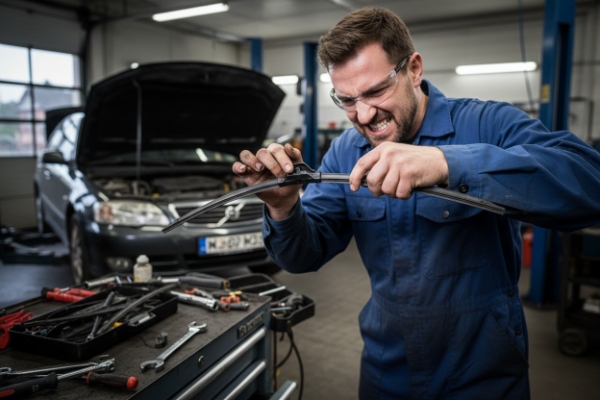 Technician struggling with wrong wiper arm type
Incorrect arm type matching is a leading cause of wiper-related comebacks in repair shops
The Most Common Wiper Arm Type Mistakes Repair Chains Still Make
Even experienced technicians make these costly errors:
- Assuming all vehicles still use the traditional J-Hook.
- Forcing a blade onto an incompatible arm, damaging the arm or the new blade.
- Choosing the wrong adapter when multiple options look similar.
- Not checking for newer Push Button, Side Lock, or Top Lock systems on post-2018 models.
- Installing blades without verifying the full range of motion and contact pressure.
These mistakes lead to streaking, noise, blade detachment while driving, customer dissatisfaction, and unnecessary repeat visits that hurt shop efficiency and profitability.
How to Quickly Identify Wiper Arm Types and Replace Blades Correctly – 2026 Practical Guide
Follow this simple step-by-step process every time:
- Inspect the Wiper Arm End — Look at the shape where the blade connects.
- Identify the Type — Common types include J-Hook, Bayonet, Pinch Tab, Side Lock, Top Lock, and Push Button.
- Match the Correct Adapter — Use multi-fit adapters when possible to cover multiple arm types.
- Install and Test — Click the blade firmly, check full range of motion, and test on wet glass.
- Document for Future Reference — Note the arm type in the repair record for faster future service.
Here’s a quick reference table of the most common wiper arm types in 2026:
| Arm Type | Appearance | Common Vehicles | Recommended Solution |
|---|---|---|---|
| J-Hook | Curved hook shape | Older cars, many trucks | Universal multi-fit adapters |
| Pinch Tab | Flat tab with side pinch | Many Asian and European models | Dedicated or multi-fit |
| Side Lock | Side locking mechanism | Newer GM, Ford, some EVs | Side Lock specific or multi-fit |
| Top Lock | Top locking button | Many modern sedans and SUVs | Top Lock specific |
| Push Button | Push-button release | Newer European and Asian models | Push Button adapters |
| Bayonet | Straight push-in bayonet | Some trucks and specialty vehicles | Bayonet specific |
Using this table and multi-fit solutions dramatically reduces installation errors.
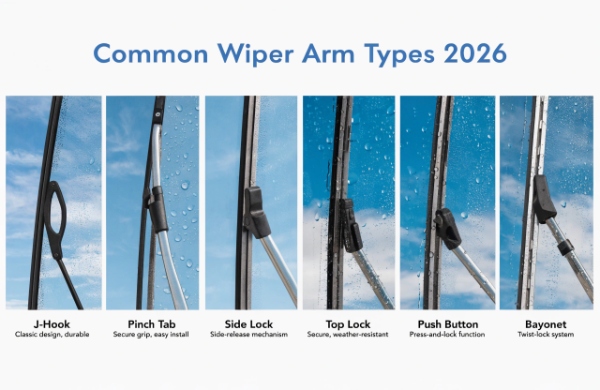 Wiper arm types identification chart
Quick visual guide to common wiper arm types in 2026
Why TOPEX Makes Arm Type Matching and Replacement Easier for Repair Chains
TOPEX has designed its wiper blade systems specifically to solve the real challenges faced by repair chains and auto shops.
The brand offers a wide range of multi-fit adapters that cover most common arm types with fewer SKUs, simplifying inventory management. Every blade comes with clear markings and high-resolution installation guides that help technicians install correctly the first time.
TOPEX blades use premium rubber compounds (including silicone options) that provide excellent wiping performance with minimal streaking and noise. The strong memory steel spines ensure consistent pressure even on large, curved bus and truck windshields.
For repair chains, TOPEX provides additional advantages: competitive trade pricing, fast bulk shipping, technical support, and the applicable models PDF that makes arm-type selection quick and accurate. Many shops report significantly fewer wiper-related comebacks and improved service efficiency after standardizing on TOPEX blades.
Ready to Reduce Wiper-Related Comebacks and Increase Shop Efficiency?
Wiper blade replacement may seem simple, but using the wrong arm type or poor installation technique leads to comebacks, unhappy customers, and lost profits for repair chains.
In 2026, with more vehicle models featuring unique arm types and drivers expecting fast, perfect service, shops that master arm identification and correct replacement gain a real competitive edge.
TOPEX helps repair chains succeed by offering wide arm compatibility, clear adapter systems, high-quality blades that install smoothly the first time, and reliable bulk supply.
Stop losing time and money on wiper-related issues. Equip your team with the right tools, products, and knowledge to get every replacement right — the first time.
In 24 hours you’ll receive a free arm-type quick reference guide, bulk pricing for repair chains, and sample blades for your shop to test.
No commitment. Just faster, cleaner, and more profitable wiper service.
Chat with our fleet/repair specialist on WhatsApp. Fast shipping • Competitive trade pricing • Technical support for repair chains.
FAQ
How many different wiper arm types are there in 2026?
There are at least 8–10 common types, with new variations continuing to appear on modern vehicles.
What are the most common wiper arm types on modern vehicles?
J-Hook, Pinch Tab, Side Lock, Top Lock, and Push Button are the most frequently seen.
How can I quickly identify the correct wiper arm type?
Inspect the end of the arm and compare it to a visual reference chart or use a multi-fit adapter set.
Why do wiper blades often come back after replacement?
The most common cause is incorrect arm-type matching or improper installation technique.
Does TOPEX support multiple arm types with one blade?
Yes. TOPEX offers multi-fit adapters that cover multiple arm types, reducing inventory complexity.
Can repair chains get special pricing and technical training from TOPEX?
Yes. TOPEX provides competitive trade pricing, bulk support, and technical assistance tailored for repair chains.
More resources: Truck and Bus Wiper Blades | Flat Wiper Blades | How to Choose the Right Wiper Blade Type
External: School Bus Wiper Blade Guide

--- END ---


