
How to Lower Wiper Blade MOQs Without Creating Dead Stock
Sep 02, 2026
A low minimum order quantity can make a new wiper blade program appear less risky. However, the total number of blades is only one part of the inventory decision. A small order divided across too many blade structures, lengths, connectors, colors, and packaging versions can still create fragmented stock that sells slowly and is difficult to replenish.
For wholesalers, e-commerce sellers, automotive retailers, and new private-label brands, the real objective is not simply to persuade a factory to accept fewer units. It is to build a focused opening range that covers important vehicles while keeping capital available for faster-moving products.
Buyers can lower wiper blade MOQs without creating dead stock by standardizing products and packaging, prioritizing high-demand applications, using verified multi-fit connectors, limiting initial customization, and placing a controlled trial order. Quantities should be planned by SKU, while sell-through, inventory age, fitment returns, and replenishment time should guide later expansion.
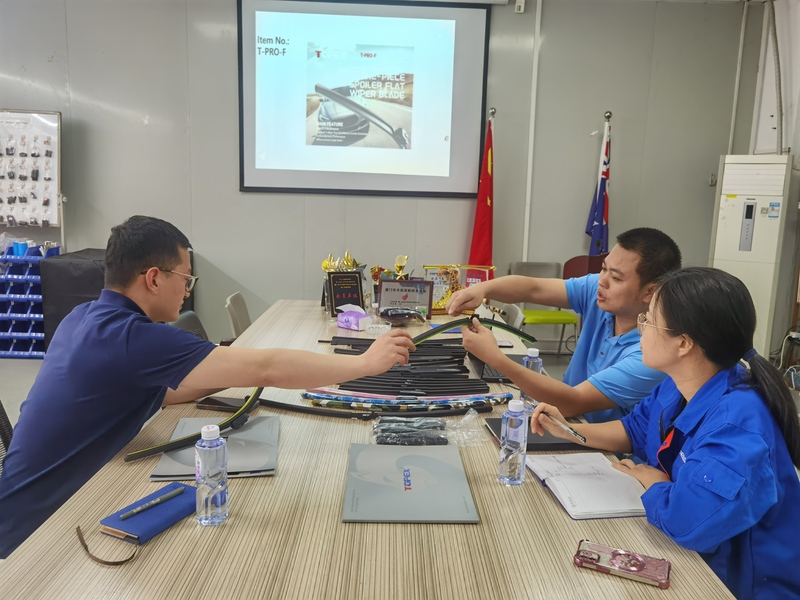
I am Jacky Huang, CEO of Xiamen TOPEX Auto Parts Co., Ltd. When buyers ask me for a low MOQ, I first ask how many blade models, lengths, connectors, colors, and package designs they want. A request for 1,000 blades may be simple if it uses one existing product platform, but difficult if those units are divided across dozens of variations.
A successful MOQ discussion must therefore consider both the supplier’s production constraints and the buyer’s inventory risk.
Why Lower MOQs Can Still Create Higher Inventory Risk
MOQ is often presented as one headline number, such as 500, 1,000, or 5,000 pieces. In practice, a wiper blade order can have several minimums at the same time.
The factory may establish a total order minimum, but rubber materials, molded components, blade lengths, adapters, printed packaging, and master cartons may each have separate production or purchasing requirements.
A lower total MOQ can still create higher inventory risk when the order is divided across too many low-volume SKUs. Buyers should calculate the quantity, capital exposure, and expected sales period for every model, length, adapter, and packaging version—not only the total order quantity.
MOQ Exists at Several Levels
Before negotiating, buyers should ask the supplier to separate the following requirements:
| MOQ level | What the buyer should confirm |
|---|---|
| Total order | Minimum value or quantity for the complete purchase |
| Product model | Minimum for each flat, hybrid, conventional, or OE platform |
| Blade length | Minimum quantity for each size |
| Adapter | Whether connectors have separate production minimums |
| Product color | Minimum for custom spoilers, shells, or components |
| Branded component | Minimum for molded or printed logos |
| Individual packaging | Minimum for each artwork or printed size |
| Master carton | Required carton quantity and markings |
| Custom tooling | Cost and minimum production run for new components |
A supplier may accept a low total quantity while requiring a full carton or production batch for every length. The resulting order may still contain more stock than the buyer can sell.
Fragmented Inventory Is Difficult to Manage
Assume two buyers each order 2,000 blades:
- Buyer A orders 10 SKUs with an average of 200 pieces each.
- Buyer B orders 40 SKUs with an average of 50 pieces each.
Buyer B has a lower quantity per SKU, but its inventory is more fragmented. Some applications may sell quickly while others remain untouched. Reordering becomes difficult because the supplier may not reproduce only a few pieces of each slow-moving size.
Fragmentation also increases:
- Purchase-order complexity
- Packaging versions
- Barcode and labeling work
- Picking errors
- Warehouse locations
- Stock counts
- Fitment-data maintenance
- Risk of incomplete product ranges
- Cost of clearing discontinued SKUs
Low MOQ should reduce risk, not distribute it across a larger number of uncertain products.
Replenishment Can Become Harder
A buyer may sell out of a popular size but still hold slow-moving stock from the original order. If the supplier requires another mixed order to meet the total MOQ, the buyer may have to purchase more unpopular products to replenish the successful SKU.
This creates a repeating inventory problem. The opening order should therefore consider future replenishment, not only initial factory acceptance.
Buyers should ask whether the supplier can:
- Mix lengths within one product platform
- Combine compatible products in one shipment
- Replenish fast-moving sizes separately
- Use standard adapters already in production
- Reserve neutral packaging
- Support scheduled or rolling orders
- Consolidate production with other orders
- Offer replacement packaging separately
A slightly higher unit price for flexible replenishment may be more profitable than a lower price tied to excessive inventory.
The MOQ Negotiation Mistakes That Create Slow-Moving SKUs
Many buyers negotiate the total quantity before deciding which products deserve inventory. This reverses the correct process. The SKU plan should come first, followed by negotiation based on the products that are genuinely needed.
The biggest MOQ negotiation mistakes are focusing only on the total order, adding too many sizes for theoretical coverage, creating multiple colors and packaging versions, requesting new tooling too early, and giving the same opening quantity to core and long-tail products.
Negotiating Only the Total Order MOQ
A supplier’s statement that it accepts 1,000 pieces does not explain how those units can be divided. The buyer should request a written breakdown.
Important questions include:
- What is the minimum per product model?
- What is the minimum per length?
- Can different adapters be mixed?
- Is there a minimum per product color?
- Does each package size require separate printing?
- Can neutral packaging be used?
- Can custom labels replace fully printed boxes?
- Can fast-moving SKUs be reordered independently?
- Are mixed cartons allowed?
- Which components are shared with regular production?
These answers determine whether the proposed MOQ is commercially useful.
Adding Long-Tail Products for Maximum Coverage
A large application catalogue may look attractive, but not every vehicle deserves opening inventory. Broad coverage can create slow-moving sizes and vehicle-specific connectors that sell only occasionally.
Buyers should focus first on:
- Common local vehicle makes
- High-volume model years
- Frequently replaced blade lengths
- Popular arm types
- Products with established sales history
- Applications supported by reliable fitment data
- Seasonal demand relevant to the market
Rare applications can be introduced through small stocks, special orders, or rapid replenishment after demand is confirmed.
Customizing Too Many Colors and Packages
Customization divides the order into additional production and inventory groups. A private-label range with three colors, two blade structures, fifteen lengths, and multiple package designs can create dozens of variations before the first sale occurs.
A lower-risk launch can use:
- One standard product color
- Existing molds and adapters
- One consistent brand identity
- Neutral packaging with custom labels
- Shared packaging across compatible lengths
- One language version where appropriate
- Standard master cartons
- Limited initial product tiers
Full customization can follow after the buyer identifies which products sell.
Forcing the Same Quantity Across Every SKU
Core and long-tail applications should not receive equal stock. If the supplier requires the same quantity per size, the buyer may need to negotiate a different structure or reconsider the range.
| SKU group | Demand profile | Opening inventory approach |
|---|---|---|
| A: Core | Frequent and predictable sales | Deeper stock |
| B: Growth | Moderate demand or strong potential | Controlled quantity |
| C: Long tail | Irregular or unproven demand | Minimal stock or special order |
| Seasonal | Demand concentrated in a period | Time-limited inventory |
| Experimental | New product or channel test | Smallest practical quantity |
The buyer should explain this demand structure to the supplier. A rational SKU plan makes MOQ negotiations more credible than a general request for “your lowest quantity.”
How to Reduce SKU Count Without Sacrificing Vehicle Coverage
Reducing SKUs does not mean removing products randomly. The buyer must identify which products create meaningful coverage and which add complexity without sufficient demand.
Vehicle registrations, historical sales, marketplace data, workshop records, and customer requests can help establish the initial range.
Buyers can reduce SKU count by prioritizing high-demand local vehicles, applying ABC inventory classification, consolidating compatible lengths and connectors, using verified multi-fit platforms for baseline coverage, and reserving OE-specific blades for applications with proven sales potential.
Begin with Local Vehicle Demand
The supplier’s complete catalogue should not determine the buyer’s opening order. The buyer should prepare a market-based application list containing:
- Vehicle make
- Model
- Model year
- Driver-side length
- Passenger-side length
- Rear-blade requirement
- Arm type
- Preferred product structure
- Estimated replacement demand
- Existing sales or inquiry frequency
The TOPEX wholesale wiper blade buying guide explains why product planning should begin with local vehicle demand rather than maximum catalogue coverage.
Use ABC Classification
ABC classification helps determine where inventory capital should be concentrated.
A practical process is:
- Rank existing sales by SKU.
- Identify the vehicles generating the most requests.
- Group products into core, growth, and long-tail categories.
- Assign different opening quantities and reorder points.
- Review the classification after the trial period.
- Promote or remove SKUs according to actual performance.
New buyers without historical data can begin with vehicle-population information, competitor ranges, online search demand, and workshop feedback. These assumptions should be replaced by actual sales data as soon as possible.
Use Multi-Fit Products Selectively
Multi-fit products can reduce SKU pressure by using one blade platform with several adapters. This can be valuable when common lengths and connectors overlap across many vehicles.
The TOPEX flat wiper blade range offers different beam-style and adapter options that can be considered when building a focused multi-fit program.
However, buyers should verify:
- Adapter locking
- Installed blade angle
- Windshield contact
- Connector height
- Installation steps
- Included components
- Application data
- Package instructions
One multi-fit SKU should replace several products only when it fits the relevant vehicles reliably. An exaggerated coverage claim may reduce SKU count while increasing returns.
Combine Multi-Fit and OE-Specific Products
Multi-fit blades and OE-specific blades solve different inventory problems.
| Product approach | Main advantage | Main limitation |
|---|---|---|
| Multi-fit | Broader coverage with fewer base products | More adapters and installation decisions |
| OE exact-fit | Simple vehicle-specific installation | More dedicated SKUs |
| Universal U-hook | Efficient coverage of common hook arms | Limited coverage of modern connectors |
| Rear blade | Completes SUV and hatchback applications | Highly fragmented connectors |
A balanced range may use multi-fit products for broad baseline coverage and OE-specific products for popular applications where customers value simpler installation.
Standardize Components and Packaging
Shared components can give the supplier more flexibility. Buyers can ask whether several lengths use the same adapter, spoiler material, color, rubber specification, and packaging structure.
Standardization can reduce:
- Raw-material minimums
- Mold changes
- Color changes
- Printing setup
- Packaging inventory
- Assembly complexity
- Reorder difficulty
It may also allow a buyer to accept a slightly higher product price in exchange for lower stock exposure and easier replenishment.
How TOPEX Supports Flexible Orders and Market-Focused SKU Planning
At TOPEX, I approach MOQ discussions by reviewing the complete product mix rather than responding with one number. The appropriate solution depends on the target country, vehicle population, sales channel, packaging, customization, and expected quantities by SKU.
TOPEX supports lower-risk sourcing through market-focused size and adapter planning, fitment information, existing product platforms, controlled sample orders, packaging options, and trial-order discussions. The goal is to reduce unnecessary variations while preserving commercially relevant vehicle coverage.
Market and Application Review
Before proposing an order mix, we can review:
- Target country or region
- Important vehicle makes and models
- Common blade lengths
- Arm and connector distribution
- Flat, hybrid, conventional, OE, or rear demand
- Wholesale, retail, fleet, or e-commerce channel
- Price level
- Climate and seasonality
- Packaging requirements
- Forecast quantity by SKU
This information helps identify which products deserve opening stock and which can wait.
Existing Platforms Reduce Development Minimums
Using an existing blade, adapter, material specification, and color generally gives the supplier more flexibility than developing a new product.
For a new buyer, a practical sequence may be:
- Use an existing blade platform.
- Select standard colors.
- Use verified adapters already in production.
- Begin with neutral or minimally customized packaging.
- Test a focused range.
- Add custom components only after sales are proven.
The TOPEX seasonal inventory planning guide can also help buyers connect order timing with weather-related demand and replenishment planning.
Packaging Can Be Introduced in Stages
Private-label packaging often has its own printing MOQ. Buyers can reduce early risk by separating brand validation from maximum customization.
Possible stages include:
- Standard product and neutral packaging
- Neutral package with branded label
- Shared printed package with size stickers
- Fully printed retail packaging
- Custom product color or molded brand component
The correct route depends on the channel. A physical retail chain may need stronger shelf presentation earlier, while an e-commerce seller may initially prioritize product performance, fitment data, and shipping protection.
A Low-Risk Trial Order and Replenishment Plan for New Buyers
A trial order should test both product demand and supplier execution. It should be large enough to provide useful sales data but focused enough to avoid long-term exposure if some assumptions are wrong.
New buyers should begin with standard products, core sizes, verified adapters, and simple packaging. They should track sales, inventory age, fitment returns, gross margin, and replenishment time by SKU before increasing quantities or launching fully customized packaging.
Build the Trial Order
A trial-order plan should include:
- Product code
- Blade structure
- Length
- Adapter
- Vehicle coverage
- Opening quantity
- Unit and landed cost
- Target selling price
- Reorder point
- Supplier lead time
- Review date
Do not approve the order from total quantity alone. Review the inventory exposure of every SKU.
Track the Right Metrics
| Metric | What it reveals |
|---|---|
| Sell-through rate | How quickly each SKU is selling |
| Inventory age | Which products are becoming slow-moving |
| Weeks of supply | Whether stock is too high or too low |
| Stockout frequency | Whether core inventory is insufficient |
| Fitment-return rate | Possible data or adapter problems |
| Performance-return rate | Possible product-quality problems |
| Gross margin | Profit before returns and service costs |
| Reorder interval | Actual replenishment requirement |
| Lead-time variation | Reliability of supply planning |
| Package damage | Whether packaging needs improvement |
A product should not be expanded only because the first batch sold. Buyers should also check whether it sold at the intended margin and generated an acceptable return rate.
Create Replenishment Rules
After the trial, each SKU can be assigned an action:
- Expand: strong sell-through, acceptable margin, and low returns
- Maintain: stable but moderate performance
- Reduce: slow sales or excessive stock
- Correct: demand exists, but fitment or packaging problems need attention
- Discontinue: weak demand with no strategic reason to retain the item
- Seasonal hold: pause replenishment until the next weather cycle
Reorder points should reflect average sales, supplier production time, transportation, customs clearance, and safety stock.
Delay Full Private Label Until Demand Is Clear
Custom packaging can strengthen brand recognition, but unsold branded stock is harder to redirect or clear. Buyers should confirm which blade types and sizes perform before creating many printed variations.
Once the trial data is positive, the buyer can:
- Increase quantities for A products.
- Improve availability for B products.
- Remove weak C products.
- Introduce branded packaging for proven SKUs.
- Add selected OE-specific applications.
- Expand into rear, hybrid, winter, or premium products.
- Negotiate better pricing based on repeatable demand.
This sequence converts MOQ negotiation from a one-time request into a long-term supply plan.
Conclusion
Reducing wiper blade MOQ is not simply about persuading a factory to accept fewer units. Buyers must control how those units are divided across blade structures, lengths, adapters, colors, packaging formats, and vehicle applications.
A focused opening range should prioritize high-demand local vehicles, use verified multi-fit products where they genuinely reduce SKU requirements, and reserve OE-specific blades for applications with proven sales potential. Standard products, shared components, flexible quantity allocation, and controlled trial orders can make MOQ negotiation easier.
After launch, sell-through, inventory age, fitment returns, margins, and replenishment data should determine which SKUs are expanded, reduced, corrected, or discontinued. A successful low-MOQ strategy does not merely reduce the first order—it creates an inventory system that can grow without accumulating dead stock.
Frequently Asked Questions About Wiper Blade MOQs
What determines the MOQ for wholesale wiper blades?
MOQ can be influenced by the blade model, length, adapter, rubber specification, color, production setup, carton quantity, packaging, printing, and total order value. Buyers should confirm the minimum at each level instead of relying only on one total-order figure.
How can buyers negotiate a lower MOQ with a wiper blade factory?
Use existing product platforms, standard colors, shared adapters, standard or neutral packaging, and a focused SKU range. Provide a realistic sales plan and explain the potential for repeat orders. Buyers may also accept a slightly higher unit price in exchange for lower initial inventory exposure.
Can multi-fit wiper blades reduce the number of required SKUs?
Yes, one blade platform with several adapters can cover multiple arm types and reduce base-product SKUs. However, coverage should be verified on important vehicles. Connector security, installation angle, windshield contact, and application instructions must be tested before relying on the claimed coverage.
How should buyers select sizes for an initial trial order?
Start with common local vehicle applications, historical sales, workshop demand, competitor ranges, and online searches. Give deeper stock to core sizes, smaller quantities to growth products, and minimal or no opening stock to unverified long-tail applications.
Does private-label packaging usually have a separate MOQ?
Yes. Printed boxes, cards, blister packs, labels, and branded components may have minimums separate from the blades. The MOQ may also apply to each size or artwork version. Buyers should confirm packaging quantities before finalizing the SKU range.
Which inventory metrics help identify slow-moving wiper blade SKUs?
Important metrics include sell-through rate, inventory age, weeks of supply, stockout frequency, fitment returns, performance returns, gross margin, reorder interval, and lead-time variation. These measurements help buyers decide which products to expand, maintain, reduce, or discontinue.

--- END ---


