
Honda CR-V Wiper Blade Sizes by Year: Front and Rear Fitment Guide
Oct 27, 2026
Honda CR-V wiper blade sizes have changed several times as the vehicle has moved through different generations. The driver-side, passenger-side, and rear blades normally use different lengths, and newer CR-V models can also use a different front-arm connection from earlier vehicles.
Searching only for “Honda CR-V wiper blades” is therefore not enough. A correct replacement depends on the model year, generation, sales market, installation position, arm connection, adapter, and windshield geometry.
Before ordering CR-V wiper blades, confirm all three positions separately and inspect the existing connectors. The size chart below provides a practical reference, but regional application data, VIN-specific information, and the original blade assembly should take priority when sources disagree.
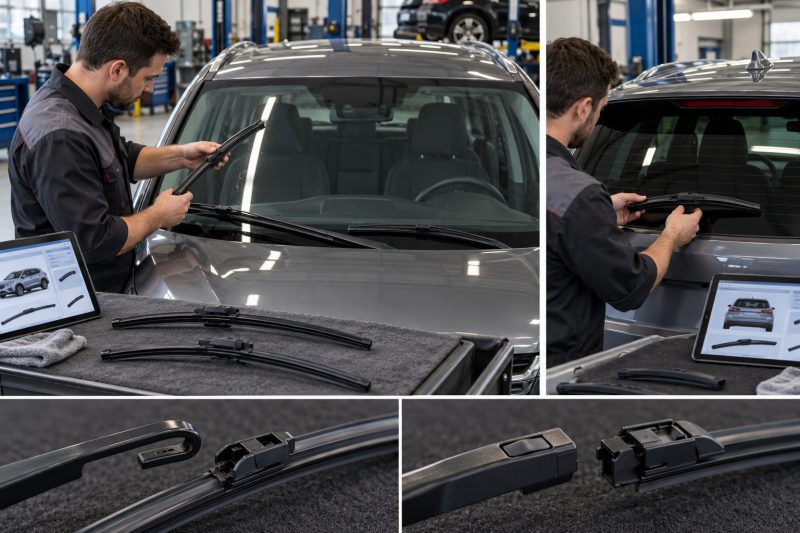
I am Jacky Huang, CEO of Xiamen TOPEX Auto Parts Co., Ltd. Through my work with vehicle application data, wiper blade development, and B2B aftermarket programs, I have seen apparently simple size errors create installation failures and unnecessary returns. For CR-V owners and distributors, identifying the generation and connector is just as important as measuring the blade.
Why the Wrong CR-V Wiper Size Can Reduce Visibility and Damage Fitment
Honda selects the two front blade lengths to clear the intended viewing area without allowing the blades to collide, leave the windshield boundary, or contact surrounding trim.
Installing a blade that is approximately the correct length can still disturb this relationship.
A Short Blade Reduces the Cleared Area
A shorter blade may install without difficulty, but it leaves more of the windshield uncleared. On the driver side, that can reduce visibility during heavy rain, snow, or dirty road spray.
The passenger blade also contributes to the total cleared area. If it is too short, contamination may remain near the centre or lower section of the windshield.
A Long Blade Can Cause Interference
A blade that is one inch longer may not provide a useful improvement. Instead, it can:
- Contact the other front blade
- Strike the windshield trim or cowl
- Extend beyond the glass boundary
- Lose contact on the curved outer glass
- Create additional load on the arm
- Stress the connector or adapter
- Produce vibration at road speed
- Fail to return to its intended parked position
The problem may not appear while the vehicle is parked. It can become visible only when the blades reach the upper or outer end of their sweep.
Reversing the Front Pair Creates Two Problems
Most CR-V generations use a longer driver-side blade and a shorter passenger-side blade. Installing them in reverse may leave the driver with insufficient coverage while the longer passenger blade interferes with the trim or driver blade.
| Fitment error | Possible consequence | Corrective action |
|---|---|---|
| Driver blade too short | Reduced primary viewing area | Install the specified driver-side length |
| Driver blade too long | Contact with trim or passenger blade | Verify the original front pairing |
| Passenger blade too short | Reduced overall windshield coverage | Use the listed passenger size |
| Passenger blade too long | Blade collision or glass-edge contact | Replace it with the correct application |
| Front blades reversed | Poor driver visibility and possible interference | Reinstall each blade in its correct position |
| Rear blade incorrectly sized | Reduced rear visibility or trim contact | Verify the dedicated rear application |
| Correct length but wrong curvature | Blade-end lift or missed areas | Confirm the complete product fitment |
Poor Fitment Can Stress the Wiper System
Repeated blade contact can damage more than the rubber edge. It may affect:
- The connector
- The wiper arm
- The linkage
- The parked position
- The motor
- The windshield trim
Stop operating the wipers if they strike another component, twist inside the connector, or move outside the glass boundary.
The CR-V Wiper Fitment Mistakes Owners Commonly Make
The most common mistake is purchasing by model name without confirming the model year. The Honda CR-V has been produced since the 1990s, and its blade dimensions and connectors have changed across generations.
Ignoring the Generation
The year groups in this guide broadly correspond to the following CR-V generations:
- 1997–2001: First generation
- 2002–2006: Second generation
- 2007–2011: Third generation
- 2012–2016: Fourth generation
- 2017–2022: Fifth generation
- 2023–2026: Sixth generation
Generation boundaries are helpful, but the owner should still verify the sales market and production date. A vehicle registered in one year may have been built under an earlier specification.
Assuming Every Market Uses Identical Blades
A North American fitment chart may not apply to every CR-V sold in Europe, Asia, Australia, Latin America, or another market. Regional differences may involve:
- Model-year naming
- Production periods
- Left- or right-hand drive
- Body specifications
- Front-arm connectors
- Rear-blade design
- Hybrid and non-hybrid variants
- Replacement product platforms
A regional blade finder is generally more reliable than a generic global chart.
Selecting the Front Pair by Length Alone
The correct length does not prove that the blade will connect securely. A 24-inch J-Hook blade and a 24-inch push-button blade are different applications.
Before purchasing, confirm:
- Blade length
- Driver or passenger position
- Connector family
- Connector width
- Adapter code
- Installation direction
- Blade curvature
- Application year range
Treating the Rear Blade Like a Short Front Blade
The rear CR-V blade is not simply a smaller front blade. It commonly uses a compact plastic body and dedicated arm connection.
A front blade of the same nominal length may not:
- Attach to the rear arm
- Sit at the correct angle
- Follow the rear glass
- Clear the intended area
- Remain inside the trim
- Return to the correct parked position
Rear applications should always be looked up separately.
Trusting One Database Without Inspecting the Vehicle
Most current sources agree on the common 24/19/10-inch combination for 2023–2026 CR-V models. However, conflicting listings still exist, including data that carries the preceding generation’s 26/17/12-inch sizes into 2026.
When databases disagree, I recommend giving priority to:
- VIN-specific Honda parts information
- A Honda dealer or qualified service provider
- A current regional blade-manufacturer catalogue
- Inspection of the original arm and blade
- Physical measurement and vehicle testing
Honda CR-V Front and Rear Wiper Sizes by Model Year
The following table consolidates commonly published North American CR-V sizes. Inch-to-millimetre figures use standard nominal conversions. Actual replacement products may use slightly different metric values.
| Common model years | Driver side | Passenger side | Rear | Front connector guidance |
|---|---|---|---|---|
| 1997–2001 | 20 in. / 500 mm | 19 in. / 475 mm | 12 in. / 300 mm | Commonly listed with J-Hook-style front arms |
| 2002–2006 | 21 in. / 525 mm | 20 in. / 500 mm | 10 in. / 250 mm | Verify year and regional J-Hook application |
| 2007–2011 | 26 in. / 650 mm | 17 in. / 425 mm | 14 in. / 350 mm | Commonly listed with J-Hook front fitment |
| 2012–2016 | 26 in. / 650 mm | 16 in. / 400 mm | 13 in. / 325 mm | Confirm connector and regional variation |
| 2017–2022 | 26 in. / 650 mm | 17 in. / 425 mm | 12 in. / 300 mm | Common fifth-generation reference |
| 2023–2026 | 24 in. / 600 mm | 19 in. / 475 mm | 10 in. / 250 mm | Commonly listed with push-button front arms |
Fitment notice: These measurements are common catalogue references, not a universal guarantee for every country, trim, or production date. Confirm the actual vehicle before ordering.
1997–2001 CR-V
The commonly published combination for the first-generation CR-V is:
- Driver side: 20 inches or approximately 500 mm
- Passenger side: 19 inches or approximately 475 mm
- Rear: 12 inches or approximately 300 mm
The front blades are similar in length, making it particularly important to identify the driver and passenger positions correctly.
2002–2006 CR-V
Commonly listed sizes include:
- Driver side: 21 inches or approximately 525 mm
- Passenger side: 20 inches or approximately 500 mm
- Rear: 10 inches or approximately 250 mm
The one-inch difference between the front blades may be easy to overlook. Measure and replace the blades one at a time to avoid reversing them.
2007–2011 CR-V
The third-generation CR-V introduced a much larger driver-side blade:
- Driver side: 26 inches or approximately 650 mm
- Passenger side: 17 inches or approximately 425 mm
- Rear: 14 inches or approximately 350 mm
This substantial difference between the front blades reflects the windshield and wiper geometry. Installing two similar lengths would not reproduce the intended wiping coverage.
2012–2016 CR-V
The commonly published fourth-generation sizes are:
- Driver side: 26 inches or approximately 650 mm
- Passenger side: 16 inches or approximately 400 mm
- Rear: 13 inches or approximately 325 mm
The 13-inch rear measurement is less common than standard 12- or 14-inch listings, so rear compatibility should be checked carefully.
2017–2022 CR-V
The fifth-generation combination is commonly listed as:
- Driver side: 26 inches or approximately 650 mm
- Passenger side: 17 inches or approximately 425 mm
- Rear: 12 inches or approximately 300 mm
Do not carry these measurements into a 2023 or later vehicle without checking the generation. The sixth-generation front sizes are widely listed as shorter on the driver side and longer on the passenger side.
2023–2026 CR-V
Multiple current fitment sources list:
- Driver side: 24 inches or approximately 600 mm
- Passenger side: 19 inches or approximately 475 mm
- Rear: 10 inches or approximately 250 mm
The 2026 CR-V listing from WiperIndex identifies a 24-inch driver blade and 19-inch passenger blade.
These measurements should still be confirmed for the specific market, VIN, and connector. Conflicting online records may incorrectly repeat the preceding generation’s 26/17/12-inch combination.
Why the Sixth-Generation Sizes Changed
The 2023 redesign altered the relationship between the front blades. Compared with the commonly published 2017–2022 combination:
| Generation group | Driver side | Passenger side | Rear |
|---|---|---|---|
| 2017–2022 | 26 in. / 650 mm | 17 in. / 425 mm | 12 in. / 300 mm |
| 2023–2026 | 24 in. / 600 mm | 19 in. / 475 mm | 10 in. / 250 mm |
The later system uses a shorter driver blade and longer passenger blade. This demonstrates why the vehicle name alone is not sufficient for replacement selection.
J-Hook vs. Push-Button: Why Connector Type Matters
A blade can have the correct nominal length and still be unusable if its connector does not match the CR-V wiper arm.
J-Hook Connections on Earlier CR-V Models
Many earlier CR-V generations are commonly associated with J-Hook front arms. The metal arm curves back toward itself, and the blade adapter receives the hook through a channel.
A compatible J-Hook adapter should:
- Match the hook dimensions
- Slide into place without excessive force
- Engage the locking tab
- Hold the blade in the correct orientation
- Resist a gentle pull
- Release only when the tab is operated
J-Hook is a connector family rather than one completely universal specification. Buyers should still verify the arm and adapter.
Push-Button Connections on 2023–2026 Models
Fitment sources commonly identify a push-button connection for sixth-generation CR-V models. A flat arm enters the connector and locks through a button or retention feature.
Push-button systems can differ in:
- Arm width
- Button position
- Connector profile
- Insertion direction
- Cover design
- Release procedure
A universal blade is compatible only when its adapter explicitly covers the required CR-V arm specification.
Connector Comparison
| Feature | J-Hook | Push-button |
|---|---|---|
| Arm appearance | Curved hook-shaped end | Flat arm with button or locking feature |
| Installation | Hook enters an adapter channel | Arm slides into a dedicated connector |
| Common CR-V use | Frequently listed for earlier generations | Commonly listed for 2023–2026 |
| Main selection risk | Incorrect hook size or incomplete tab engagement | Incorrect arm width or button design |
| Verification | Check hook dimensions and locking tab | Check width, button position, and adapter code |
| Removal | Release tab and slide from hook | Press button or release feature and slide blade |
Blade Curvature Still Matters
The correct connector only proves that the blade can attach. It does not prove that the rubber will maintain contact across the windshield.
The TOPEX flat wiper blade range includes products for different lengths and adapter requirements. Each CR-V application should still be checked for spring curvature, pressure distribution, and full-sweep performance.
Rear Connectors Require Separate Verification
The rear CR-V system normally uses a dedicated arm and blade profile. Its connection should not be inferred from the front arm.
Confirm:
- Rear blade length
- Arm-end shape
- Integrated connector
- Installation direction
- Clearance around the glass and trim
- Full wiping path
- Parked position
An OE exact-fit rear blade can reduce installation decisions when the vehicle application is accurate.
Original Honda Assemblies May Accept Inserts
Some genuine Honda blade assemblies are designed to accept replacement rubber inserts. This approach can preserve the original frame and connector while replacing the worn wiping edge.
Before reusing the original structure, inspect it for:
- Corrosion
- Loose joints
- Bent components
- Damaged spring rails
- Cracked plastic
- Weak connector retention
- Missing end caps
Replacing only the rubber is inappropriate when the supporting assembly is damaged or no longer distributes pressure correctly.
The TOPEX hybrid wiper blade range provides another aftermarket option for applications requiring a supporting structure with an aerodynamic cover.
How to Verify and Install the Correct CR-V Wiper Blades
A reliable selection process combines vehicle identification, catalogue verification, physical inspection, and an operational test.
1. Identify the Exact CR-V
Record:
- VIN
- Sales country or region
- Model year
- Production date
- CR-V generation
- Trim or powertrain variant
- Left- or right-hand-drive configuration
The VIN is especially valuable when the vehicle is close to a generation boundary or when online databases disagree.
2. Check All Three Positions Separately
Confirm:
- Driver-side length
- Passenger-side length
- Rear-blade length
- Front connector type
- Rear connector type
- Required adapter code
- Product reference
Do not assume that a front adapter can be used on the rear arm.
3. Cross-Check Reliable Fitment Sources
A practical verification hierarchy is:
- VIN-specific Honda parts information
- A Honda dealer or service provider
- A current blade-manufacturer catalogue
- A regional aftermarket fitment finder
- Measurement of the existing blades
When sources disagree, inspect the physical connector and original product before ordering.
4. Inspect the Existing Blades
Before removal:
- Measure the driver blade.
- Measure the passenger blade separately.
- Measure the rear blade.
- Photograph each connector from several angles.
- Record any visible product or OE references.
- Observe the installation direction.
- Check whether the existing blades stay within the glass boundaries.
- Confirm that the current products are not already incorrect.
The original blade is useful evidence, but it should not be the only fitment source.
5. Prepare the Vehicle Safely
Some CR-V models may require the front wipers to be moved into a maintenance or service position before the arms can be lifted.
Follow the owner’s manual and:
- Switch off the vehicle as instructed.
- Move the wipers into the required service position.
- Place a folded towel on the windshield.
- Lift the arm carefully.
- Replace one blade at a time.
- Never allow a bare metal arm to snap against the glass.
6. Confirm the Connector Lock
After installing the new blade:
- Confirm the expected click or locking movement.
- Check that any connector cover closes completely.
- Apply a gentle pull in the removal direction.
- Verify that the blade cannot slide sideways.
- Confirm the correct blade orientation.
- Check arm and bonnet clearance.
- Make sure the adapter is not visibly distorted.
Never use tape, adhesive, cable ties, or improvised modifications to secure an incompatible blade.
7. Complete a Wet-Windshield Test
Use washer fluid or wet the windshield appropriately before operating the blades.
Confirm that:
- Every blade remains securely attached.
- The two front blades do not contact each other.
- Neither front blade moves outside the glass.
- The rubber maintains consistent contact.
- No repeated streak or missed area remains.
- The blades reverse direction smoothly.
- There is no chatter, skipping, or scraping.
- The rear blade clears its intended area.
- All blades return to the correct parked positions.
At TOPEX, I recommend that distributors record CR-V applications by market, generation, model year, position, length, connector, and adapter. This structured information is more reliable than one product listing described simply as suitable for “Honda CR-V.”
Conclusion
Honda CR-V wiper blade sizes have changed several times across the model’s generations, so replacements should always be selected by year, position, and connector type.
The driver, passenger, and rear blades normally use different lengths, while newer CR-V models may also use a different front-arm connection from earlier generations. The commonly listed sixth-generation combination is 24 inches for the driver, 19 inches for the passenger, and 10 inches for the rear, but the vehicle’s regional specification should still be verified.
Before ordering, confirm the market, model year, VIN, and existing connector, then compare the results with a reliable fitment catalogue. After installation, make sure every blade locks securely, remains within the glass boundaries, and clears the windshield without interference, skipping, or missed areas.
Frequently Asked Questions About Honda CR-V Wiper Blade Sizes
What size wiper blades does a Honda CR-V use?
The size depends on the model year. Common front combinations include 20/19 inches for 1997–2001, 21/20 inches for 2002–2006, 26/17 inches for 2007–2011, 26/16 inches for 2012–2016, 26/17 inches for 2017–2022, and 24/19 inches for 2023–2026. Confirm the regional application before ordering.
Are Honda CR-V wiper sizes the same for every model year?
No. Blade lengths change across generations, and the driver, passenger, and rear positions normally use different sizes. The connector also changed on newer models, so model year and position must be included in the lookup.
What size rear wiper blade does a Honda CR-V need?
Commonly published rear sizes include 12 inches for 1997–2001, 10 inches for 2002–2006, 14 inches for 2007–2011, 13 inches for 2012–2016, 12 inches for 2017–2022, and 10 inches for 2023–2026. The rear connector and profile must also match.
Does the Honda CR-V use a J-Hook or push-button connector?
Many earlier CR-V generations are commonly listed with J-Hook front arms. The 2023–2026 sixth-generation models are commonly listed with push-button connections. Because regional specifications can differ, inspect the original arm and confirm the adapter in a current catalogue.
Can I install a longer wiper blade on my Honda CR-V?
I do not recommend installing a longer blade unless a verified application catalogue approves it. A longer blade may contact the other wiper, trim, cowl, or glass edge. It may also lose contact on curved glass or create unnecessary stress on the connector.
How can I confirm the correct CR-V wiper fitment before ordering?
Use the VIN, sales market, model year, generation, and blade position in a reliable fitment catalogue. Cross-check another source, measure the existing blades, photograph the connectors, and confirm the adapter. After installation, complete a wet-windshield test before driving.

--- END ---


