Private Label Wiper Blades: What to Prepare Before Requesting a Quote
Nov 17, 2026
Launching private-label wiper blades involves more than placing a logo on an existing product. An incomplete request can produce quotations that look comparable but are based on different blade structures, adapters, packaging and quality assumptions.
Before requesting a quote, prepare a clear brief covering your target market, vehicle applications, product range, technical requirements, branding, packaging, estimated quantities and quality expectations. This allows suppliers to quote the same scope, identify fitment risks and explain which requirements may affect tooling, packaging commitments or order cost.
The following preparation process is intended primarily for automotive aftermarket importers and private-label brands. It will help you request a more accurate quotation, compare suppliers fairly and move from pricing to sample approval without repeatedly changing the project.
Why a Detailed RFQ Produces a More Reliable Wiper Blade Quote
A request such as “Please quote your best price for private-label wiper blades” does not give a supplier enough information to prepare a useful offer. The supplier may choose a basic blade, standard rubber, generic adapters and neutral packaging, while the buyer expects a premium product with customized components and retail-ready boxes.
These quotations cannot be compared fairly because they describe different products.
I recommend treating the RFQ as the first version of the product specification. It does not need to contain every final detail, but it should define the commercial and technical boundaries of the project.
At minimum, the supplier should understand:
- Where the products will be sold
- Which customer and price segment you intend to serve
- Which blade structures you want to include
- Which sizes and connectors you need
- Whether the range will be multi-fit or OE exact-fit
- What branding and packaging are required
- How many units you expect by SKU
- Which documents or tests need to be reviewed
- How the samples and bulk order will be approved
Without this information, the quoted unit price may exclude packaging, additional adapters, artwork setup, labels or other project-specific items.
Make suppliers quote the same scope
Before comparing prices, create one RFQ sheet and send the same version to each shortlisted supplier. Ask them to state any assumptions, exclusions or alternative recommendations separately.
A practical RFQ comparison should distinguish between:
| Quotation item | What the buyer should define | Why it affects the quote |
|---|---|---|
| Blade structure | Conventional, flat, hybrid or OE exact-fit | Each structure uses different components and assembly |
| Wiping element | Required material or approved supplier option | Material and profile can affect cost and performance |
| Size range | Exact lengths and estimated quantity per size | A broad range may create different production quantities |
| Connector system | Integrated connector or multi-adapter set | Adapter count and complexity affect product scope |
| Product color | Standard black or customized components | Custom colors may require separate material preparation |
| Branding | Logo location and application method | Printing or molded branding may have different requirements |
| Packaging | Neutral, branded sleeve, blister or printed box | Packaging has separate material and printing costs |
| Instructions | Languages, diagrams and adapter guidance | Custom documents require preparation and approval |
| Inspection | Agreed sample and shipment checks | Testing and inspection scope should be clear |
| Delivery term | Requested trade term and destination | Freight and responsibility differ by quotation basis |
The lowest quotation is not automatically the lowest-cost option. A price that excludes adapters, printed packaging or inspection requirements may increase later after the project is already underway.
Define the Product Range and Fitment Coverage Before Pricing
The product range should be designed around the vehicles and sales channels in the target market. Copying a supplier’s complete catalog usually creates too many overlapping or slow-moving SKUs.
Start by deciding what role each product will have in your range. For example:
- Conventional blades for older vehicles and price-sensitive channels
- Flat blades for modern curved windshields and mid-to-premium positioning
- Hybrid blades for applications or customers that prefer a covered frame structure
- OE exact-fit blades for specialized vehicle connections
- Rear blades for verified high-volume applications
- Colored or branded products for differentiated retail programs
Buyers evaluating customized appearance can review the available custom-color one-piece spoiler wiper blade category when defining the visual direction of a private-label range. Product color should still be considered alongside fitment, materials and expected sales volume.
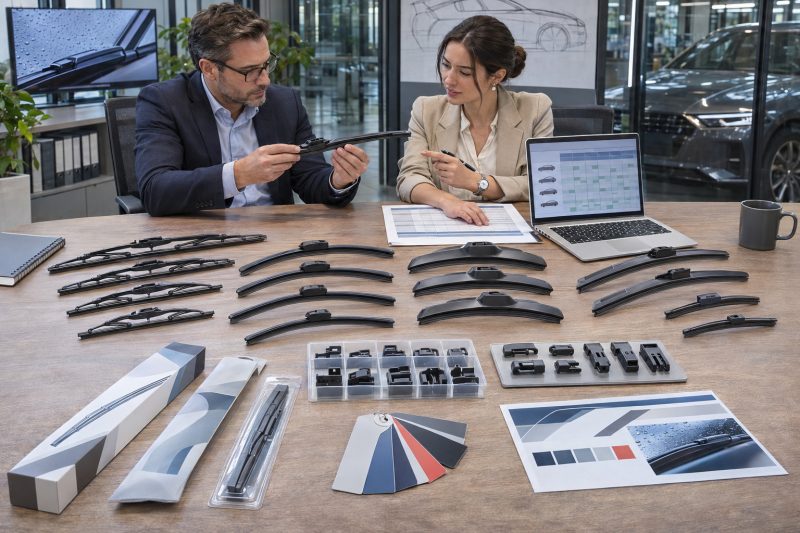
Prepare a size-and-quantity matrix
A quotation based only on the total order quantity can hide risk at the SKU level. A total of 20,000 blades may appear commercially attractive, but dividing that quantity across many structures, sizes, colors and packages can produce very small quantities per combination.
Prepare an estimated order matrix showing:
- Product series
- Blade length
- Connector or adapter set
- Color
- Package version
- Quantity per SKU
- Total quantity by product family
If the final quantity is not yet known, provide a realistic range and ask the supplier to show how pricing changes at different volumes. Avoid requesting prices for unrealistic quantities simply to obtain a lower reference price.
Define multi-fit and exact-fit strategies separately
Multi-fit blades and OE exact-fit blades solve different assortment problems.
A multi-fit platform may cover several arm types through interchangeable adapters. This can reduce the number of base blade SKUs, but it also requires accurate adapter mapping, clear instructions and reliable application data.
OE exact-fit products normally use an integrated or application-specific connector. They can offer more direct installation and a profile closer to the original design, but they require more precise vehicle-to-SKU data and may increase inventory complexity.
For each proposed product, ask the supplier to identify:
- The intended vehicle applications
- The blade position
- The arm connection
- The required adapter
- The supported production period
- Any market or drive-orientation restrictions
- The source or verification status of the fitment data
Do not approve coverage from connector appearance or blade length alone.
Prioritize applications that matter commercially
A new private-label range does not need maximum theoretical coverage on its first order. I would begin with the applications that contribute the greatest verified demand in the intended market.
Useful inputs include:
- Local vehicle registrations
- Existing sales records
- Customer enquiries
- Competitor assortment gaps
- Common blade lengths
- Popular connector families
- Front and rear replacement demand
- Fleet or workshop requirements
Additional OE exact-fit or rear products can be introduced after the core range generates reliable sales and fitment data.
Prepare Product Specifications and Sample Approval Criteria
A supplier cannot quote the same product consistently if the product specification remains vague. Terms such as “premium rubber,” “strong frame” or “good quality” do not provide measurable acceptance criteria.
The specification should focus on characteristics that matter to the intended application and sales position.
Describe the physical product
Depending on the blade structure, the product brief may include:
- Nominal blade length
- Overall construction
- Wiping-element material and profile
- Supporting frame or spring-steel structure
- Spoiler design
- Connector and adapter system
- End-cap design
- Surface finish
- Product color
- Logo method and position
- Required package contents
If you do not yet know which material or structure is appropriate, describe the target market, price position and expected application. Ask the supplier to explain the proposed configuration rather than inserting an unsupported material claim into the specification.
For example, a buyer considering a customized spoiler product can use the T-PRO SC custom wiper blade as a product-reference page while discussing structure, appearance and branding requirements. The final quotation should still identify the exact configuration being offered.
Define how samples will be evaluated
Sample approval should cover more than appearance. A blade that carries the correct logo but cannot lock securely onto the intended arm is not ready for production.
A sample evaluation can include:
- Correct model, length and components
- Wiping-edge condition
- Connector dimensions
- Adapter identification
- Installation and removal
- Connector retention
- Blade orientation
- Windshield contact
- Wet wiping
- Noise and judder
- Product color and logo
- Packaging fit
- Barcode and instructions
Test representative products rather than one convenient short blade. Include long lengths, important connector families and every blade structure planned for the order.
Separate initial testing from durability claims
A short vehicle test can confirm initial fitment, locking and wiping behavior. It cannot prove long-term service life or performance in every climate.
If durability, corrosion or temperature performance is important, ask the supplier to explain:
- The test method
- Test conditions
- Sample quantity
- Acceptance criteria
- Whether the result applies to the exact quoted product
- Whether the evidence comes from internal or independent testing
Do not convert a material test or accelerated-aging result directly into a guaranteed road-service lifespan. Actual blade life also depends on climate, use frequency, glass condition, contamination, installation and maintenance.
Connect the sample to mass production
Once the final sample is approved, retain it as a golden reference and support it with written specifications. The agreement should identify which characteristics cannot be changed without buyer approval.
These may include:
- Wiping-element material
- Spring steel
- Connector dimensions
- Adapter resin
- Coating
- Product color
- Logo
- Packaging
- Critical sub-suppliers
A golden sample is valuable, but it should not replace measurable dimensions, controlled artwork and written acceptance criteria.
Finalize Branding and Packaging Information Early
Private-label packaging often takes longer to finalize than the blade itself. If branding begins only after the product price is agreed, the buyer may discover additional packaging quantities, artwork requirements or fitment-labeling work.
Prepare brand assets
Send the supplier controlled files for:
- Logo
- Brand colors
- Product-series name
- Approved fonts where relevant
- Product claims
- Company or responsible-party information
- Contact details
- Website or QR-code destination
Vector artwork is usually more suitable for printing than a screenshot or low-resolution image. Every file should have a clear revision number so the supplier knows which version is approved.
Decide what the package must communicate
Retail packaging should help customers identify the correct product before opening it. The required information may include:
- Brand and series
- Blade structure
- Length
- Driver, passenger or rear position
- Connector or adapter information
- Package contents
- SKU
- Barcode
- Installation instructions
- Fitment-finder reference
- Origin and responsible-party details where applicable
- Batch or traceability information
Do not copy vehicle coverage or performance claims from another package without checking that they apply to the quoted product.
Select packaging for the sales channel
Different channels need different packaging priorities.
| Sales channel | Packaging priority | Questions to confirm |
|---|---|---|
| Retail chain | Shelf presentation and product identification | Does it fit the retailer’s display and barcode system? |
| E-commerce | Parcel protection and accurate listing data | Can it resist bending, crushing and repeated handling? |
| Wholesale | Compact storage and fast SKU recognition | Can warehouse staff identify sizes and connectors quickly? |
| Workshop | Efficient picking and installation guidance | Are position and adapter codes easy to find? |
| Private-label launch | Controlled cost and revision flexibility | Will printed packaging create excessive obsolete stock? |
Request a physical packaging sample containing the actual blade, adapters and instructions. A digital artwork proof cannot confirm internal clearance, product retention or transport protection.
Clarify Commercial Terms, Quality Control and Project Responsibilities
A usable quotation should explain more than unit price. It should show what is included, which items remain provisional and what the buyer must approve before production.
Ask the supplier to confirm:
- Quotation validity
- Trade term
- Quantity by SKU
- Product and packaging quantities
- Sample charges where applicable
- Tooling or setup charges where applicable
- Production timing basis
- Packaging-artwork responsibilities
- Inspection arrangements
- Payment terms
- Change-control procedure
- Warranty or claim-handling process
Do not assume that the product quantity and custom packaging quantity are identical. Printed boxes, sleeves, labels or inserts may have their own production requirements.
Define inspection expectations before ordering
Quality criteria should be agreed before production rather than discussed when the finished cartons are ready.
The inspection plan may cover:
- Product identity
- Dimensions
- Appearance
- Assembly
- Connector retention
- Adapter contents
- Initial wiping performance
- Logo
- Packaging
- Barcode
- Carton quantity
- Traceability
Material aging, corrosion and long-cycle durability may require separate testing rather than ordinary shipment inspection.
Compare supplier responses, not only prices
A useful supplier comparison looks at whether each company has understood the project.
I would review:
- Completeness of the quotation
- Clarity of the proposed product
- Fitment evidence
- Explanation of adapters
- Sample representativeness
- Packaging capability
- Change control
- Production traceability
- Response to technical questions
- Handling of uncertain applications
A supplier that identifies a missing requirement or challenges an unsupported application claim may be reducing your risk, even if its quotation takes longer to prepare.
Frequently Asked Questions
What information is essential in a private-label wiper blade RFQ?
Include the target market, blade structures, size range, connectors, adapters, estimated quantities, branding, packaging and sample-approval requirements. Also identify the sales channel and intended price position, because these factors influence the proposed product and packaging.
Should buyers request prices before finalizing the product range?
A preliminary quotation can support planning, but it should state its assumptions. More reliable pricing requires an estimated quantity by size, structure, adapter set and package. Otherwise, later changes may alter both product and packaging costs.
How many wiper blade samples should a buyer test?
There is no universal number. The sample set should represent the order’s main risk groups, including short and long blades, high-volume applications, important connectors and every proposed blade structure. Testing one easy J-hook application is not enough for a mixed range.
What files are needed for private-label packaging?
Prepare vector logos, brand colors, approved product names, barcode information, company details, language requirements and controlled artwork text. Fitment claims and installation instructions should be verified before mass printing.
How can buyers ensure bulk production matches the approved sample?
Retain a golden sample and support it with written specifications, approved artwork and inspection criteria. Require the supplier to obtain approval before changing critical materials, connectors, coatings, packaging or other controlled components.
Conclusion
A useful private-label wiper blade quotation starts with a defined market, product range, fitment strategy, specification and packaging plan. Buyers should compare quotations only after confirming that suppliers are pricing the same product scope and quality expectations.
If you are preparing a private-label project, send TOPEX your target market, proposed blade range and packaging requirements. These details provide a practical starting point for identifying suitable product options and preparing a quotation that reflects the intended program.

--- END ---
Prev: Windshield Wiper Symbols Explained: Controls & Meanings
Already the latest article