Custom Colour Wiper Blade Samples: How to Approve Colours and Patterns
Nov 27, 2026
A colour sample can look correct in a photograph but appear different on the finished wiper blade. Materials, surface texture, lighting, blade length and the proposed decoration method can all affect the result.
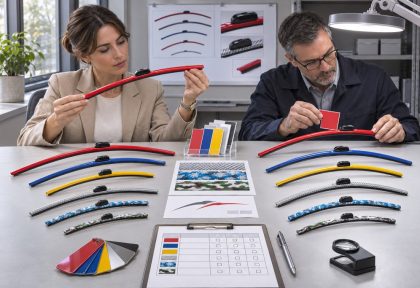
Buyers should approve custom colours and patterns on representative physical blades, not only through digital mock-ups or loose colour chips. The approval record should define the colour reference, customized component, finish, pattern scale, alignment, acceptable variation and production version that the supplier must reproduce.
This guide is intended for private-label wiper blade brands and retail buyers preparing a customized range. It explains how to build a useful sample brief, evaluate physical samples and convert the approved appearance into a controlled bulk-production standard.
Define Exactly What the Custom Sample Must Show
The first sample request should identify the product, components and visual requirements clearly. “Please make a red wiper with our pattern” does not tell the supplier which parts should be red, what shade to use or how the pattern should appear across different sizes.
Identify the base blade first
Custom appearance should be applied to a defined blade platform. Before discussing colour, confirm:
- Blade structure
- Product model
- Lengths to be customized
- Connector or adapter system
- Intended vehicle applications
- Driver, passenger or rear position
- Wiping-element specification
- Standard component materials
- Packaging format
A colour sample made on one product does not automatically approve another blade structure. A spoiler, frame, end cap and connector may use different materials or surface textures, even when the products share the same nominal length.
Buyers can review the custom colour one-piece spoiler wiper blade range when deciding which blade platform should be used for the initial sample.
List every customized component
The sample brief should identify which parts remain standard and which parts require customization.
Possible customized areas include:
- Spoiler sections
- Frame or outer cover
- End caps
- Connector housing
- Adapter cover
- Decorative insert
- Printed logo
- Patterned surface
- Retail packaging
Use a product photograph or diagram to mark each area. This is more reliable than describing the location only in text.
Specify the sample versions
One sample may not answer every design question. Depending on the project, the buyer may request:
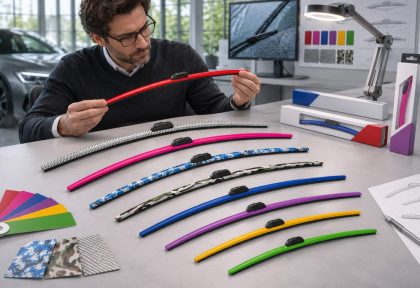
- Several colour options on the same blade
- One colour with different finishes
- Several pattern scales
- Alternative logo positions
- Short and long blade versions
- Product-only sample
- Final packaged sample
Avoid requesting too many combinations without a clear decision plan. Each version should answer a specific question, such as whether the logo remains legible or whether a pattern works across the intended length range.
Use a controlled sample brief
| Sample field | Information to provide | Reason for approval |
|---|---|---|
| Product model | Exact blade platform and structure | Prevents approval on the wrong product |
| Blade lengths | Sizes represented by the sample | Shows how the design changes by length |
| Customized parts | Spoiler, frame, end cap or connector | Defines the scope of colour approval |
| Colour reference | Recognized code or physical reference | Reduces subjective colour descriptions |
| Finish | Matte, gloss or approved alternative | Surface finish changes visual appearance |
| Pattern file | Controlled artwork and revision | Prevents use of an outdated design |
| Pattern position | Coverage area and orientation | Controls layout on the finished blade |
| Logo | File, size, colour and location | Confirms brand presentation |
| Standard parts | Components that remain unchanged | Prevents unnecessary customization |
| Packaging | Required package and artwork version | Connects the blade to the saleable product |
The sample brief should carry a revision number and approval date. If the buyer later changes the colour, artwork or blade platform, the document should be updated rather than modified informally through separate messages.
Approve Colours on the Actual Blade Components
A digital rendering is useful for selecting a direction, but it is not a production colour standard. Screens display colours differently, and the finished result depends on the component material, texture and finish.
Use both a reference and a physical sample
A reliable approval normally combines:
- A defined colour reference
- A physical product sample
- Photographs of the approved sample
- Written identification of the customized component
- A record of the viewing conditions
- An approved finish
The colour reference helps the supplier prepare the sample. The physical blade shows how that colour actually appears on the selected product.
If the brand already uses the colour on packaging or another product, send a controlled physical reference where practical. Explain whether the wiper must match it closely or only remain within the same brand family.
Compare every relevant component
The same colour can appear different on two components because the underlying materials and textures are not identical. A smooth connector cover may reflect light differently from a textured spoiler.
Inspect the complete assembly rather than approving parts separately. Check whether the components look consistent when viewed together, even if a minor technical difference remains between materials.
The approval should state which standard applies:
- One colour reference for every component
- One reference with accepted material-related differences
- Separate approved references for different components
- Deliberate use of several related colours
Without this decision, production inspectors may not know whether a visible difference is intentional.
Review colour under normal viewing conditions
I recommend checking the sample under more than one common light source because colour can shift between daylight and indoor lighting.
Useful viewing conditions include:
- Indirect natural daylight
- Normal office or warehouse lighting
- Retail-style lighting where relevant
- Side-by-side comparison with the approved reference
- Side-by-side comparison between blade sizes
Avoid making the final decision from a strongly edited photograph. Camera settings, screen brightness and image compression can change the apparent shade.
Define acceptable variation before production
A statement such as “the colour must be exactly the same” is difficult to inspect unless the buyer and supplier have agreed on a measurable method and limit. When no instrument-based criterion has been established, use an approved physical sample together with agreed visual conditions and boundary references where practical.
The written standard can address:
- Obvious shade differences
- Uneven colour
- Visible marks
- Surface contamination
- Gloss inconsistency
- Colour difference between paired components
- Variation across different blade lengths
- Acceptable areas hidden after installation
Do not invent a numerical colour tolerance after the bulk order is finished. If a measured tolerance is required, it should be agreed before production with the relevant method and conditions.
Confirm whether colour affects product identification
A custom colour should not hide:
- Adapter codes
- Product model
- Installation markings
- Batch information
- Locking features
- Required warning or product labels
The coloured component must still allow technicians and customers to identify and install the product correctly.
Evaluate Pattern Scale, Position and Consistency
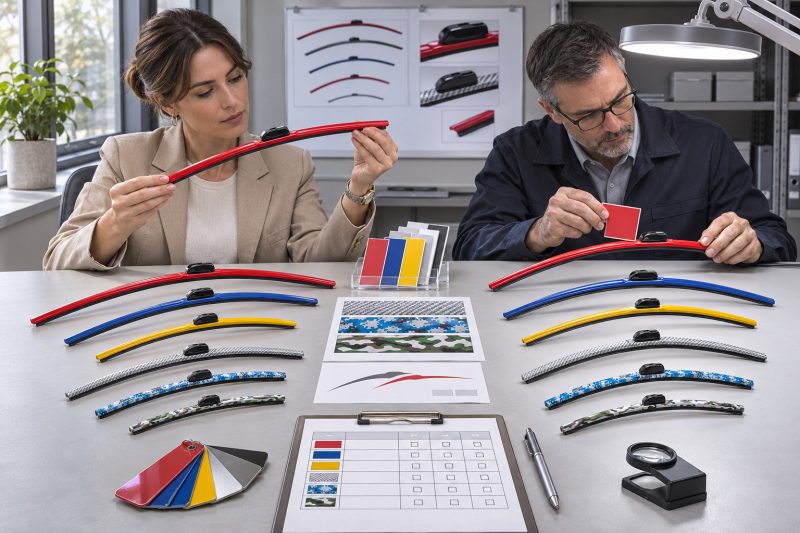
Pattern approval is more complex than solid-colour approval because the buyer must control not only colour but also scale, direction, coverage and alignment.
Approve the artwork before application
The supplier should receive controlled artwork rather than a screenshot or photograph of the intended pattern.
The artwork package should include:
- Final design file
- Colour references
- Pattern repeat
- Orientation
- Coverage area
- Prohibited modification
- File revision
- Approval date
If the supplier needs to adapt the artwork to the product shape, ask for a layout proof before physical sampling. The proof should show where the pattern begins and ends and how it relates to the connector, spoiler and end caps.
Check the design on different lengths
A pattern that looks balanced on a 24-inch blade may appear crowded on a 14-inch blade or too widely spaced on a 28-inch product.
Buyers should decide whether the pattern will:
- Keep the same scale on every size
- Use proportional scaling
- Repeat more often on longer blades
- Use a centered feature
- Start from a fixed point near the connector
- Use separate artwork for different length groups
There is no single correct method. The choice should support a consistent product family while remaining practical for production.
For a range containing many lengths, I would approve at least:
- One short blade
- One medium blade
- One long blade
These three samples usually reveal whether the pattern scale and positioning rules work across the proposed assortment.
Inspect orientation after installation
The sample should be evaluated in its installed orientation, not only while lying flat on a table. A directional graphic may appear reversed or partially hidden after the blade is fitted.
Confirm:
- Viewing direction
- Left/right orientation
- Relationship to the wiper arm
- Visibility from outside the vehicle
- Position when parked
- Driver/passenger differences
- LHD or RHD relevance where applicable
If a single design is intended for both sides, check that it does not look incorrect when the blade direction changes.
Define pattern defects
The approval standard should describe defects that would make a product unacceptable.
Possible pattern issues include:
- Incorrect orientation
- Misalignment
- Unapproved scaling
- Cropped key graphics
- Visible breaks
- Smearing
- Uneven colour
- Missing areas
- Marks or contamination
- Different placement across paired blades
The buyer should distinguish between critical visual errors and small variations that do not affect the intended presentation.
Check normal handling
The sample should be handled, installed and packed using the expected process. This helps reveal whether the proposed decorative surface is easily marked during normal assembly or packaging.
The evaluation does not prove long-term outdoor durability. If the buyer requires evidence for abrasion, weathering or another performance claim, the supplier should explain the test method and confirm that it applies to the exact product and decoration process.
Buyers comparing a one-piece spoiler structure for a patterned range can review the TOPEX one-piece spoiler wiper blade category before selecting the final base product.
Approve Logos and Packaging with the Blade Sample
The colour or pattern should be evaluated together with the logo and package. These elements form one visual system, and problems often become visible only when the complete saleable product is assembled.
Verify logo size and position
The logo should be large enough to identify the brand but should not interfere with product use or important markings.
Check:
- Logo proportions
- Colour
- Legibility
- Position
- Orientation
- Distance from the connector
- Relationship to the pattern
- Appearance across several blade lengths
- Visibility after installation
If the product uses both a logo and a pattern, define which element has priority. A busy pattern may reduce logo contrast, while an oversized logo may disrupt the design.
Confirm the logo application method
The sample record should identify how the logo is applied and which surface receives it. If the supplier proposes a different method for mass production, the buyer should review a production-representative sample before approval.
The quotation and specification should state:
- Logo method
- Logo colour
- Logo dimensions
- Application position
- Relevant setup or tooling
- Approval sample
- Inspection criteria
A digital mock-up should not be treated as approval of the physical logo.
Coordinate the package with the product
Packaging should help the customer identify the correct colour, pattern and blade specification. If the blade is hidden inside a closed box, the package needs an accurate product image or colour identification.
Confirm that the package shows:
- Correct colour name or code used for the SKU
- Pattern version
- Blade length
- Product structure
- Connector or adapter information
- Package contents
- SKU
- Barcode
- Installation instructions
If several visual variants share a common package, use controlled labels or another clear method to distinguish them.
Test packaging protection
Customized surfaces may require protection from repeated rubbing, compression or contact with loose adapters.
Place the actual blade and all accessories inside the proposed package and check:
- Internal clearance
- Product retention
- Contact points
- Wiping-edge protection
- Adapter placement
- Movement during handling
- Package sealing
- Product removal
A package that protects a standard black blade may still leave visible marks on a lighter or glossier customized surface.
| Approval area | Product sample check | Packaged sample check |
|---|---|---|
| Colour | Shade, finish and component consistency | Accurate representation on the package |
| Pattern | Scale, alignment and orientation | Correct variant identification |
| Logo | Size, position and legibility | Brand consistency with artwork |
| Blade length | Visual balance by size | Correct size and barcode |
| Connector | No colour interference with operation | Correct adapter information |
| Surface protection | No marks before packing | No damage from internal movement |
| Accessories | Correct adapters and instructions | Complete and securely positioned |
| Traceability | Sample revision and identification | SKU, batch and packaging version |
Convert Sample Approval into a Production Standard
A visually approved sample is useful only if the supplier can identify and reproduce the same version during bulk production.
Create a complete approval record
The final approval package should contain:
- Product model
- Blade lengths covered
- Customized components
- Colour references
- Finish
- Pattern artwork
- Pattern placement rules
- Logo artwork
- Logo position
- Packaging artwork
- Physical golden sample
- Approval photographs
- Revision numbers
- Approval date
- Buyer and supplier confirmation
Keep superseded samples and files clearly separated from the final version. An old sample should not remain on the production floor without identification.
Define which changes require approval
The supplier should obtain written approval before changing any item that may alter the appearance or function of the product.
These items may include:
- Base material
- Colour reference or formulation
- Surface texture
- Finish
- Pattern artwork
- Pattern application method
- Logo method
- Connector component
- Packaging material
- Printing artwork
- Production location where relevant
A change that seems minor in isolation may become obvious when new stock is displayed beside the previous batch.
Request production-representative samples
An early development sample may be prepared through a special process. Before bulk production, confirm that the approved appearance can be reproduced using the intended production method and materials.
The production sample should match:
- Final blade structure
- Final materials
- Approved colours
- Approved pattern
- Approved logo
- Correct adapters
- Final packaging
If any item remains provisional, record it clearly and require final approval before shipment production continues.
Inspect representative variants
Pre-shipment inspection should include different sizes, colours and pattern versions rather than checking one convenient SKU.
Inspection can cover:
- Product identity
- Colour consistency
- Pattern placement
- Logo
- Surface finish
- Assembly
- Connector operation
- Packaging
- Barcode
- Quantity
- Batch identification
The inspection method should compare bulk units with the approved sample and written standard. A general instruction to check for “correct colour” is not enough.
Frequently Asked Questions
Is a digital colour rendering enough to approve a custom wiper blade?
No. A rendering helps select the design direction, but it cannot show how the colour will appear on the actual component material and finish. Final approval should use a representative physical blade supported by a defined reference and written specification.
How many colour samples should a buyer request?
Request only enough versions to make a clear decision. The set may include alternative shades, finishes or component combinations. At least one sample should represent the final blade structure and be suitable for retention as the approved reference.
Should a pattern use the same scale on every blade length?
Not necessarily. A fixed scale, proportional scale or repeated layout may work depending on the artwork. Buyers should compare short, medium and long blades and define one placement rule before approving the full range.
How can buyers prevent colour differences in repeat orders?
Retain an approved physical sample, colour reference and controlled specification. Require written approval before changes to materials, finish, colour, decoration method or production details that could affect appearance.
Does approving the colour also approve the complete blade?
No. Product approval should also cover the blade structure, connector, adapters, fitment, wiping performance, logo and packaging. A visually correct sample may still be unsuitable if its functional configuration is incorrect.
Conclusion
Custom colour and pattern approval should be based on representative physical blades, controlled references and clear placement rules. Buyers should evaluate different materials, blade lengths, installation orientations and packaging before freezing the design for production.
To prepare TOPEX samples for review, provide the selected blade model, required lengths, colour references, pattern artwork and logo file. These details help define which sample versions are needed and what the final approval must cover.

--- END ---