
Front vs. Rear Wiper Blades: Where Distributors Are Missing Sales
Sep 14, 2026
Most wiper blade programs focus on the windshield because front blades generate the highest replacement volume. However, a front-only assortment leaves part of the vehicle uncovered.
Many SUVs, crossovers, hatchbacks, estates, and MPVs also use a rear wiper. If a retailer identifies only the front blades, the customer may search elsewhere for the third product.
Rear blades should not receive the same inventory depth as front blades, but they should be connected to front-blade demand. The safest strategy is to identify popular rear-wiper-equipped vehicles, stock verified applications in controlled quantities, and use fitment prompts, complete sets, and sales data to expand only where demand is proven.
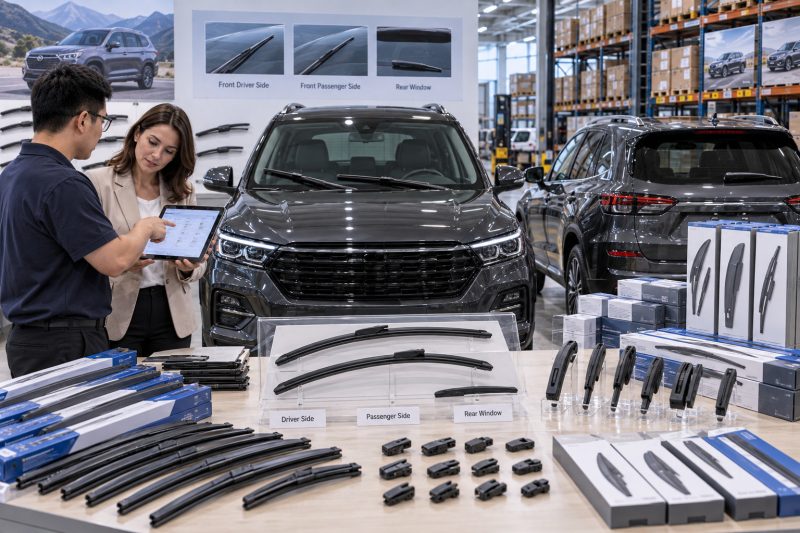
I am Jacky Huang, CEO of Xiamen TOPEX Auto Parts Co., Ltd. When reviewing a range, I ask whether it covers the complete vehicle and reflects local applications.
Why a Front-Only Wiper Range Leaves Revenue on the Table
A customer replacing worn front blades is already thinking about visibility and vehicle maintenance. This creates a natural opportunity to check the rear blade. If the retailer’s fitment system identifies all three positions, the customer can complete the job in one transaction.
Without rear coverage, several losses may occur:
- The customer purchases only the two front blades.
- Staff cannot identify the correct rear application.
- A workshop spends time sourcing the missing part elsewhere.
- An online shopper leaves the website to find a complete set.
- The distributor loses a higher basket value.
- A competitor gains the customer relationship.
Rear demand is particularly relevant for vehicles whose body shape allows dirt, spray, and moisture to collect on the rear glass. The need exists even though replacement timing may not match the front blades exactly.
| Customer situation | Front-only result | Complete-range opportunity |
|---|---|---|
| Driver replaces both front blades | Two units sold | Offer the verified rear application |
| Workshop services an SUV | Rear blade sourced separately | Supply all positions on one invoice |
| Customer searches by vehicle | Only front positions appear | Display driver, passenger, and rear results |
| Front blades are sold as a pair | Rear need remains invisible | Add a compatible rear recommendation |
| Newer application has limited coverage | Customer contacts several sellers | Win the sale with verified availability |
Availability gaps can be commercially useful when approached carefully. In a recent Chevrolet Trax owner discussion, owners described difficulty finding suitable replacements and discussed three-blade sets. This is not market-wide evidence, but it illustrates how vehicle-specific availability problems can send customers searching across dealers, stores, and online marketplaces.
The Rear Wiper Assortment Mistakes That Create Dead Stock
Recognizing demand does not mean stocking every rear SKU. Vehicle-specific applications can create slow inventory quickly.
Purchasing by Length Alone
Rear blades of the same nominal length may use different molded connectors, arm interfaces, profiles, curvature, or integrated components. A 12-inch rear blade is not automatically interchangeable with every other 12-inch product.
Buyers should confirm:
- Country or sales region
- Vehicle make, model, generation, and year
- Rear installation position
- Blade length
- Arm and connector design
- Adapter or integrated interface
- OE reference where available
- Product SKU and included components
Treating Rear Blades as Universal Products
Multi-application claims require verification because physical attachment does not guarantee secure locking, proper angle, clearance, or glass contact.
Expanding Long-Tail Coverage Too Quickly
Adding many SKUs for maximum theoretical coverage can tie up capital in rare applications.
| Assortment mistake | Inventory effect | Better approach |
|---|---|---|
| Equal quantity for every rear SKU | Long-tail products become overstocked | Allocate by local vehicle demand |
| Length-only purchasing | Similar sizes are duplicated incorrectly | Plan by vehicle, connector, and position |
| Global catalog copied locally | Irrelevant applications enter inventory | Build a country-specific list |
| Unverified multi-fit claims | Returns increase despite fewer SKUs | Test important vehicles and connectors |
| Front and rear data kept separately | Attachment sales are missed | Connect positions in one fitment record |
| Sets replace all individual products | Customers cannot replace one position | Offer both sets and selected individual SKUs |
Core rear SKUs need consistent availability, growth products need controlled quantities, and long-tail applications can use light stock or special orders.
How to Identify the Front and Rear Applications Worth Stocking
The strongest starting point is the local vehicle parc. Distributors should identify common vehicles equipped with rear wipers and connect each one to its complete blade configuration.
Build a Position-Specific Fitment Record
A useful application record should include:
| Data field | Why it matters |
|---|---|
| Sales country | Regional versions may use different specifications |
| Make, model, and generation | Prevents confusion between similarly named vehicles |
| Model-year range | Captures design changes during a vehicle lifecycle |
| Body style | Rear-wiper equipment may vary by hatchback, sedan, SUV, or estate |
| Driver-side length and connector | Identifies the first front blade |
| Passenger-side length and connector | Identifies the paired front blade |
| Rear length and interface | Connects the attachment-sale opportunity |
| OE number or reference | Supports cross-checking where available |
| Product SKU | Links the vehicle to sellable inventory |
| Verification status | Shows whether the application has been physically checked |
Body style deserves attention because a model name may cover several versions. A hatchback may have a rear wiper while the related sedan does not. Regional equipment differences can also affect model-year coverage.
Combine Vehicle Data with Commercial Evidence
Registration data should be combined with:
- Historical sales by vehicle and position.
- Customer and workshop inquiries for rear blades.
- Searches producing no compatible result.
- Front-blade sales for rear-equipped vehicles.
- Competitor availability and pricing.
- Fitment-return reasons.
- Supplier lead time and per-SKU MOQ.
- Inventory age and reorder frequency.
A popular vehicle with frequent front sales but no rear listing is a practical opportunity. Rare applications should remain controlled.
Verify Samples on Representative Vehicles
Testing should cover engagement, retention, installed angle, clearance, glass contact, sweep area, noise, and wiping.
The TOPEX OE exact-fit wiper blade range demonstrates the importance of application-specific selection. For rear products, the same principle applies: the vehicle, year, position, and connector must be confirmed before inventory is approved.
How Complete Vehicle Sets Can Improve Coverage and Basket Value
A complete set combines driver-side, passenger-side, and rear blades for one verified vehicle, reducing selection work.
Complete sets can provide several benefits:
- Higher order value per vehicle search
- Easier selection for consumers
- Clear driver/passenger pairing
- Greater confidence in rear compatibility
- Simpler workshop ordering
- Stronger private-label differentiation
- One installation guide for the complete vehicle
Sets should complement individual products because customers do not always replace every position simultaneously.
| Sales format | Best use | Main limitation |
|---|---|---|
| Individual front blade | Single-position replacement | Customer must identify the paired size |
| Front pair | Convenient windshield replacement | Rear demand may remain hidden |
| Individual rear blade | Flexible rear-only service | Lower basket value |
| Complete three-blade set | Whole-vehicle replacement and online convenience | Not every customer needs all three simultaneously |
| Workshop application kit | Professional service for known vehicles | Requires accurate application control |
Make the Package and Listing Position-Specific
Every set should identify the region, vehicle, year, body style, positions, lengths, and installation method.
Installation content may include:
- Connector photographs
- Position labels
- Blade-length references
- Step-by-step diagrams
- QR-linked installation video
- Warnings about vehicle-year or body-style differences
- Instructions for removing the original rear blade safely
The TOPEX flat wiper blade range supports different front sizes and connectors. Verified rear applications turn them into a complete vehicle offer.
Use Sets Selectively
Sets work best for popular vehicles with stable fitment. Virtual bundles assembled from individual stock can test demand before dedicated packaging is produced.
Turn Fitment Searches and Front-Blade Sales into Rear-Blade Demand
Rear-blade demand becomes visible when the sales system asks the right question. A vehicle lookup should return all installed positions, not stop after showing the front pair.
Rear recommendations can appear in:
- Vehicle-fitment search results
- Front-blade product pages
- Shopping-cart suggestions
- Retail counter systems
- Workshop service checklists
- Customer-service scripts
- Seasonal maintenance campaigns
- Replacement reminder emails
The message can simply say: “Your vehicle also uses a rear blade—check its condition.”
Track the Attachment Opportunity
| Metric | What it reveals |
|---|---|
| Rear attachment rate | Share of eligible front orders that include a rear blade |
| Complete-set conversion | Customer response to bundled selection |
| No-result searches | Rear applications missing from the range or database |
| Rear stockout frequency | Proven SKUs requiring deeper inventory |
| Fitment-return rate | Application, connector, or instruction problems |
| Inventory age | Rear SKUs becoming slow-moving |
| Reorder frequency | Recurring replacement demand |
| Return-adjusted margin | Profit after returns and support costs |
Classify returns by application error, body-style mismatch, connector issue, instructions, missing parts, customer error, or defect.
At TOPEX, I recommend starting with rear-equipped vehicles already generating front sales, verifying samples, connecting all positions in the data, and expanding only after proven demand.
The review decision for each rear SKU should be simple:
- Expand when demand and margin are strong.
- Maintain when sales are stable at the current depth.
- Correct when demand exists but fitment or instructions create returns.
- Reduce when inventory exceeds actual sales.
- Special order when the application has value but low frequency.
- Discontinue when sales and strategic importance remain weak.
Conclusion
Rear wiper blades should not be treated as smaller copies of front blades. Their volumes may be lower, but vehicle-specific designs and limited availability can create valuable opportunities for distributors with accurate fitment data.
The lowest-risk strategy is to identify rear-wiper-equipped vehicles common in the local market, stock proven applications in controlled quantities, and connect them to existing front-blade sales. Complete vehicle sets can simplify selection and increase order value, while individual rear blades preserve replacement flexibility.
By tracking fitment searches, attachment rates, stockouts, returns, and inventory age, distributors can capture overlooked rear-blade demand without building an unnecessarily large catalog.
Frequently Asked Questions About Front and Rear Wiper Blades
Why should distributors stock rear wiper blades?
Rear blades allow distributors to complete more vehicle applications, increase basket value, and serve customers who cannot find suitable replacements easily. They are especially relevant for popular SUVs, hatchbacks, crossovers, estate cars, and MPVs.
Are rear wiper blades universal or vehicle-specific?
Many rear blades are vehicle-specific. Products with the same length may use different plastic connectors, integrated arm interfaces, angles, or profiles. Compatibility should be confirmed by vehicle, year, body style, position, and connector.
Which vehicles are most likely to require a rear wiper blade?
SUVs, crossovers, hatchbacks, estate cars, and MPVs commonly use rear wipers. Equipment still varies by model, body style, year, and region, so distributors should confirm each application rather than rely on vehicle category alone.
Should retailers sell front and rear blades as a complete set?
Complete sets can simplify selection and raise basket value for popular vehicles. Retailers should also retain individual options because customers do not always replace all positions simultaneously. Virtual bundles can test demand before dedicated packaging is produced.
How can distributors avoid overstocking rear wiper SKUs?
Begin with common local vehicles, use controlled trial quantities, and classify products as core, growth, or long-tail. Sell-through, searches, attachment rates, inventory age, returns, and replenishment frequency should guide expansion.
What fitment information is required for rear wiper blades?
Records should include the country, vehicle make, model, generation, year, body style, rear position, blade length, connector or arm interface, OE reference where available, product SKU, and verification status.

--- END ---


