
How Multi-Fit Flat Wiper Blades Help Wholesalers Cut SKUs and Inventory Pressure
Aug 11, 2026
You keep adding new exact-fit SKUs every season. Each arm type and vehicle variation needs its own code. Warehouse bins multiply. Cash sits in slow-moving stock. Returns rise when the wrong connector is picked. The problem is not lack of demand. It is the exact-fit model itself.
Multi-fit flat wiper blades let one blade body cover the majority of common arm types through interchangeable adapters. Wholesalers cut total SKUs dramatically, free up capital, reduce warehouse pressure, lower fitment returns, and keep inventory turning faster.
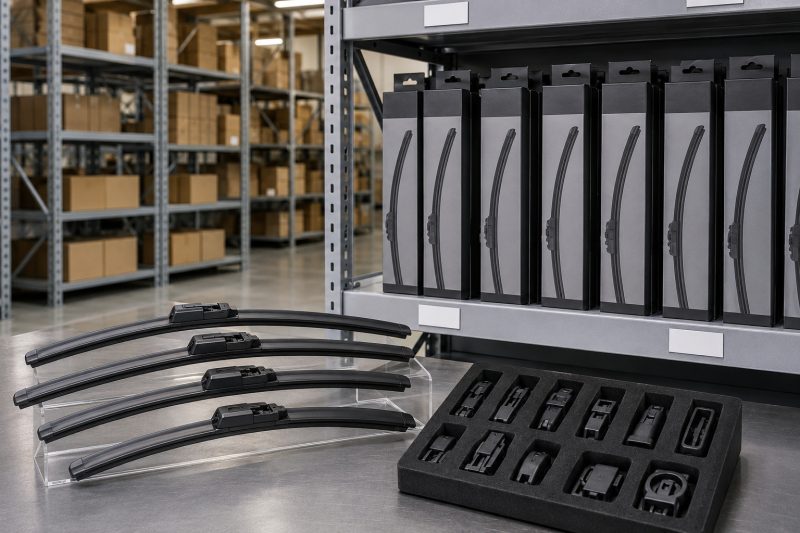
You now see a practical way to stop SKU explosion. Let’s examine why traditional exact-fit strategies create serious inventory pressure, how multi-fit connector systems actually work and what coverage they deliver, the real difference in SKU count and warehouse cost, the positive effects on cash flow and returns, and the concrete steps to introduce multi-fit flat blades while managing residual risks.
Why Traditional Exact-Fit Strategies Create Serious Inventory Pressure for Wholesalers
I speak with distributors who started with a clean catalogue. Over the years the number of exact-fit part numbers kept growing. Inventory complexity followed and never stopped.
Traditional exact-fit strategies create serious inventory pressure because every new arm type or vehicle variation requires its own SKU, capital stays locked in slow-moving items, warehouse space fills with low-velocity stock, and the risk of picking the wrong connector rises with every added code.
Continuous Growth in Part Numbers
Modern vehicles use J-hook, side-pin, push-button, bayonet, pinch-tab and other arm styles. Exact-fit logic turns each combination of length and connector into a separate SKU. The list expands every model year.
Capital Tied Up in Long-Tail Stock
Many exact-fit blades move only a few units per month. Money sits on the shelf while faster products wait for reinvestment. Cash flow tightens even when overall sales look stable.
Warehouse Space and Complexity Multiply
More SKUs mean more bin locations, more labels, more picking paths, and more opportunities for error. Management time shifts from selling to simply controlling the assortment.
Higher Fitment Error Risk
When dozens of blades differ only by the small plastic connector, the chance of shipping the wrong one increases. Fitment-related returns become a regular and expensive part of the business.
Slow Response to New Vehicles
Adding coverage for a new platform means creating yet another exact-fit SKU. Decision speed drops and the risk of future obsolescence rises.
| Exact-Fit Pressure Point | Immediate Effect | Business Result |
|---|---|---|
| New arm types each year | SKU count keeps rising | Higher complexity |
| Slow-moving variants | Capital locked in stock | Tight cash flow |
| Extra bin locations | Warehouse space pressure | Higher operating cost |
| Wrong-connector shipments | Fitment returns | Margin and service cost |
This table shows how the exact-fit model turns normal market variety into permanent inventory burden. The root cause is structural.
My Distributor Conversation Pattern
A mid-sized wholesaler once showed me his wiper list. More than half the active SKUs were exact-fit items that moved fewer than ten units a month. The capital tied up in those slow codes was larger than his entire fast-moving core range.
Market Reality in 2026
Vehicle platforms continue to diversify. Wholesalers who stay with pure exact-fit logic face permanent SKU growth even when total demand stays flat. The pressure does not ease by itself.
Exact-fit creates the problem. Multi-fit systems attack it at the source.
How Multi-Fit Connector Systems Work and What Coverage They Deliver
The principle is simple. Separate the blade body from the connector interface.
Multi-fit flat wiper blades use one standardized beam body plus a set of interchangeable adapters that fit the major arm types. A small number of length-based SKUs plus the right adapter mix routinely cover 95–99% of vehicles in major markets.
One Blade Body, Multiple Adapters
The flat beam is manufactured as a single design. Different adapters click or slide onto the same body to match J-hook, side-pin, push-button, bayonet, pinch-tab and other common arms. The performance characteristics of the flat blade stay the same.
Realistic Coverage Rates
A well-designed multi-fit set for passenger cars and light commercial vehicles commonly reaches 95–99% coverage when the adapter mix matches the local vehicle park. The remaining few percent can be handled with a very small number of special exact-fit items if needed.
Regional Adapter Emphasis
Emerging markets often need strong U-hook volume. Europe frequently requires reliable push-button and bayonet options. North America benefits from solid side-pin coverage. The system allows the adapter mix to be adjusted without changing the core blade SKUs.
Compatibility with Flat Beam Performance
Multi-fit adapters work on true flat (beam) structures. Even pressure distribution, low wind lift, and quiet operation remain intact. The inventory benefit does not come at the expense of high-speed performance.
Supporting Tools That Protect Accuracy
Clear packaging labels list the included adapters. Accurate digital and printed fitment charts tell staff and customers exactly which vehicles are covered. Simple installation guidance reduces user error.
- Standardize on a limited set of high-volume flat blade lengths.
- Stock the adapter types that match your regional arm-type mix.
- Use clear on-pack information so picking and selling stay accurate.
- Maintain up-to-date fitment data as new vehicles appear.
- Treat the remaining few percent of special applications as true exceptions.
These elements turn connector variety from an inventory problem into a manageable accessory layer.
Practical Coverage Reality
In most mature markets a carefully chosen multi-fit flat range already serves nearly every common passenger car. The long tail of rare arm types becomes small enough to manage with minimal extra stock.
Operational Simplification
Fewer base SKUs mean fewer bin locations, simpler replenishment planning, and faster training for warehouse and counter staff.
The system works. The commercial difference appears when the numbers are compared directly.
Actual Inventory Comparison: Exact-Fit vs Multi-Fit SKU Count and Warehouse Cost
Side-by-side numbers show how large the gap becomes.
Exact-fit strategies commonly require 150–200 or more active SKUs to cover a full market. Multi-fit flat systems routinely reduce the core range to roughly 8–30 length-based SKUs while still covering 95–99% of vehicles, cutting warehouse locations, carrying cost, and obsolescence risk in proportion.
Typical Exact-Fit SKU Load
A full exact-fit assortment for passenger cars often runs to 150–200 part numbers once all common lengths and connectors are included. Many of those codes move slowly.
Multi-Fit Core Range Size
The same coverage can be achieved with 8–12 or 20–30 multi-fit flat SKUs focused on the highest-volume lengths. Adapter variety is handled as an accessory rather than a separate blade SKU for every combination.
Warehouse Location Impact
Fewer base SKUs translate directly into fewer bin locations. Some operators report reductions from hundreds of locations down to a few dozen for the core wiper range.
Carrying Cost and Obsolescence
Capital previously locked in long-tail exact-fit items is released. The risk of holding obsolete connector-specific stock declines because the multi-fit body remains useful across many vehicles.
Picking and Replenishment Efficiency
Order picking becomes faster when staff handle a small set of high-velocity codes instead of searching through dozens of near-identical exact-fit variants. Replenishment planning focuses on a manageable core.
| Comparison Factor | Exact-Fit Model | Multi-Fit Flat Model |
|---|---|---|
| Typical active SKUs | 150–200+ | 8–30 core lengths |
| Vehicle coverage | High but fragmented | 95–99% with adapter mix |
| Bin locations required | High | Dramatically lower |
| Capital in slow movers | Significant | Minimal |
| Obsolescence risk | Higher | Lower |
| Picking complexity | High | Simplified |
This table summarizes the structural difference. The multi-fit approach attacks complexity at the root.
Real Operator Results
Distributors who completed the shift consistently report the same pattern: less capital tied up, cleaner warehouses, and more management attention available for selling rather than controlling exceptions.
Retailer Side Benefit
Retail partners receive a simpler assortment that still covers almost every vehicle. Their own inventory pressure and customer “will it fit?” questions decline in parallel.
The inventory numbers improve. The financial effects follow.
Positive Impact on Cash Flow, Order Frequency, and Return Rates
When SKU count drops and coverage stays high, several financial and operational metrics move in the right direction at once.
Multi-fit flat blades improve cash flow by releasing capital from slow stock, support more frequent and smaller replenishment of high-velocity items, and reduce fitment-related returns that previously eroded margin and consumed service time.
Cash Flow Liberation
Money that sat in low-velocity exact-fit codes becomes available for faster-turning products, marketing, or simply lower overall working-capital needs. Liquidity improves without a sales decline.
Higher Order Frequency on Core Items
Sales concentrate on a smaller set of multi-fit lengths. Replenishment becomes more regular and predictable. Stock-outs of popular sizes decline while total inventory value often falls.
Lower Fitment Return Rates
Wrong-connector shipments drop sharply because the multi-fit body plus clear adapter labeling removes most of the ambiguity. Fitment-related returns, often 40–60% of total returns in exact-fit ranges, fall meaningfully.
Reduced Service and Handling Cost
Fewer returns mean less inbound inspection, less re-stocking or scrapping, and less customer-service time. Net margin on the remaining volume rises.
Cleaner Data for Forecasting
With fewer SKUs the demand signal for each core length becomes clearer. Forecasting accuracy improves and safety-stock levels can often be reduced.
- Free capital previously locked in long-tail stock.
- Concentrate sales on high-velocity multi-fit lengths.
- Cut wrong-connector returns through clearer packaging and adapters.
- Lower handling and service costs that never appear on the purchase order.
- Improve forecast reliability on the remaining core range.
These gains compound. The assortment becomes both leaner and more profitable.
My Review of Transition Results
Wholesalers who measured cash tied up, return rate by reason, and turns before and after the multi-fit shift almost always saw improvement on all three metrics within one or two seasons. The key was tracking the numbers by system type rather than treating every blade as equal.
Practical Margin Effect
Even if the unit purchase price of a multi-fit flat blade is slightly higher than the cheapest exact-fit alternative, the reduction in returns, handling, and capital cost frequently produces a higher net contribution per unit sold.
Cash flow and returns improve. Implementation determines how quickly the benefits arrive.
How to Implement Multi-Fit Flat Blades and Start Cutting Inventory Pressure Today
A controlled, staged approach turns the concept into measurable results without disrupting current sales.
Wholesalers can implement multi-fit flat blades by mapping current exact-fit volumes, selecting a high-coverage multi-fit platform, aligning adapters to regional needs, supporting the range with clear fitment tools, testing with controlled quantities, and gradually shifting volume from exact-fit SKUs to the multi-fit core.
Step 1: Map Current Exact-Fit Volumes
List every active connector type and the monthly volume each generates. Identify the long-tail items that consume space and capital while contributing little to sales.
Step 2: Choose a High-Coverage Multi-Fit Flat Platform
Select a true flat (beam) system proven to reach 95–99% coverage in your main markets. Confirm that the adapters are robust and the blade delivers the high-speed and noise performance your customers expect.
Step 3: Align Adapters with Regional Demand
Stock the adapter mix that matches your vehicle park. Keep a small buffer of the highest-volume exact-fit items only if the multi-fit range leaves a genuine gap.
Step 4: Equip the Range with Support Tools
Provide accurate fitment charts, clear on-pack adapter lists, and simple installation guidance. These tools protect against returns and speed both warehouse and counter service.
Step 5: Test with Controlled Quantities
If the supplier offers low MOQ, run a trial on the top lengths. Track sell-through, return rate by reason, and operational feedback before full conversion.
Step 6: Shift Volume Gradually
Move the highest-velocity sizes first. Reduce or eliminate slow exact-fit SKUs as the multi-fit equivalents prove themselves. Review the mix quarterly.
Residual Risks and Practical Solutions
Adapter quality must be high or installation complaints will rise. Customer and staff education is essential—clear packaging and simple instructions solve most issues. A small exact-fit buffer can remain for the final few percent of rare applications so coverage stays complete.
- Start with data on your current connector volumes.
- Prioritize coverage percentage and adapter reliability.
- Support the range with clear information tools.
- Measure returns and turns during the transition.
- Scale the successful multi-fit lengths and retire the long-tail exact-fit codes.
These steps create a low-risk path from complexity to simplicity.
My Recommended Starting Point
I advise wholesalers to begin with their top eight to twelve blade lengths. Convert those to multi-fit flat first, keep precise records for one full season, and then decide how far to extend the system.
Long-Term Inventory Discipline
Once the core range is multi-fit, resist the urge to add every new exact-fit variant that appears. Treat specials as true exceptions rather than the default.
For high-performance multi-fit flat platforms that support this inventory strategy, explore the Topex flat wiper blade category. You can also review specific models such as the Topex T-PRO-F one-piece spoiler and the T-PRO-SC custom for designs that combine aerodynamic performance with practical multi-fit compatibility.
Conclusion
Inventory pressure in the wiper blade category is largely a connector and exact-fit problem, not a demand problem. Multi-fit flat wiper blades solve it at the source by letting one beam body cover the vast majority of vehicle arm types through interchangeable adapters. The result is dramatically fewer SKUs, lower carrying costs, faster turnover, reduced fitment-related returns, and simpler operations for both wholesalers and their retail partners. In 2026, the distributors who adopt well-engineered multi-fit flat solutions will free up capital, warehouse space, and management attention—while competitors remain trapped in SKU proliferation. Start by mapping your current exact-fit mix, test a high-coverage multi-fit flat range, and let the numbers prove the difference.
Frequently Asked Questions About Multi-Fit Flat Wiper Blades
How many SKUs can a typical multi-fit flat system eliminate compared with exact-fit blades?
A well-designed multi-fit flat system commonly reduces required core SKUs by 60–90%. Many distributors move from 150–200 exact-fit items down to roughly 8–30 length-based multi-fit SKUs while maintaining 95–99% vehicle coverage.
What vehicle coverage percentage can a good multi-fit flat adapter set realistically achieve?
High-quality multi-fit programs regularly reach 95–99% coverage of passenger cars and light commercial vehicles in major markets when the adapter mix is matched to local arm-type prevalence.
Do multi-fit systems increase installation complexity or return risk for end customers?
No. When adapters are clearly labeled and packaging includes simple instructions, installation remains straightforward. Fitment-related returns typically decline because the risk of shipping the wrong connector is greatly reduced.
How much can inventory carrying costs and warehouse space be reduced with multi-fit flat blades?
Carrying costs and required bin locations drop substantially—often in line with the 60–90% SKU reduction. Capital previously locked in slow-moving exact-fit stock is freed and obsolescence risk falls.
Should wholesalers completely replace exact-fit blades or run a hybrid inventory model?
Most start with a hybrid model: convert the high-volume lengths to multi-fit flat while keeping a small number of special exact-fit items for the remaining few percent of vehicles. Full conversion can follow once data confirms coverage and sell-through.
What practical steps should a wholesaler take to evaluate and switch to multi-fit flat blades?
Map current exact-fit volumes, select a high-coverage multi-fit flat system, align adapters to regional needs, equip the range with clear fitment tools, test with controlled quantities, measure returns and turns, and gradually shift volume from exact-fit SKUs to the multi-fit core.

--- END ---


