How to Compare Wiper Blade Quotes Beyond Unit Price: A Buyer’s Guide
Nov 18, 2026
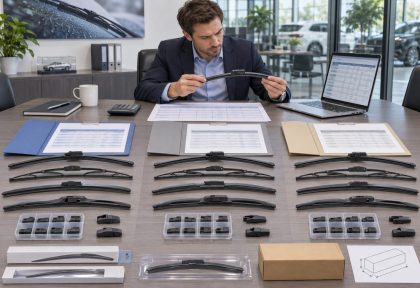
Two wiper blade quotations can show similar products but represent very different materials, connectors, packaging, fitment coverage and quality controls. Comparing only the unit price can therefore lead to higher costs after the order is placed.
A reliable comparison starts by confirming that every supplier is quoting the same product scope. Buyers should compare blade construction, wiping-element specifications, adapters, fitment data, packaging, inspection standards, commercial terms and change control before deciding which quotation offers better overall value.
This guide explains how importers and private-label buyers can normalize quotations, identify missing costs and ask suppliers for evidence that supports their product claims.
Why the Lowest Wiper Blade Price May Not Be the Lowest Cost
The quoted unit price is only one part of the landed and operational cost. A low price can result from a simpler product specification, fewer adapters, neutral packaging, limited inspection or different commercial terms.
These differences do not automatically make the cheaper product unsuitable. They do mean that the quotations should not be treated as equivalent until the scope has been clarified.
For example, one supplier may quote a flat blade with one pre-installed adapter, while another includes a multi-adapter set and retail packaging. The second price will probably be higher, but it also covers a different product and sales program.
I recommend separating the comparison into three levels:
- Product cost: The blade, connector, adapters and product-specific components.
- Program cost: Branding, packaging, fitment data, samples and inspection.
- Ownership cost: Returns, stockouts, rework, customer support and obsolete inventory.
A quotation that looks competitive at the first level may become less attractive after the remaining costs are added.
Identify what the price includes
Ask every supplier to state whether the quotation includes:
- The complete blade
- Pre-installed connector
- Additional adapters
- Wiping-element coating
- Product logo
- Retail packaging
- Installation instructions
- Barcode labels
- Inner and master cartons
- Fitment information
- Inspection requirements
- Spare components or agreed overage
- Export packaging
The quotation should also identify any tooling, artwork, sample or setup charges separately. This makes it easier to distinguish one-time project expenses from recurring unit costs.
Compare the same trade terms
A quotation based on EXW cannot be compared directly with one based on FOB or another delivery term. The buyer needs to understand which transport, export and handling responsibilities are included.
Confirm:
- Quoted trade term
- Named port or place
- Currency
- Payment terms
- Price validity
- Export packaging
- Estimated carton quantity
- Gross and net weight
- Order volume
- Documentation included
If these details are missing, calculate the landed cost only after the supplier clarifies them.
Normalize the Product Specification Before Comparing Prices
A fair quotation comparison requires one common product specification. The buyer should define the product first and then ask every supplier to quote against the same requirements.
Terms such as “premium wiper,” “high-quality rubber” or “universal blade” are too vague. Each supplier may interpret them differently.
Compare blade structure correctly
Conventional, flat, hybrid and OE exact-fit blades use different structures and solve different fitment or positioning needs.
A quotation should identify:
- Blade structure
- Available length range
- Supporting frame or spring design
- Spoiler configuration
- Connector system
- Intended installation position
- Product color
- Logo method
Do not compare a conventional blade with a flat blade only because both products have the same length. Their components, assembly and intended market positions differ.
Buyers assessing modern beam-style products can review the available flat wiper blade range when defining which structure they want suppliers to quote.
Clarify the wiping element
“Rubber” and “silicone” describe wiping-element materials. They do not identify the complete blade structure or guarantee a particular service life.
Ask the supplier to explain:
- Wiping-element material
- Profile and dimensions
- Surface treatment or coating
- Edge condition
- Material specification
- Evidence supporting durability claims
Avoid comparing products by material name alone. Actual performance also depends on the wiping-edge finish, spring pressure, windshield conformity, installation and production consistency.
Check critical dimensions
Nominal length is not the only relevant dimension. Depending on the product, buyers may also need to compare:
- Actual blade length
- Wiping-element length
- Connector width
- Adapter height
- Hook or button dimensions
- Spring-strip dimensions
- Spoiler profile
- Overall installed height
If a supplier proposes a different design, ask how the difference affects fitment, packaging and application coverage.
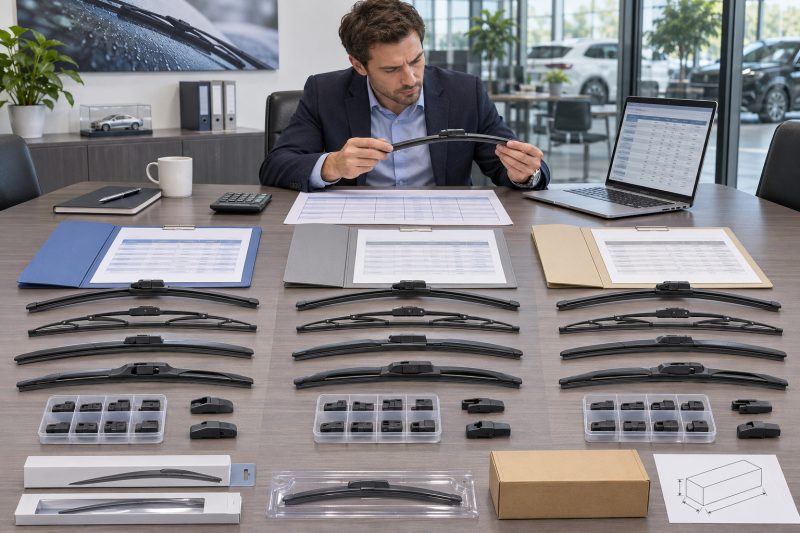
Use one quotation comparison table
| Comparison field | Supplier A | Supplier B | Supplier C |
|---|---|---|---|
| Blade structure | Confirm exact design | Confirm exact design | Confirm exact design |
| Length range | Record included sizes | Record included sizes | Record included sizes |
| Wiping element | Material and coating | Material and coating | Material and coating |
| Connector | Type and dimensions | Type and dimensions | Type and dimensions |
| Adapter set | Codes and quantities | Codes and quantities | Codes and quantities |
| Product branding | Method and position | Method and position | Method and position |
| Packaging | Format and materials | Format and materials | Format and materials |
| Fitment data | Scope and format | Scope and format | Scope and format |
| Inspection | Included checks | Included checks | Included checks |
| Commercial term | EXW, FOB or other | EXW, FOB or other | EXW, FOB or other |
| Lead-time basis | Starting condition | Starting condition | Starting condition |
| Change control | Written notice required? | Written notice required? | Written notice required? |
This table should record facts rather than general impressions. If one supplier leaves a field blank, treat it as an open question rather than assuming it is included.
Compare Connectors, Fitment Coverage and Inventory Impact
A blade with the correct length can still be unusable if the connector does not match the vehicle’s arm. Fitment coverage therefore has direct value, but only when the supporting data is accurate.
Review the connector system
A quotation should identify whether the product uses:
- A dedicated OE exact-fit connector
- A pre-installed multi-fit connector
- Several loose adapters
- A conventional hook connection
- Another vehicle-specific interface
Supplier descriptions such as “universal” or “covers most vehicles” are not sufficient. Ask for the connector families, adapter codes and application data behind the claim.
The TOPEX guide to wiper blade connector types provides a practical reference for distinguishing common arm connections. The exact dimensions and vehicle application still need to be confirmed.
Evaluate multi-fit coverage carefully
A multi-fit product can reduce the number of base blade SKUs, but it may add adapter complexity. Its value depends on whether the supplied adapters cover commercially important vehicles and whether customers can identify and install them correctly.
Ask the supplier to provide:
- Vehicle make and model
- Vehicle generation
- Production period
- Sales market
- Blade position
- Blade length
- Arm connection
- Required adapter
- Product SKU
- Verification status
Do not assign equal value to two coverage claims without checking how they were created. One supplier may provide a structured vehicle-to-SKU database, while another provides only a list of connector names.
Compare exact-fit inventory requirements
OE exact-fit products normally offer more direct installation for specialized connectors, but they may require additional SKUs.
The buyer should determine:
- How many important vehicles gain unique coverage
- Which applications overlap existing products
- Expected demand by SKU
- Minimum quantity per model
- Replenishment lead time
- Risk of slow-moving stock
- Availability of verified substitutes
A cheaper exact-fit blade can still create poor inventory performance if its application has limited local demand or requires excessive packaging quantities.
Consider driver, passenger and rear positions
A vehicle may require different products for the driver, passenger and rear positions. Fitment coverage should therefore be measured at the position level rather than only by vehicle name.
Check whether the quotation includes:
- Front driver-side applications
- Front passenger-side applications
- Rear blades
- Position-specific connectors
- Correct left/right orientation
- LHD or RHD restrictions where relevant
Incomplete position data can cause returns even when the vehicle appears in the catalog.
Evaluate Packaging, MOQ and Hidden Program Costs
Packaging can materially change the cost and risk of a private-label order. Product MOQ and packaging MOQ may not be the same, and one artwork change can leave unused printed materials.
Compare the complete packaging scope
Ask each supplier to identify:
- Packaging format
- Material and dimensions
- Printing method
- Internal product protection
- Adapter placement
- Instruction sheet
- Barcode label
- Inner-carton quantity
- Master-carton quantity
- Carton dimensions
- Packaging quantity requirements
A lower unit price based on neutral bulk packaging should not be compared directly with a quotation that includes a printed retail box.
Match packaging to the sales channel
Retail, e-commerce and wholesale channels need different packaging priorities.
| Sales channel | Main packaging requirement | Cost risk to check |
|---|---|---|
| Retail chain | Shelf display and clear product identification | Custom printing and retailer-specific labels |
| E-commerce | Protection from parcel handling | Additional reinforcement and volumetric freight |
| Wholesale | Compact storage and fast SKU recognition | Mixed-size picking errors |
| Workshop | Simple identification and installation guidance | Missing position or adapter information |
| Private label | Brand consistency and controlled artwork | Obsolete printed stock after revisions |
A full-color box may support a premium retail range but add unnecessary cost to a workshop program. The better choice depends on the customer and channel, not on which package looks more expensive.
Understand MOQ at SKU level
A total order quantity can appear acceptable until it is divided across lengths, adapters, colors and package versions.
Ask the supplier to separate:
- Total product MOQ
- MOQ per blade structure
- MOQ per length
- MOQ per color
- MOQ per connector
- MOQ per package version
- Printed-material quantity
- Reorder quantity
This information reveals whether the proposed range is commercially practical. It also helps the buyer avoid accepting a low total MOQ that creates excessive quantities of slow-moving combinations.
Include freight efficiency
Wiper blades are relatively light but long, so packaging dimensions can affect freight cost. Compare:
- Units per carton
- Carton length
- Carton volume
- Gross weight
- Pallet arrangement where relevant
- Freight cost per saleable unit
A small reduction in unit price may not compensate for inefficient packaging that increases shipment volume.
Assess Quality Control, Consistency and Supplier Risk
A quotation should explain how the supplier intends to reproduce the approved product. A strong sample does not prove that every production batch will use the same materials and assembly controls.
Ask how the sample connects to production
The approved sample should be supported by:
- Product specification
- Controlled component list
- Connector dimensions
- Approved packaging
- Artwork revision
- Inspection criteria
- Batch identification
- Change-control agreement
I would ask whether the supplier will notify the buyer before changing the wiping element, spring steel, adapter resin, coating, tooling, sub-supplier or production location.
Define inspection before production
“Good quality” is not a usable inspection standard. Buyers and suppliers should agree on what will be checked and how defects will be classified.
Pre-shipment inspection may cover:
- Product identity
- Dimensions
- Appearance
- Assembly
- Connector retention
- Adapter contents
- Wiping-edge condition
- Initial wiping performance
- Logo
- Packaging
- Barcode
- Quantity
- Traceability
Long-cycle durability, material aging and corrosion resistance may require separate testing rather than ordinary shipment inspection.
Compare supplier responses to problems
A supplier’s problem-solving process can affect long-term cost as much as the product price.
Ask how the supplier handles:
- A fitment complaint
- A missing adapter
- Early wiping failure
- A packaging error
- A repeated batch problem
- A proposed material change
A useful response should identify the affected batch, contain remaining stock, investigate the cause and explain the corrective action. A replacement shipment without root-cause analysis may not prevent recurrence.
Review hybrid and other structures separately
A supplier may quote similar prices for different structures, but buyers should still evaluate each construction according to its intended market and application.
For example, the TOPEX hybrid wiper blade range represents a different product category from a flat or conventional blade. Its quotation should be compared with products offering a similar structure, connector scope and packaging—not with unrelated blade types selected only by length.
Convert the Quotations into a Total-Value Decision
After normalizing the specifications, calculate the expected cost and risk of each offer. The goal is not to create an overly complex scoring system but to prevent unit price from hiding important differences.
A practical review can score:
- Product-specification match
- Fitment accuracy
- Adapter coverage
- Sample performance
- Packaging suitability
- MOQ by SKU
- Freight efficiency
- Inspection clarity
- Traceability
- Change control
- Replenishment flexibility
- Technical response quality
The weighting should reflect the program. An e-commerce seller may give greater weight to fitment data and packaging protection. A wholesale distributor may prioritize SKU efficiency, replenishment and mixed-order management.
Calculate return-adjusted margin
A lower purchase cost does not create a better margin if the product produces more fitment returns, installation questions or aged stock.
Include reasonable estimates for:
- Landed cost
- Marketplace or distribution fees
- Customer support
- Fitment-related returns
- Repacking
- Discounts on opened products
- Slow-moving inventory
- Emergency replenishment
Do not insert unsupported defect or return percentages simply to complete the model. Use your own historical data where available and update the comparison after the trial order.
Use samples to verify quotation claims
The sample should match the quoted configuration. Record:
- Model
- Length
- Connector
- Adapters
- Wiping element
- Product color
- Logo
- Packaging
- Batch or sample identification
If the supplier sends a standard sample but quotes a customized version, list the differences and require production-representative approval before bulk manufacturing.
A controlled trial order provides better evidence than one sample. It allows the buyer to review mixed-SKU accuracy, packaging, fitment, batch consistency and supplier communication under normal production conditions.
Frequently Asked Questions
What should be included in a wiper blade quotation?
The quotation should identify the blade structure, size range, wiping element, connector, adapters, branding, packaging, quantity by SKU, trade term and payment conditions. It should also state exclusions and any separate sample, tooling, artwork or inspection charges.
Why can two similar wiper blades have different prices?
They may use different materials, connectors, adapter sets, coatings, packaging and inspection requirements. One quotation may also include services or components that another excludes. Buyers should compare written specifications before treating the products as equivalent.
How should buyers compare multi-fit coverage?
Compare the vehicle applications, blade positions, connectors and adapter codes supported by each product. Ask how the data was verified and whether the supplied instructions clearly connect each arm type to the correct adapter.
Is the supplier with the lowest MOQ always less risky?
No. A low total MOQ may still require high quantities per size, color or package version. Buyers should examine the quantity at SKU and packaging level and compare it with realistic sales demand.
How can buyers confirm that bulk production matches the quote?
Approve a production-representative sample and support it with written specifications, packaging files and inspection criteria. Require batch traceability and written approval before critical materials, connectors or packaging are changed.
Conclusion
A useful wiper blade quotation comparison begins by confirming that every supplier is pricing the same blade structure, connector system, adapter set, packaging and quality requirements. Unit price becomes meaningful only after these differences and commercial terms have been normalized.
To prepare a comparable TOPEX quotation, provide your target market, proposed product range, estimated quantity by size and packaging requirements. These details make it possible to identify the correct product scope and separate optional features from the essential order cost.

--- END ---
Already the last article
Already the latest article