
Flat vs Hybrid vs Conventional Wiper Blades: B2B Sourcing Guide & Inventory Strategy
Aug 10, 2026
You stock all three types because customers ask for them. Inventory grows. Returns stay high. Margins stay thin. The mix feels safe but quietly drains cash and warehouse space.
Flat, Hybrid, and Conventional wiper blades serve different vehicles, climates, and price points. Choosing the right mix by market reduces SKUs, lowers returns, and protects margins. The wrong balance creates excess stock and performance complaints.
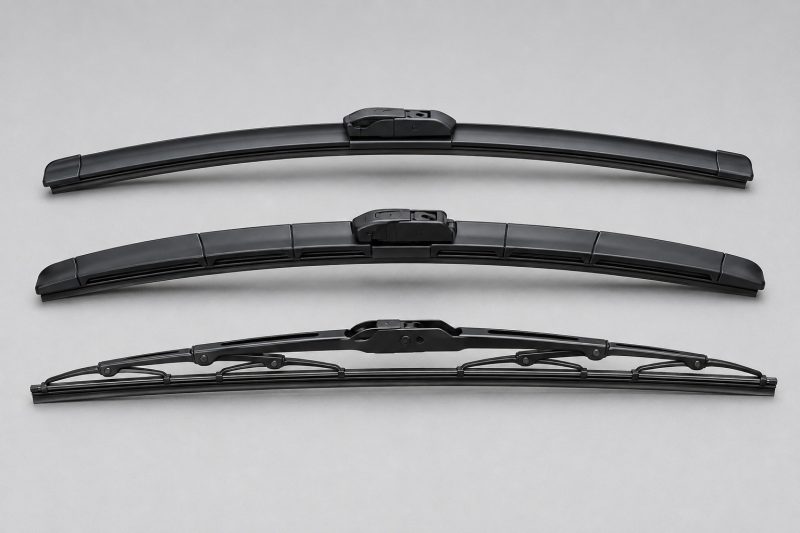
You now see that type selection is an inventory decision, not just a product decision. Let’s examine why B2B buyers must reassess the three types in 2026, how the structures actually differ in performance and cost, which type fits which market scenario, how to balance inventory by region and fleet profile, and the real impact of shifting toward Flat and Hybrid designs.
Why B2B Buyers Must Reassess Wiper Blade Types in 2026
I speak with wholesalers and fleet buyers every month. Many still treat all wiper blades as interchangeable. The cost of that assumption appears in aging stock, return reports, and shrinking contribution margins.
B2B buyers must reassess wiper blade types in 2026 because inventory cost, return rates, customer satisfaction, and net margin are all directly affected by the mix of Flat, Hybrid, and Conventional designs. An unbalanced assortment creates SKU inflation, slow movers, and higher after-sales friction.
Inventory Cost Rises with Poor Matching
Stocking equal volumes of all three types without regard to local vehicle age or climate leaves slow-moving Conventional blades in modern-vehicle markets and under-stocks Flat blades where they are preferred. Capital sits idle.
Return Rates Reflect Performance Gaps
Conventional frames generate more complaints on curved glass and at highway speeds. Flat and Hybrid designs reduce lift, chatter, and incomplete clearing when matched correctly. Higher returns quietly erase purchase-price savings.
Customer Expectations Have Shifted
Drivers of post-2010 vehicles expect quiet, streak-free wiping. Supplying only the lowest-cost Conventional option damages retailer confidence and repeat orders.
SKU Proliferation Without Strategy
Adding every length and connector variant of all three types multiplies complexity. Without a clear role for each type, the catalogue becomes hard to manage and expensive to hold.
Margin Pressure Intensifies
Price competition is fiercest on basic Conventional blades. Flat and Hybrid lines support better retail pricing and lower complaint rates when positioned correctly, protecting overall profitability.
| Reassessment Driver | Business Effect | Risk if Ignored |
|---|---|---|
| Vehicle age mix | Wrong type for the park | Slow stock and returns |
| Climate demands | Performance mismatches | Seasonal complaint spikes |
| Price sensitivity | Over- or under-specifying | Lost margin or lost sales |
| SKU growth | Higher carrying cost | Cash and space pressure |
This table shows why the old “stock everything” approach no longer works. The market has segmented.
My Buyer Conversation Pattern
A regional distributor once told me his Conventional line was his highest-volume item by units. After reviewing return reasons and aging reports he discovered those units also generated the highest service cost. Shifting emphasis toward Flat and Hybrid on modern sizes improved net contribution within two seasons.
Market Reality in 2026
Modern vehicle parks continue to grow. High-speed stability, low noise, and all-weather reliability matter more than they did a decade ago. Buyers who still treat every blade as equal leave money on the table.
The need for reassessment is clear. The next step is understanding the structural differences.
Three Wiper Blade Structures Compared: Design, Performance & Cost
Clear differences in construction drive the performance and cost gaps.
Flat blades use a frameless spring-steel beam for even pressure and high-speed stability. Hybrid blades combine an internal frame with an aerodynamic cover for strong all-weather performance and broad fitment. Conventional blades rely on an exposed multi-point frame and remain the lowest-cost option for older vehicles and price-sensitive markets.
Flat (Beam) Blade Design and Strengths
Flat blades replace the traditional frame with a curved spring-steel structure. Pressure is distributed continuously along the length. Wind lift is low, noise is reduced, and contact stays consistent on modern curved glass. They are the dominant OE style on most post-2010 vehicles.
Hybrid Blade Design and Strengths
Hybrid blades keep an internal metal frame for structure and add a full aerodynamic spoiler cover. The cover improves high-speed stability and helps shed snow and ice. Multi-adapter systems on Hybrid platforms often achieve 90–95% vehicle coverage with fewer base SKUs.
Conventional Blade Design and Limitations
Conventional blades use an exposed bracket frame with multiple pressure points. They are simple and inexpensive to produce. On modern curved glass the limited pressure points can leave streaks. At highway speeds they are more prone to lift and noise. Exposed metal also collects ice more readily.
Cost and Lifespan Snapshot
Conventional blades usually carry the lowest unit cost and shorter service life (often 6–12 months). Quality Flat and Hybrid blades cost more to buy but commonly deliver 12–24 months or longer of usable performance when matched to the application.
| Factor | Flat (Beam) | Hybrid | Conventional |
|---|---|---|---|
| Structure | Frameless spring beam | Internal frame + spoiler cover | Exposed multi-point frame |
| High-speed stability | Excellent, low lift | Very good | Moderate to weak |
| Even pressure on curved glass | Strong | Strong | Limited (6–8 points) |
| Snow/ice behavior | Good | Excellent | Vulnerable to buildup |
| Typical noise level | Low | Low to moderate | Higher potential |
| Unit cost | Medium to higher | Medium | Lowest |
| Typical service life | 12–24+ months | 12–24 months | 6–12 months |
| Best multi-adapter coverage | Good | Often 90–95% | Variable |
This table gives a direct side-by-side view. Each type has a clear role.
Practical Performance Notes
Flat blades excel where quietness and high-speed clearing matter most. Hybrid blades offer the best all-weather compromise and inventory flexibility. Conventional blades remain relevant where price dominates and vehicles are older.
Quality Variables That Affect Returns
Rubber compound, coating, cold flexibility, and adapter reliability influence real-world complaint rates more than the basic structure alone. Premium versions of Flat and Hybrid consistently show lower return rates than basic Conventional units when correctly applied.
The structural differences are clear. The next question is which type fits which market.
Market-Scenario Recommendations: Matching Blade Type to Climate, Vehicle Age & Price Sensitivity
One mix does not fit every territory. Matching type to local conditions controls both performance complaints and inventory aging.
Match Flat blades to modern vehicles and high-speed or rainy markets, Hybrid blades to mixed fleets and cold or all-season regions, and Conventional blades to older vehicles and strongly price-sensitive segments. Correct matching reduces returns and improves sell-through.
Warm or Mild Climates with Modern Vehicles
Flat blades are the preferred choice. Even pressure and low wind lift deliver quiet, streak-free performance on post-2010 cars. High-speed stability is valued on freeways and expressways.
Cold, Snowy, or Fully Seasonal Climates
Hybrid blades usually perform best. The aerodynamic cover helps manage snow and ice while the internal structure maintains strength. They also support broad multi-adapter coverage for mixed fleets.
Older Vehicle Parks and Budget Markets
Conventional blades still hold a logical place. Lower unit cost matches price expectations, and many older vehicles have flatter glass that tolerates multi-point frames adequately.
Mixed or Emerging Markets
A higher Hybrid share often works well. One Hybrid platform with multi-fit adapters can cover a large percentage of both newer and older vehicles while limiting SKU growth.
Fleet and Commercial Profiles
Fleets that operate newer vehicles benefit from Flat or Hybrid standardization. Fleets with mixed or older assets may keep a Conventional core for cost control and add Hybrid for the newer units.
- Prioritize Flat for modern passenger cars in developed markets.
- Lean on Hybrid for all-weather reliability and SKU efficiency.
- Retain Conventional for budget and older-vehicle demand.
- Adjust ratios by actual vehicle age data in each territory.
- Review climate-driven return patterns seasonally.
These guidelines keep the assortment aligned with real demand.
Regional Illustration
In a territory dominated by post-2015 vehicles and frequent highway driving, a 60–70% Flat + Hybrid mix is common. In a market with many pre-2010 vehicles and strong price focus, Conventional may still represent half or more of volume.
Decision Filter
Ask three questions for each major customer segment: What is the average vehicle age? What is the dominant climate stress? How price-sensitive is the buyer? The answers point to the correct primary type.
Matching prevents waste. Inventory strategy turns the matching into numbers.
Inventory Strategy: How to Balance the Three Types by Region and Fleet Profile
A deliberate ratio by region and customer type keeps stock lean and relevant.
Balance inventory by assigning Flat blades to modern high-speed segments, Hybrid blades to mixed and all-weather needs with multi-adapter efficiency, and Conventional blades to older and budget segments. Use multi-fit systems to limit total SKUs while covering mainstream demand.
Developed Markets with Young Vehicle Parks
Target 50–70% Flat, 20–40% Hybrid, and a limited Conventional share. Focus Flat on the highest-volume modern sizes. Use Hybrid multi-adapters to cover residual fitment needs without adding many SKUs.
Mixed or Emerging Markets
Raise Hybrid share to 40–60%. The combination of all-weather performance and broad adapter coverage reduces the number of separate Conventional and Flat variants required.
Older Fleet or Strongly Price-Driven Regions
Keep Conventional as the volume base (often 40–60%). Add Hybrid for customers who want better winter or quiet performance. Introduce Flat selectively on the newest vehicles.
Multi-Adapter Role in SKU Control
Hybrid and universal Flat designs with multi-fit adapters allow one length to serve many arm types. Distributors commonly consolidate dozens of model-specific SKUs into a handful of length variants while still covering the majority of passenger and light-commercial vehicles.
Review Cadence
Re-examine the mix every six to twelve months using sell-through, aging, and return data by type. Adjust ratios before slow movers accumulate.
- Map vehicle age and climate by territory.
- Set target percentages for each blade type.
- Standardize on multi-fit adapters for Flat and Hybrid cores.
- Limit Conventional to proven budget demand.
- Track turns and returns by type and adjust quarterly.
These steps convert product knowledge into controlled inventory.
Practical SKU Outcome
Operators who apply multi-adapter Hybrid and Flat platforms often report significant reductions in total wiper SKUs while improving coverage of current vehicles. Capital and warehouse space are released for higher-velocity items.
Fleet-Specific Note
Large fleets benefit from standardizing on one primary type (usually Flat or Hybrid) for the bulk of the fleet and keeping a small Conventional buffer only if older assets remain significant.
Strategy sets the direction. Real-world results confirm the value.
Real-World Impact: How Switching Toward Flat/Hybrid Cuts SKUs and Lifts Margins
The commercial gains appear when the mix is adjusted with data.
Switching emphasis toward Flat and Hybrid blades, supported by multi-fit adapters, typically reduces total SKUs, lowers performance-related returns, improves inventory turns, and supports higher average margins compared with a Conventional-heavy assortment.
SKU Simplification
Replacing many single-fit Conventional variants with multi-adapter Flat and Hybrid lengths cuts the number of active items. Warehouse complexity and replenishment effort decline.
Return Rate Improvement
Better high-speed stability and more even pressure reduce complaints about lift, chatter, and streaking on modern vehicles. Fitment accuracy from multi-adapters further lowers wrong-product returns.
Margin and Pricing Power
Flat and Hybrid blades support stronger retail pricing than basic Conventional units. When returns stay controlled, net contribution per unit rises.
Faster Turns on Core Items
Sales concentrate on a smaller set of high-relevance SKUs. Aging stock decreases and cash cycles more quickly.
Customer and Retailer Satisfaction
Retail partners receive products that match current vehicle expectations. Complaint volume drops and reorder confidence rises.
| Impact Area | Conventional-Heavy Mix | Flat/Hybrid-Focused Mix |
|---|---|---|
| Typical SKU count | High | Significantly lower |
| Performance return risk | Higher on modern vehicles | Lower |
| Average margin potential | Thin | Stronger |
| Inventory turns | Slowed by aging stock | Faster on core range |
| Retailer confidence | Mixed | Higher |
This table summarizes the observed commercial differences. The shift is most profitable when guided by local vehicle and climate data.
My Observed Transition Results
Wholesalers who moved their top-volume modern sizes from Conventional to Flat or Hybrid while keeping multi-fit coverage reported both lower return rates and improved gross margin within one to two seasons. The key was measuring results by type rather than treating all blades as equal.
Controlled Test Path
Begin with the highest-volume lengths. Introduce Flat or Hybrid versions alongside existing Conventional stock. Compare sell-through, returns, and net margin for one full season. Expand the better-performing type and reduce the weaker one.
For proven Flat and Hybrid platforms that support efficient inventory strategies, explore the Topex flat wiper blade category and the Topex hybrid wiper blade category. You can also review specific models such as the Topex T-PRO-F one-piece spoiler and the T-PRO-HC custom hybrid for practical options that combine performance with multi-fit flexibility.
Conclusion
For B2B buyers and wholesalers, the choice between Flat, Hybrid, and Conventional wiper blades is no longer just a product decision—it is an inventory and margin decision. Flat blades dominate modern vehicles and high-speed performance, Hybrid blades deliver the best all-weather balance with broad fitment, and Conventional blades still serve older fleets and price-driven markets. The winners in 2026 will be those who match the mix to local vehicle age, climate, and customer expectations rather than stocking everything equally. Start by reviewing your current SKU aging and return data, then test a focused assortment with low-MOQ samples. A smarter mix reduces inventory pressure, lowers returns, and protects profitability while giving customers the performance they actually need.
Frequently Asked Questions About Flat vs Hybrid vs Conventional Wiper Blades
What are the key performance differences between Flat, Hybrid, and Conventional wiper blades?
Flat blades offer the best high-speed stability and even pressure on modern curved glass. Hybrid blades provide strong all-weather performance and excellent multi-adapter coverage. Conventional blades are the lowest-cost option but show more lift, noise, and ice vulnerability on current vehicles.
Which type should wholesalers prioritize for modern vehicles (2010+) versus older fleets?
Prioritize Flat or Hybrid for post-2010 vehicles. Keep Conventional for older fleets and strongly price-sensitive segments where the lower unit cost matches buyer expectations.
How does climate (cold/snowy vs warm/rainy) affect the ideal inventory mix?
Cold and snowy regions favor higher Hybrid share because of better ice and snow behavior. Warm or mild rainy regions can lean more heavily on Flat blades for quiet, high-speed performance.
Can multi-fit adapters significantly reduce the number of SKUs needed?
Yes. Multi-adapter Hybrid and universal Flat designs commonly allow distributors to consolidate dozens of model-specific SKUs into a small number of length variants while still covering the majority of vehicles.
Which blade type typically delivers the lowest return rates for distributors?
When correctly matched to the vehicle, quality Flat and Hybrid blades usually generate lower performance-related returns than basic Conventional blades on modern glass and at highway speeds.
How should a B2B buyer structure an initial test order to compare the three types?
Select the highest-volume lengths in your market. Order modest quantities of Flat, Hybrid, and Conventional versions for those lengths. Track sell-through, return reasons, and net margin side by side for one season, then adjust the mix according to the data.

--- END ---


