
How to Buy Wholesale Wiper Blades: A Retailer’s Sourcing Guide
Aug 27, 2026
Buying wholesale wiper blades may appear straightforward: choose several popular lengths, compare supplier prices, and place an order before the rainy season. In reality, retailers must balance vehicle coverage, connector compatibility, product quality, shelf space, packaging, inventory turnover, and replenishment speed.
A store can stock the correct blade length but still lose the sale if the adapter does not fit the customer’s vehicle. It can also achieve broad theoretical coverage while tying up too much capital in slow-moving products. The objective is not to stock every available wiper blade. It is to provide dependable coverage for the vehicles customers actually drive.
Retailers should buy wholesale wiper blades by analyzing local vehicle applications, selecting an appropriate mix of conventional, flat, hybrid, OE-specific, and rear blades, and controlling stock according to demand. Samples should be tested for fitment and wiping performance before the opening order, while sales, returns, and replenishment data should guide future expansion.
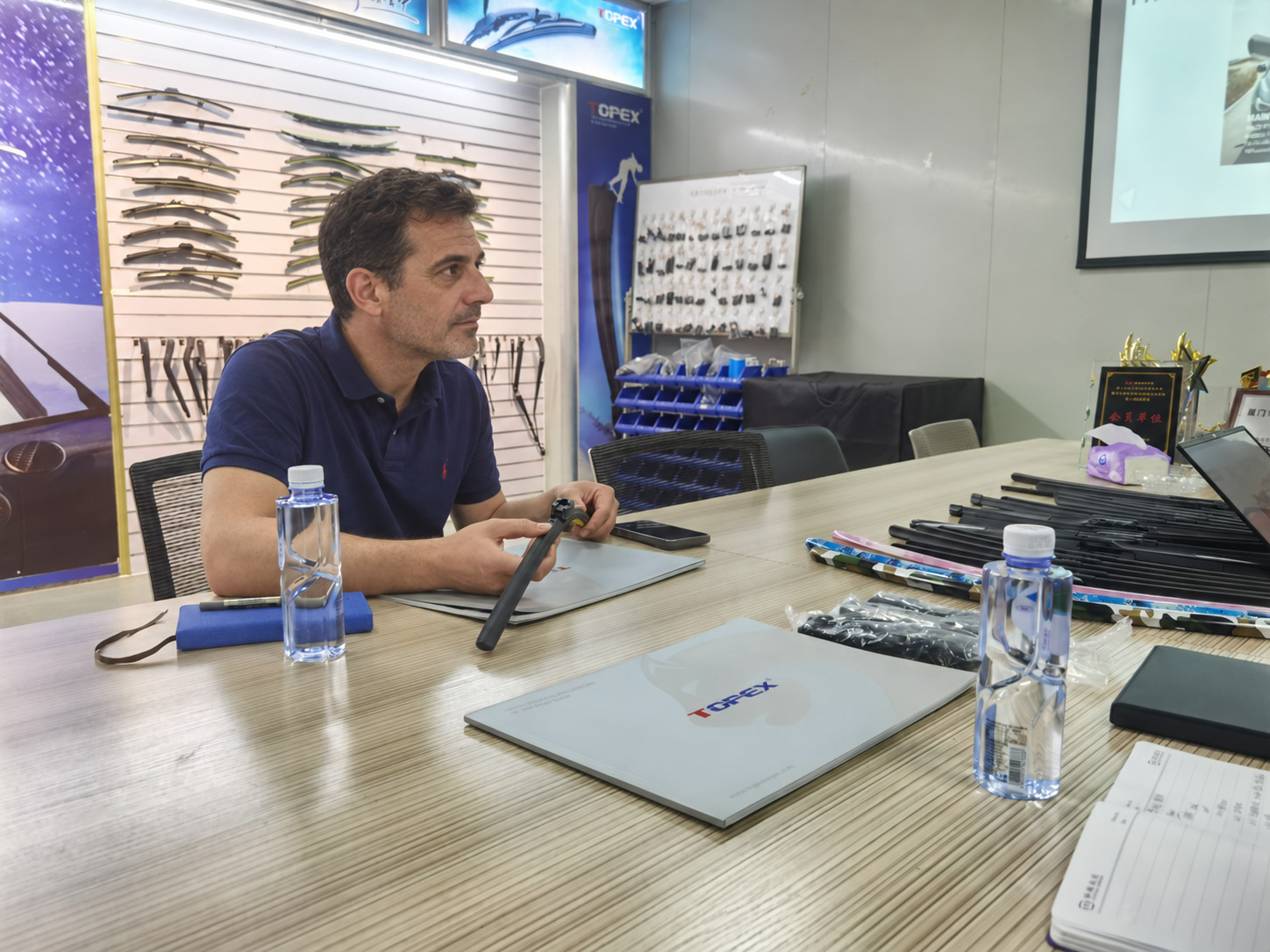
I am Jacky Huang, CEO of Xiamen TOPEX Auto Parts Co., Ltd. When I discuss a new wholesale program with retailers and distributors, I normally begin with their target country, vehicle population, sales channel, and expected price range. These details are more useful than simply asking how many blade models a factory can supply.
A well-planned opening order should provide strong coverage without creating unnecessary inventory pressure. It should also leave enough flexibility to add new applications after the retailer has collected real sales data.
Why Choosing Wholesale Wiper Blades Is More Complex Than It Looks
Every retailer wants sufficient stock when rain or snow increases replacement demand. However, holding more products does not automatically create better availability. Wiper blades vary by structure, length, vehicle position, arm connection, windshield curvature, material, and price level.
Retailers must also consider how customers select products. A professional workshop can identify the arm type before installation, while a self-service retail customer may depend entirely on packaging. An e-commerce customer relies on vehicle filters, product photographs, and installation instructions.
Choosing wholesale wiper blades is complex because retailers must balance vehicle coverage, connector diversity, product quality, retail price, packaging, shelf space, seasonal demand, and replenishment speed. A profitable range must cover common local applications without spreading inventory across too many slow-moving SKUs.
Blade Length Is Only One Part of Fitment
Two vehicles may use the same blade length but require different connectors. Even when a multi-fit adapter can connect to both arms, the installed angle, locking security, or windshield contact may differ.
Important arm systems include:
- U-hook
- Push button
- Pinch tab
- Side pin
- Bayonet
- Top lock
- Narrow push button
- Vehicle-specific rear connections
Retailers should identify the blade position as well. Driver-side, passenger-side, and rear blades often have different sizes or connectors.
| Fitment information | Why the retailer needs it |
|---|---|
| Vehicle make and model | Identifies the application family |
| Model year | Helps distinguish vehicle generations |
| Blade position | Separates driver, passenger, and rear blades |
| Blade length | Prevents incomplete coverage or interference |
| Arm type | Determines the required adapter |
| Product code | Supports shelf selection and reordering |
| Installation guide | Reduces customer and employee errors |
A good supplier should provide structured application information rather than only a list of available lengths.
Product Quality Affects More Than Returns
Wiper blade quality influences the customer’s view of the retailer. A blade that streaks, chatters, lifts, or becomes noisy shortly after installation may create a refund, replacement, negative review, or loss of future business.
Retailers should consider:
- Rubber-edge consistency
- Spring-steel or frame pressure
- Windshield contact
- Connector security
- Noise and chatter
- High-speed stability
- Resistance to local weather
- Packaging protection
- Production consistency
A product with a higher gross margin may still be less profitable if its return rate and customer-service cost are high.
Retail Presentation Influences Product Selection
In a store, packaging is part of the fitment system. Employees and customers need to identify the size, connector, product tier, and application quickly.
Effective retail packaging should make the following information easy to find:
- Brand and product series
- Blade structure
- Length
- Front or rear position
- Compatible arm types
- Vehicle references or fitment method
- Included adapters
- Installation instructions
- Barcode and SKU
- Product benefits
Clear packaging supports shelf replenishment and reduces the risk of a product being returned to the wrong location after customer inspection.
Seasonal Demand Creates Timing Pressure
Retail demand can rise rapidly before or during a rainy season, winter storm, or extended period of bad weather. Last-minute ordering may result in stockouts, expensive air freight, or limited product availability.
Custom packaging and sea freight require additional time. Retailers should therefore use historical sales and local weather patterns to increase core inventory before the season begins.
The Buying Mistakes That Create Slow-Moving Stock and Returns
Many inventory problems begin when retailers select products according to supplier catalogues rather than local demand. A large catalogue can be useful, but it does not show which products deserve shelf space in a particular market.
Another common mistake is choosing only popular lengths. Without connector data, the retailer may stock several 18-, 20-, or 24-inch blades that do not fit the vehicles requesting those sizes.
The buying mistakes that create the most slow-moving stock and returns include selecting products by length alone, accepting unverified coverage claims, comparing only unit prices, ordering large quantities before testing, ignoring rear blades, and failing to check packaging, fitment data, and replenishment lead times.
Buying Popular Sizes Without Checking Arm Types
Length-based purchasing worked more effectively when U-hook arms dominated the market. Modern vehicle populations require a more detailed approach.
For each important length, buyers should estimate demand by connector. A popular 24-inch blade may need several adapter solutions, while another length may sell mainly as an OE-specific product.
The opening SKU list should therefore combine length and connection instead of treating them as separate questions.
Pursuing the Highest Coverage Percentage
A product advertised as covering a very high percentage of vehicles can sound attractive. However, the retailer should ask how the figure was calculated.
Broad coverage does not automatically mean:
- Every model year has been verified.
- All adapters lock equally securely.
- Installation is simple.
- The blade follows every windshield curvature.
- The included instructions cover all connections.
- The online fitment data is accurate.
- Customers will select the correct adapter.
Multi-fit blades can reduce SKU pressure, but coverage should be checked against important local vehicles. A smaller range with reliable fitment may create fewer returns than a broader but poorly documented range.
Comparing Unit Prices Without Normalizing Quotations
One supplier’s quotation may include several adapters and printed packaging, while another price may cover only a basic blade in a sleeve. Before comparing suppliers, retailers should confirm the same specification.
| Price factor | Possible effect on the quotation |
|---|---|
| Blade structure | Conventional, flat, hybrid, or OE-specific products have different costs |
| Rubber specification | Compound and coating affect price and positioning |
| Adapter quantity | Additional connectors increase material and packaging requirements |
| Packaging | Color boxes, blisters, or cards have different costs |
| Branding | Custom printing may require design and setup charges |
| Order quantity | Volume affects production and packaging costs |
| Inspection | Additional testing or third-party inspection adds cost |
| Incoterm | EXW, FOB, and CIF include different responsibilities |
| Payment terms | Credit and deposit arrangements may affect pricing |
Retailers should compare landed cost, expected return cost, and achievable retail margin rather than FOB price alone.
Ordering Large Quantities Before Testing
A low price at a higher quantity can encourage a retailer to place a large opening order. This creates risk when fitment, customer acceptance, packaging, or sales performance has not been verified.
A controlled trial order provides evidence about:
- Sell-through by SKU
- Installation difficulty
- Fitment returns
- Wiping complaints
- Packaging damage
- Customer response to price
- Replenishment requirements
- Supplier communication and delivery
The opening order should test the range—not attempt to satisfy an entire year of demand.
Ignoring Rear Wiper Blades
Rear blades are often treated as a minor category, but SUVs, crossovers, hatchbacks, and estate cars create regular replacement demand. Rear connectors are frequently vehicle-specific, making clear application information especially important.
A focused rear range can increase basket value and support customers who want to replace front and rear blades together. Retailers should identify the most common local rear applications rather than stocking every possible design.
How to Build the Right Wiper Blade Product Mix for Your Store
The correct product mix depends on vehicle age, climate, local customer expectations, price levels, and sales channel. A European e-commerce seller may require detailed OE-style fitment, while an independent store serving older vehicles may need a strong conventional U-hook range.
Retailers should build their wiper blade mix from local vehicle data and divide products into core, growth, and long-tail groups. Conventional blades can serve value and older-vehicle demand, flat and hybrid blades can support modern or higher-value programs, OE-specific products can simplify installation, and rear blades can complete application coverage.
Match Blade Structures to Customer Demand
A balanced retail range can include several structures:
| Blade type | Typical retail role | Main consideration |
|---|---|---|
| Conventional framed | Entry-level and older vehicles | Price competition and broad U-hook demand |
| Flat or beam | Modern and premium aftermarket | Curvature and adapter compatibility |
| Hybrid | Mid-range or performance positioning | Shell quality and pressure distribution |
| OE exact-fit | Application-specific replacement | More SKUs and simpler installation |
| Rear blade | SUVs, hatchbacks, and estate cars | Fragmented vehicle-specific connections |
| Winter blade | Seasonal cold-weather demand | Forecasting and inventory timing |
The TOPEX flat wiper blade range can support retailers requiring modern beam-style products with different adapters and market positions. Buyers serving customers who prefer a protected frame and distinctive appearance can also evaluate the TOPEX hybrid wiper blade range.
The range should reflect customer demand rather than giving equal inventory to every structure.
Use ABC Inventory Classification
ABC classification helps retailers decide which products deserve deeper stock.
- A items: High-volume products covering common local vehicles. These require reliable availability, regular review, and rapid replenishment.
- B items: Moderate-volume or high-potential products. They should be stocked carefully and reviewed for growth.
- C items: Long-tail applications with irregular demand. They can be stocked lightly or supplied through a fast special-order process.
Classification should use actual sales data after launch. A product expected to be an A item may perform differently once customers begin buying.
Balance Multi-Fit and OE-Specific Products
Multi-fit blades help reduce SKU count by using one blade platform with several adapters. They can work well in wholesale, retail, and e-commerce programs when the application data and instructions are accurate.
OE-specific products may require more SKUs, but they offer advantages:
- Fewer loose adapters
- More direct installation
- Familiar OE-style appearance
- Greater customer confidence
- Clearer vehicle-specific listings
Many retailers benefit from combining both approaches. Multi-fit products can provide broad baseline coverage, while OE-specific blades serve popular vehicles where installation simplicity justifies dedicated inventory.
Plan Inventory by SKU, Not Total Quantity
A quotation showing 5,000 blades does not explain the inventory risk. The retailer needs to know how those units are distributed across lengths, connectors, and product tiers.
A practical opening plan should record:
- Product code
- Blade type
- Length
- Adapter
- Vehicle coverage
- Opening quantity
- Reorder point
- Supplier lead time
- Target retail price
- Expected margin
- Actual weekly sales
This information makes it easier to identify stockouts and slow-moving products before they become expensive.
How TOPEX Helps Retailers Improve Coverage and Inventory Efficiency
Retailers need a supplier that supports both the physical product and the information required to sell it. A competitive blade without dependable application data, packaging, or replenishment support can still create inventory problems.
At TOPEX, I begin new retail projects by discussing the buyer’s target market, channel, price range, climate, and important vehicles. The goal is to create a focused opening range rather than automatically offering every available SKU.
TOPEX supports retailers through multiple blade structures, application and adapter information, private-label packaging, controlled trial-order planning, product and installation content, and market-focused SKU recommendations. These services help retailers improve relevant coverage without creating unnecessary inventory.
Product Range and Fitment Support
A retail program may combine flat, hybrid, conventional, OE exact-fit, rear, winter, and other specialized products. We can discuss which categories are most relevant to the buyer’s market and price structure.
Important planning information includes:
- Target country
- Vehicle makes and model years
- Local arm types
- Required blade lengths
- Front and rear demand
- Retail price tiers
- Packaging format
- Quantity by SKU
- Seasonal deadlines
- Replenishment expectations
A range should be wide enough to meet customer demand but simple enough for staff and customers to understand.
Private-Label and Retail Content
Retail packaging can be customized according to brand and channel requirements. Depending on the project, support may include:
- Logo and brand colors
- Printed boxes, cards, sleeves, or blister packaging
- Product tier identification
- Length and adapter labeling
- Barcodes and SKUs
- Installation diagrams
- Carton labels
- Product photographs
- Online descriptions
- Application information
Packaging files should be approved only after the product, adapters, and fitment claims are finalized.
The TOPEX 2026 flat wiper blade buying guide also provides additional information for buyers comparing products and market requirements.
Trial Orders and Replenishment Planning
A trial order allows retailers to evaluate product performance, package clarity, application accuracy, customer response, and supplier service.
After launch, I recommend sharing structured results such as:
- Sales by SKU
- Incorrect-fit returns
- Wiping complaints
- Installation questions
- Package damage
- Fast-moving lengths
- Stockouts
- Slow-moving items
- Customer price response
This information helps adjust the next order and improve inventory efficiency over time.
A Practical Checklist Before Placing Your Wholesale Order
A wholesale order should be based on a clear retail plan. The buyer should know which applications are being targeted, how products will be displayed or listed, and how performance will be measured after launch.
Before ordering, retailers should analyze local vehicle demand, create a SKU plan, request comparable quotations and samples, test fitment and wiping performance, approve packaging and barcodes, calculate landed cost, launch a controlled quantity, and use sales and return data to plan replenishment.
Wholesale Purchasing Checklist
- Identify common local vehicles and model years.
- Confirm driver, passenger, and rear-blade requirements.
- List the main blade lengths and arm types.
- Choose the required product structures and price tiers.
- Divide SKUs into core, growth, and long-tail groups.
- Request quantity-based quotations using the same specification.
- Confirm MOQ by model, length, and package.
- Obtain representative samples.
- Test adapters, installation, windshield contact, and wiping.
- Review vehicle application data.
- Approve packaging, labels, instructions, and barcodes.
- Calculate landed and expected return costs.
- Confirm production and replenishment lead times.
- Place a controlled opening order.
- Inspect products after arrival.
- Track sales and returns by SKU.
- Increase core inventory before seasonal demand.
- Expand the range according to verified results.
Prepare for the Rainy or Winter Season
Retailers should establish baseline stock and increase important SKUs before predictable demand periods. The exact timing depends on supplier production, packaging, freight method, customs clearance, and local distribution.
Seasonal planning should include:
- Previous-year sales
- Weekly sell-through
- Current inventory
- Open purchase orders
- Supplier lead time
- Shipping time
- Reorder point
- Safety stock
- Local weather patterns
- Promotional schedule
During severe weather, stores should monitor sales more frequently. A monthly review may be too slow when demand changes within several days.
Measure Results After Launch
The retailer should evaluate more than revenue. Useful measurements include:
| Retail measurement | What it reveals |
|---|---|
| Sell-through by SKU | Which products deserve more stock |
| Stockout frequency | Whether reorder points are too low |
| Inventory age | Which products are becoming slow-moving |
| Fitment returns | Possible data or adapter problems |
| Performance complaints | Possible quality or application issues |
| Gross margin | Profitability before other costs |
| Return-adjusted margin | More realistic product performance |
| Reorder interval | Actual replenishment demand |
| Front-and-rear attachment rate | Opportunity to increase basket value |
These results should determine the next order. Market claims and supplier recommendations are useful starting points, but actual retail data provides the strongest evidence.
Conclusion
Buying wholesale wiper blades successfully requires the right balance of vehicle coverage, product quality, inventory depth, and retail presentation. Retailers should begin with local vehicle data and actual replacement demand rather than purchasing every available size or choosing the lowest quotation.
Samples must be checked for adapter fit, windshield contact, wiping quality, and installation simplicity. Packaging should communicate length, connector, product tier, and compatibility clearly at the point of sale.
A controlled opening order allows the retailer to measure sell-through, returns, customer feedback, and replenishment needs before expanding the range. The best wholesale supplier is therefore not simply the one offering the lowest unit price. It is the partner that helps the retailer maintain availability, reduce incorrect-fit returns, support customers, and replenish profitable SKUs reliably.
Frequently Asked Questions About Wholesale Wiper Blades
What types of wiper blades should retailers stock?
Most retailers need a combination of conventional, flat, hybrid, OE-specific, and rear blades. The exact mix depends on the age and structure of the local vehicle population, climate, customer price expectations, and sales channel. Winter or specialty products may also be necessary in specific markets.
How many wiper blade SKUs does an auto parts store need?
There is no universal number. A store should stock enough SKUs to cover high-demand local applications without spreading inventory too thinly. Core products need deeper stock, moderate-demand products can have smaller quantities, and long-tail applications may be handled through rapid replenishment or special orders.
How can retailers reduce incorrect-fit wiper blade returns?
Use accurate make-model-year data, confirm blade position and length, identify the arm type, provide clear adapter instructions, and train staff to check fitment before installation. Packaging, shelf labels, and online listings should use the same product and application information.
What determines the wholesale price of wiper blades?
Price depends on blade structure, materials, rubber specification, adapters, packaging, branding, order quantity, testing, payment terms, and Incoterms. Buyers should compare equivalent specifications and calculate landed cost rather than selecting a supplier from unit price alone.
Should retailers buy universal or OE-specific wiper blades?
Many retailers benefit from stocking both. Multi-fit products can provide broad coverage with fewer SKUs, while OE-specific blades can offer simpler installation and stronger customer confidence for popular applications. The correct balance depends on vehicle demand and available shelf space.
When should stores increase inventory before the rainy season?
The order should be placed early enough to cover production, custom packaging, transportation, customs clearance, and local distribution. Retailers should work backward from the expected start of seasonal demand and use previous sales data, supplier lead time, and safety-stock requirements to set the ordering date.

--- END ---


