
OE Exact-Fit vs. Universal Wiper Blades: Which Is Better for Your Vehicle?
Oct 23, 2026
Choosing replacement wiper blades requires more than matching the length printed on the package. The blade must also connect securely to the wiper arm, sit at the intended height and angle, follow the windshield curvature, and distribute pressure evenly throughout the sweep.
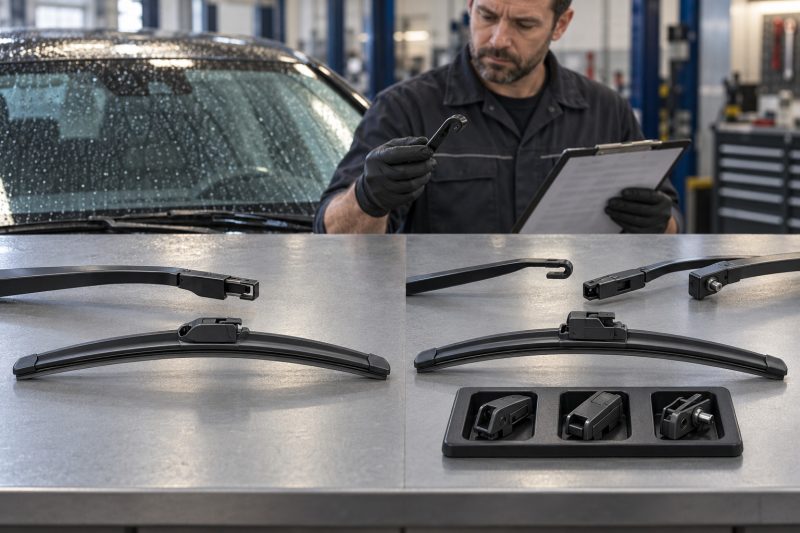
OE exact-fit blades use application-specific connectors or profiles designed for defined vehicles. Universal—more accurately described as multi-fit—blades use a shared blade platform with one or more adapters to cover several arm types. Both formats can provide reliable wiping, but their installation methods, appearance, vehicle coverage, inventory requirements, and fitment risks are different.
An OE exact-fit blade is usually more convenient when the vehicle uses a specialized connector or the driver wants an original-style replacement. A high-quality universal blade can deliver excellent value when its application catalogue confirms the exact vehicle, length, arm type, and adapter. The correct choice depends on verified fitment and wiping performance rather than the label alone.
I am Jacky Huang, CEO of Xiamen TOPEX Auto Parts Co., Ltd. Through my work with wiper blade development, vehicle applications, OEM and private-label projects, I have seen good and poor examples of both formats. The connector design is important, but rubber quality, spring tension, windshield conformity, and manufacturing consistency ultimately determine whether the installed blade performs reliably.
Why a Wiper Blade That Fits the Arm May Still Wipe Poorly
A blade can connect to the wiper arm without being fully compatible with the vehicle. Physical attachment is only one part of fitment. The installed blade must also maintain the correct orientation, contact the complete windshield surface, remain stable at road speed, and clear the intended viewing area.
A universal adapter may technically attach to the arm but produce excessive height, movement, or an incorrect operating angle. A dedicated connector can also perform badly if the blade body has unsuitable curvature or poor pressure distribution.
Connector Engagement Does Not Confirm Windshield Contact
The connector transfers pressure and movement from the arm into the blade. Once installed, the complete product must follow the windshield as the arm moves through its sweep.
Poor conformity may cause:
- Missed areas near the blade ends
- Excessive pressure at the centre
- Repeated streaks in one section
- Chattering during directional changes
- Smearing across the driver’s view
- Blade lift at highway speed
- Uneven wear along the rubber edge
A stationary blade may look correct while parked. These problems often become visible only during a wet operational test.
Adapter Height Can Affect Aerodynamics
A multi-fit adapter sometimes sits higher than an integrated exact-fit connector. The added height may be acceptable for many vehicles, but it can affect appearance or aerodynamic stability in certain applications.
Possible consequences include:
- Increased exposure to airflow
- Vibration at higher vehicle speeds
- A profile that looks different from the original blade
- Reduced clearance around the arm or bonnet
- Movement between the adapter and arm
- Wind noise or unstable wiping
The effect depends on the vehicle and adapter design. Buyers should evaluate the installed product instead of assuming that every universal adapter creates the same result.
Spring Curvature Must Match the Windshield
Beam blades use curved spring-steel elements to distribute pressure. Conventional and hybrid blades use supporting frames or combined tension systems. If that pressure system does not suit the glass, the connector alone cannot correct the problem.
| Fitment condition | Can the blade attach? | Is good wiping assured? |
|---|---|---|
| Correct length but wrong connector | No | No |
| Correct connector but incomplete locking | Possibly | No |
| Secure connector but unsuitable curvature | Yes | No |
| Correct fit but poor rubber edge | Yes | No |
| Verified application and complete glass contact | Yes | More likely |
| Verified application plus successful wet test | Yes | Confirmed for the tested conditions |
A blade should therefore be evaluated as a complete system rather than as a connector attached to a piece of rubber.
The Biggest Misunderstandings About Exact-Fit and Universal Wipers
The terms OE, OEM, exact fit, universal, and multi-fit are often used loosely. Understanding their actual meaning helps buyers avoid unsupported assumptions.
OE Exact-Fit Does Not Necessarily Mean Genuine OEM
OE exact-fit usually describes vehicle-specific fitment. An aftermarket manufacturer can produce a blade with the correct length, connector, profile, and pressure characteristics for a defined vehicle.
Genuine OEM normally refers to a part supplied through or produced for the vehicle manufacturer. The two terms should not be used interchangeably.
| Product term | Typical meaning | What it does not automatically prove |
|---|---|---|
| OE exact-fit | Application-specific aftermarket replacement | Genuine automaker branding |
| Genuine OEM | Supplied through or for the vehicle manufacturer | Best value or longest service life |
| Aftermarket | Sold outside the vehicle manufacturer’s parts network | Inferior quality |
| Universal | Designed for multiple applications | Compatibility with every vehicle |
| Multi-fit | Shared blade platform using adapters | Verified performance on every listed arm |
The TOPEX guide to OE, OEM, and aftermarket wiper blades explains why buyers should examine the actual product and application rather than relying on terminology alone.
Universal Does Not Mean Every Vehicle
Universal generally means that the blade covers multiple applications. It may include several adapters or use a connector that can be configured for different arm designs.
The blade still needs the correct:
- Length
- Driver, passenger, or rear position
- Wiper-arm family
- Connector dimensions
- Adapter code
- Installation orientation
- Windshield curvature
- Vehicle model year
- Regional application
Push-button, J-hook, side-pin, top-lock, bayonet, and other connector families often contain several dimensions or locking variations. One adapter does not necessarily cover every version within a connector family.
Exact Fit Does Not Guarantee Product Quality
An integrated connector may simplify installation, but it does not prove that the product will wipe quietly or last longer.
Exact-fit blade quality still depends on:
- Rubber compound
- Wiping-edge precision
- Spring-steel specification
- Pressure distribution
- Spoiler or cover design
- Adapter and connector strength
- Assembly consistency
- Climate resistance
- Production change control
A well-engineered universal blade can outperform an exact-fit product made with inconsistent materials or unsuitable spring curvature.
Product Labels Cannot Replace Fitment Data
The same vehicle model may use different blade sizes or connectors across production years, generations, body variants, and sales regions. Driver- and passenger-side blades may also have different lengths.
Rear blades require separate verification because their compact arm connections are frequently more vehicle-specific than the front system.
How OE Exact-Fit and Universal Wiper Blades Differ
The clearest difference is how the blade connects to the vehicle. OE exact-fit blades generally use a dedicated connector designed for a narrow group of applications. Universal blades use a common blade body with interchangeable or configurable adapters.
OE Exact-Fit Blades Reduce Installation Decisions
An exact-fit connector is normally integrated into or pre-installed on the blade. The installer identifies the correct vehicle application, removes the old blade, and connects the replacement directly.
Potential benefits include:
- Fewer loose components
- Faster installation
- Lower risk of selecting the wrong adapter
- Profile closer to the original blade
- Cleaner visual integration
- Clear vehicle-specific packaging
- More direct instructions
This approach is particularly useful for modern vehicles with specialized push-button, top-lock, side-lock, pinch-tab, or OE-specific connections.
The main commercial limitation is inventory complexity. A distributor may need several connector-specific product codes to cover the same group of blade lengths.
Universal Blades Consolidate Vehicle Coverage
A universal or multi-fit blade uses one platform across several arm types. The package may contain multiple adapters, or the pre-installed connector may be adjustable.
Potential benefits include:
- More vehicle coverage from fewer base products
- Lower SKU count
- Easier stocking of secondary applications
- Greater retail availability
- Reduced inventory investment
- Flexible wholesale assortment planning
The main challenge is adapter selection. The installer must identify the arm, choose the correct component, orient it properly, and verify that it locks completely.
Side-by-Side Comparison
| Comparison point | OE exact-fit | Universal or multi-fit |
|---|---|---|
| Connector design | Dedicated or integrated | Shared platform with adapters |
| Installation steps | Usually fewer | May require adapter selection and assembly |
| Installed profile | Often close to the original | May sit higher or look different |
| Vehicle coverage per SKU | Narrower | Broader |
| Number of SKUs required | Higher for broad coverage | Lower |
| Dependence on application data | Very high | Very high |
| Additional data required | Vehicle and position | Vehicle, position, and adapter mapping |
| Retail availability | Depends on exact SKU stock | Often easier to maintain |
| Price positioning | Often mid-range or premium | Economy to premium |
| Main selection risk | Wrong exact-fit application | Wrong application or adapter |
| Installer training | Usually simpler | More important |
| Packaging | Vehicle-specific information | Adapter matrix and several instructions |
Neither Format Automatically Wipes Better
Both formats may use conventional, beam, or hybrid blade structures. Exact fit describes the connection and application more than the construction of the wiping system.
Two blades with different connector strategies can use similar rubber and spring materials. Conversely, two products carrying the same exact-fit label can perform very differently because of their manufacturing quality.
The TOPEX flat wiper blade range includes products for different connection and application requirements. Each blade should still be evaluated for adapter retention, windshield contact, noise, and wiping quality.
Availability Affects the Ownership Experience
An exact-fit blade can offer the simplest installation, but it provides little value if the correct SKU is not available locally. A multi-fit blade may be easier to find because a retailer can stock fewer products while covering more vehicles.
Vehicle owners should therefore consider both first installation and future replacement availability.
Which Wiper Blade Type Is Better for Your Vehicle?
There is no universal answer. The correct choice depends on the vehicle’s connector, original blade design, driver expectations, local availability, and quality of the available products.
Choose OE Exact-Fit for Specialized Connections
An OE exact-fit blade is often the better starting point when:
- The vehicle has a specialized connector.
- The original blade has a distinctive low-profile design.
- The owner wants an appearance close to the original equipment.
- Installation simplicity is a priority.
- The arm has limited clearance around the bonnet or trim.
- The vehicle uses overlapping front blades.
- A dedicated product is readily available.
- The application has been verified for the exact model year.
Exact fit may also be preferable for workshops that service a predictable group of popular vehicles and value repeatable installation.
Choose a Verified Universal Blade for Broader Availability
A universal or multi-fit blade can be a strong choice when:
- The vehicle uses a common arm interface.
- The manufacturer’s catalogue confirms the application.
- The exact adapter is supplied and clearly identified.
- Price and availability are important.
- The adapter locks securely without excessive height.
- The blade maintains the correct angle.
- Wet testing confirms complete windshield contact.
- The driver accepts a profile that may differ from the original.
Universal products are particularly useful for retailers, distributors, and service centres that need broad coverage without stocking every connector-specific SKU.
Consider the Buyer’s Priorities
| Buyer priority | Likely better starting point | Reason |
|---|---|---|
| Original-style appearance | OE exact-fit | Dedicated connector generally matches the original profile |
| Fast installation | OE exact-fit | Fewer adapter decisions |
| Lower retail price | Verified multi-fit | Shared platforms can improve cost efficiency |
| Easy local availability | Multi-fit | Fewer SKUs can cover more vehicles |
| Specialized connector | OE exact-fit | More direct application-specific solution |
| Broad fleet coverage | Multi-fit or combined range | Helps control inventory complexity |
| Premium replacement | Either format | Quality and performance matter more than the label |
| Online purchase | Either with accurate data | Vehicle and adapter records must be clear |
| Workshop productivity | Exact fit for popular vehicles | Faster repeat installation |
| Long-tail applications | Verified multi-fit | May reduce slow-moving inventory |
A Combined Strategy Is Often Strongest for B2B Buyers
Distributors do not always need to choose one format for their entire range. A practical assortment may use multi-fit blades for common connectors and core lengths, then add OE exact-fit products for high-volume vehicles with specialized connections.
This approach can balance:
- Vehicle coverage
- SKU count
- Shelf space
- Installation simplicity
- Product availability
- Customer confidence
- Inventory turnover
- Return risk
The TOPEX hybrid wiper blade range can also support applications where buyers want a covered structure and a profile closer to certain original blade designs.
Compare Total Value Instead of Purchase Price
A universal blade with a low unit price may create additional support and return costs if its adapter system is confusing. An exact-fit range may create dead stock when too many vehicle-specific SKUs are ordered without demand data.
B2B buyers should compare:
- Landed cost
- Fitment accuracy
- Installation time
- Return frequency
- Warranty claims
- Inventory turnover
- Packaging requirements
- Catalogue maintenance
- Customer-support workload
- Return-adjusted margin
The better commercial option is the one that creates reliable fitment, acceptable availability, and sustainable profit.
A Final Fitment and Performance Check Before You Drive
Catalogue compatibility should always be followed by a physical and operational inspection. A listing can direct the buyer to the correct product, but installation confirms whether every part of the system works together.
Confirm the Complete Vehicle Identity
Before purchasing either format, verify:
- Sales country or region
- Vehicle make and model
- Model year
- Generation or production period
- Body style or variant
- Left- or right-hand-drive configuration
- Driver- or passenger-side position
- Front or rear placement
- Blade length
- Wiper-arm connection
- Connector dimensions
- Required adapter code
Do not purchase two identical blades unless the catalogue specifically confirms the same size for both front positions.
Inspect the Original Connection
Before removing the old blade, examine:
- Arm shape
- Hook or flat-arm width
- Pin diameter
- Release button or side tabs
- Connector cover
- Installation direction
- Blade angle
- Original profile
- Clearance around the arm
Take photographs from several angles if the connector cannot be identified confidently. Follow the vehicle manufacturer’s instructions because some wipers must be placed in a service position before the arms can be lifted.
Check the Adapter Before Installation
For a universal blade, compare the adapter code with the vehicle application. Confirm that the correct component is fitted in the right direction.
Never force, cut, bend, drill, or tape an incompatible adapter.
The connector should:
- Engage through the specified movement
- Produce the expected click or lock
- Allow its cover to close completely
- Hold the blade at the intended angle
- Resist a gentle pull
- Prevent excessive sideways movement
- Release only through the intended mechanism
An exact-fit connector should undergo the same physical checks even if no separate adapter selection is required.
Test on a Wet Windshield
Lower the blades carefully onto the glass and wet the windshield before activating the system. Observe several cycles at normal and higher wiping speeds.
Confirm that:
- Both connectors remain fully locked.
- The blades do not move inside their adapters.
- The driver and passenger blades do not collide.
- The blades remain within the glass boundary.
- The rubber maintains contact throughout the sweep.
- No section repeatedly remains uncleared.
- The blades operate without chatter, skipping, or scraping.
- The structure remains stable at directional changes.
- Both blades return to the correct parked position.
If the blade performs poorly, inspect the glass, rubber, adapter, installation, arm pressure, and product curvature before assuming that the entire product category is unsuitable.
At TOPEX, I recommend that wholesale and private-label buyers validate representative lengths, adapters, and vehicle applications before approving a complete range. One successful sample cannot confirm every SKU, connector, and windshield shape.
Conclusion
OE exact-fit wiper blades are usually the more convenient option for vehicles with specialized connectors or for drivers who want a replacement that closely matches the original profile and installation method.
Universal or multi-fit blades can still provide excellent value and wiping performance when the manufacturer’s application catalogue confirms the vehicle, blade length, arm type, and required adapter. They can also help retailers and distributors maintain broader coverage with fewer core products.
Neither label guarantees quality by itself. Rubber formulation, spring tension, windshield conformity, adapter retention, aerodynamic stability, and manufacturing consistency remain equally important.
Before purchasing, verify the complete vehicle application and test the installed blades on a wet windshield. The better blade is the one that locks securely and clears the glass consistently—not simply the one labelled “OE” or “universal.”
Frequently Asked Questions About Exact-Fit and Universal Wiper Blades
What is an OE exact-fit wiper blade?
An OE exact-fit blade is an application-specific replacement designed for a defined vehicle, arm connection, or group of compatible models. It normally uses an integrated or pre-installed connector and may reproduce the original blade’s profile and installation method. The vehicle year and blade position must still be verified.
Are OE exact-fit blades the same as genuine OEM wipers?
No. OE exact-fit describes vehicle-specific compatibility, while genuine OEM normally refers to a part supplied through or manufactured for the vehicle manufacturer. An independent aftermarket supplier can produce an exact-fit blade without it being a genuine automaker-branded component.
Do universal wiper blades fit every vehicle?
No. Universal generally means multi-application. The blade uses one or more adapters to cover a stated group of wiper arms. Buyers must still verify the vehicle, model year, blade position, length, connector family, connector dimensions, and required adapter.
Are exact-fit wiper blades easier to install?
They usually are because the intended connector is integrated or pre-installed. The user does not need to select and assemble a separate adapter. However, straightforward installation still depends on choosing the correct exact-fit application and following the product and vehicle instructions.
Can universal blades perform as well as exact-fit blades?
Yes. A high-quality universal blade can provide equally effective wiping when its adapter fits securely and its structure conforms to the windshield. Rubber quality, spring tension, edge precision, aerodynamic design, and manufacturing consistency matter more than the fitment label alone.
How can I verify that a universal adapter fits my wiper arm?
Confirm the vehicle application and adapter code in the manufacturer’s catalogue. Compare the original arm’s shape and dimensions with the instructions, then install the adapter without forcing it. It should lock completely, resist a gentle pull, remain correctly oriented, and perform securely during a wet-windshield test.

--- END ---
Prev: Wiper Blade Connector Types Explained: How to Choose the Right Fit
Already the latest article


