Commercial Fleet Wiper Blades: A Sourcing Guide for Maintenance Buyers
Nov 11, 2026
Commercial fleets depend on clear visibility to keep vehicles operating safely and on schedule. Whether a fleet includes delivery vans, pickups, long-haul trucks, city buses or coaches, a failed wiper blade can create consequences that extend far beyond the cost of the replacement part.
A blade that does not fit correctly may delay maintenance, require an emergency purchase or leave a vehicle unavailable during poor weather. A product with inconsistent durability can also increase workshop visits and technician labor across hundreds of vehicles. Fleet buyers should therefore evaluate commercial wiper blades as maintenance components rather than inexpensive consumables.
The sourcing process should begin with the fleet’s actual vehicle population, operating environment and replacement history. Buyers can then verify applications, test representative samples and build a controlled supply program around the products that provide reliable coverage and repeatable performance.
Why the Cheapest Wiper Blade Can Increase Fleet Maintenance Costs
Unit price is easy to compare, but it represents only one part of the fleet’s total maintenance cost. A lower-priced blade may become more expensive when it requires frequent replacement, takes longer to install or creates unexpected vehicle downtime.
The real cost of a commercial wiper blade may include:
- Product purchase and inbound freight
- Technician installation time
- Vehicle inspection and scheduling
- Removal and disposal of failed blades
- Emergency replacement purchases
- Vehicle downtime
- Fitment-related returns
- Warranty administration
- Driver complaints
- Inventory carrying costs
For example, a fleet may save a small amount on each blade but lose that saving when technicians need additional time to identify adapters or correct poor installation instructions. If the blade fails early, the fleet pays for another product and repeats the labor.
A more useful comparison is the cost per vehicle over a defined service period. Buyers can compare the number of replacements, labor hours, failures and emergency purchases associated with each product.
A simple fleet cost calculation can include:
Total maintenance cost = product cost + installation labor + downtime cost + emergency purchasing + warranty handling + unusable inventory
This approach does not mean that the most expensive blade will always perform best. It means that the product should be assessed by its measurable contribution to maintenance efficiency.
Fitment errors are operational costs
An incorrect blade length or connector can leave a vehicle occupying a workshop bay while technicians search for another part. The problem becomes more serious when the vehicle is scheduled for a delivery route or passenger service.
A fitment error may also create hidden costs:
- The technician opens packaging that can no longer be returned.
- The purchasing team must identify an alternative product.
- A vehicle receives only one new blade instead of a complete pair.
- The workshop begins keeping several unofficial substitutes.
- Drivers report repeated wiping problems.
- Inventory records become unreliable.
These costs make accurate application data particularly important for mixed fleets.
Service-life consistency matters more than one strong sample
A sample may perform well when first installed but fail to represent repeated production. Fleet buyers need consistent materials, assembly and performance across multiple batches.
Variations in rubber compounds, spring steel, adapter resin, coatings or assembly tolerances can change:
- Wiping-edge durability
- Windshield contact
- Noise
- Resistance to heat or cold
- Connector retention
- Corrosion behavior
- Replacement intervals
A dependable supplier should control these variables and notify the buyer before changing critical materials, tooling, sub-suppliers or production processes.
The Common Sourcing Mistakes Fleet Buyers Should Avoid
Ordering from a generic description
Descriptions such as “truck wiper,” “bus blade” or “heavy-duty wiper” do not identify a precise application. They say nothing about the required length, connector, windshield position or arm design.
Commercial vehicles may use:
- J-hook or U-hook arms
- Bayonet connections
- Side pins
- Bolt-on connections
- Saddle-style fittings
- Flat-arm systems
- Vehicle-specific connectors
Even vehicles from the same manufacturer may use different systems across model years, cab designs and regional versions. Buyers should request accurate vehicle application data instead of relying on a product category name.
Selecting blades by length alone
Blade length is necessary, but it does not confirm fitment. A replacement must also match the arm interface, installation direction, blade position and windshield geometry.
Two 28-inch blades may differ in:
- Connector type
- Hook width
- Pin diameter
- Adapter height
- Frame curvature
- Spoiler orientation
- Pressure distribution
- Structural strength
A blade that attaches loosely or sits at the wrong angle can chatter, lift or leave a missed area. Buyers can review common wiper blade connector types and fitment requirements before approving a commercial application.
Assuming every vehicle from one brand uses the same blade
A fleet may operate several trucks carrying the same manufacturer’s badge but built on different platforms. Model years, cab configurations and windshield designs can change the wiper requirements.
Vehicle identity should include:
- Manufacturer
- Model
- Model year
- Generation
- Cab or body version
- Sales region
- Driver-side or passenger-side position
- Original blade or part reference
The safest method is to map individual vehicle platforms rather than create one application for an entire brand.
Buying too many slow-moving specifications
Attempting to cover every theoretical vehicle application can create excessive inventory. Commercial blades may have lower unit sales than popular passenger-car sizes, and uncommon connectors can remain unused for years.
Fleet buyers should first identify:
- The largest vehicle groups
- The most frequently replaced applications
- Vehicles operating in severe conditions
- Products with long replenishment times
- Applications without local alternatives
- Blades that can safely cover several verified platforms
Low-volume specifications can be purchased in controlled quantities or sourced through an agreed replenishment program.
Approving the easiest sample
Testing one short blade on a convenient van does not prove that longer truck or bus applications will perform correctly. Longer blades can reveal pressure-distribution, end-contact and structural problems that remain hidden on smaller products.
A representative sample set should cover:
- Short, medium and long commercial lengths
- Driver-side and passenger-side applications
- The main connector families in the fleet
- Split and panoramic windshields
- High-mileage vehicles
- Severe operating environments
- Different blade structures included in the proposed order
Ignoring supply continuity
A commercially acceptable blade is of limited value if the supplier cannot maintain stock, repeat the approved construction or deliver within the required maintenance cycle.
Before placing an order, buyers should confirm:
- Production lead time
- Minimum order quantity
- Mixed-SKU ordering options
- Common-SKU availability
- Forecast requirements
- Emergency replenishment procedures
- Packaging lead times
- Annual price arrangements
- Change-notification requirements
Supply reliability should be assessed alongside product quality.
How to Map Your Fleet Before Selecting Wiper Blades
Fleet mapping converts vehicle information into a practical purchasing plan. Without this step, buyers may purchase products that appear suitable on paper but do not correspond to the actual vehicle population.
| Purchasing information | Details to confirm | Effect on the sourcing decision |
|---|---|---|
| Vehicle type | Van, pickup, truck, city bus or coach | Helps determine the probable product structure and operating load |
| Vehicle details | Make, model, year, generation and cab version | Prevents fitment assumptions within the same vehicle brand |
| Blade position | Driver, passenger, rear or split-windshield position | Defines the complete blade combination required per vehicle |
| Blade length | Inches and millimeters | Supports specification matching and inventory planning |
| Arm connection | Hook, bayonet, pin, bolt-on or OE-specific interface | Determines the connector or adapter requirement |
| Operating environment | Urban, highway, hot, snowy, dusty or coastal | Influences material, coating and weather-resistance priorities |
| Vehicle utilization | Annual mileage, shifts and operating hours | Supports replacement-frequency estimates |
| Maintenance method | In-house workshop or outsourced service | Affects packaging, training and delivery requirements |
| Fleet quantity | Number of vehicles on each platform | Determines SKU demand and safety-stock levels |
| Replacement history | Installation date, failure reason and service life | Helps compare actual maintenance cost |
Create a vehicle-level master list
Begin with the fleet asset register. Add one row for each vehicle or group identical vehicles by verified platform.
The record should connect each platform to:
- Driver-side blade
- Passenger-side blade
- Rear blade where applicable
- Connector or adapter
- Approved product SKU
- Installation guidance
- Current stock level
- Annual replacement demand
If a fitment field is uncertain, mark it as pending rather than completing it by assumption.
Inspect representative vehicles
Vehicle records are useful, but physical inspection is important when catalog information is incomplete or inconsistent. Maintenance teams should examine the original blade and arm connection on representative vehicles.
Record:
- The blade length from end to end.
- The arm-end shape and dimensions.
- The installation direction.
- The locking mechanism.
- The blade’s resting position.
- The windshield curvature.
- The clearance between the two blades.
- Any vehicle-specific spoiler or connector design.
Photographs should include the complete blade, exposed arm end, connector from several angles and any original part number.
Separate high-volume and high-risk applications
The largest vehicle group normally deserves the highest purchasing priority, but quantity is not the only consideration. A smaller group of vehicles may create greater operational exposure if it operates continuously or lacks readily available replacement parts.
Classify applications according to:
- Number of vehicles
- Replacement frequency
- Operational importance
- Local product availability
- Lead time
- Fitment complexity
- Environmental exposure
- Historical failure rate
This classification determines which samples should be tested first and which SKUs require higher safety stock.
Estimate annual consumption
Historical records provide the best starting point. When records are unavailable, use a conservative initial estimate and refine it after the trial period.
Annual demand should account for:
- Number of vehicles using the SKU
- Blades required per vehicle
- Expected replacement frequency
- Seasonal demand
- Damage or emergency replacements
- New vehicles entering the fleet
- Vehicles scheduled for disposal
Avoid applying one replacement interval to every application. A city bus operating long shifts in frequent rain may consume blades differently from a delivery van used occasionally.
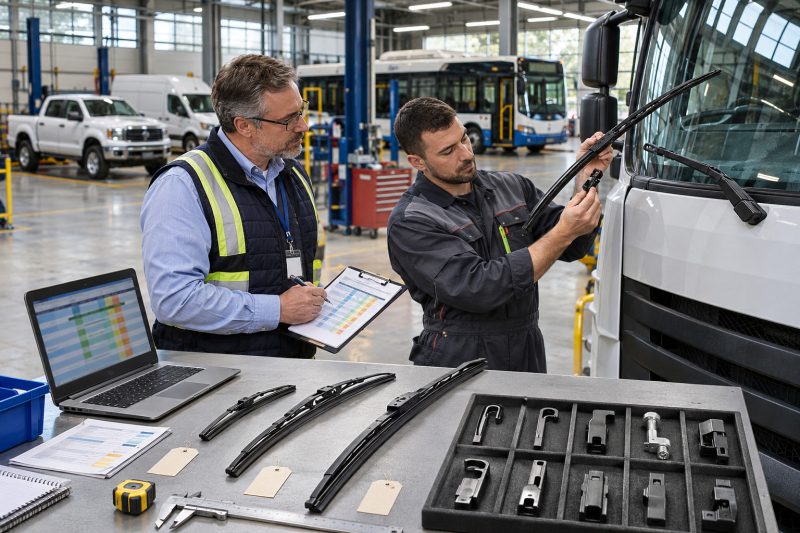
[Image Placeholder: Fleet maintenance manager comparing a vehicle list, commercial wiper blade sizes, arm connectors and physical samples inside a truck and bus workshop]
What to Test in Commercial Fleet Wiper Blade Samples
A sample should be tested on the vehicle platform for which it is being considered. Bench inspection can identify visible problems, but it cannot confirm windshield contact or operational fitment.
Confirm the sample identity
Before installation, record:
- Supplier and product model
- Nominal length
- Measured length
- Blade structure
- Rubber or wiping-element specification
- Connector and adapter
- Production batch
- Manufacturing date
- Packaging version
- Vehicle application
This information allows the team to reproduce the test and compare future shipments with the approved product.
Inspect materials and assembly
Look for:
- Damaged or uneven wiping edges
- Loose end caps
- Bent frames
- Poorly seated spring strips
- Adapter movement
- Sharp edges or molding flash
- Coating damage
- Corrosion
- Missing components
- Inconsistent blade curvature
The connector should operate without excessive force and remain securely attached to the blade.
Verify physical fitment
Install the sample using the same instructions and tools available to fleet technicians. Confirm that it:
- Matches the correct arm.
- Enters in the specified direction.
- Locks fully into position.
- Resists a gentle retention check.
- Does not interfere with the arm or trim.
- Remains correctly oriented.
- Can be removed without damaging the connector.
If an adapter is required, record its code directly in the vehicle application file and workshop instructions.
Perform a controlled wet-windshield test
Clean the windshield before testing. Oil, dirt, wax, damaged coatings and glass defects can create wiping symptoms unrelated to the blade.
Operate the wipers with washer fluid or a consistent water application and observe:
- Fine streaks
- Cloudy smearing
- Wide missed areas
- End lift
- Mid-blade gaps
- Judder at direction changes
- Chattering
- Squeaking
- Contact with trim
- Contact between blades
- Movement at the connector
The blade should maintain stable contact through the complete sweep. A broad missed area may indicate poor curvature or pressure distribution rather than a damaged wiping edge.
Commercial fleets evaluating low-profile structures for applicable vehicles can compare options within the TOPEX flat wiper blade range. Product structure should still be selected according to verified vehicle fitment rather than appearance alone.
Test representative operating conditions
Not every fleet can reproduce laboratory environments, but practical field trials should reflect normal operations.
Depending on the fleet, evaluation may include:
- Highway driving
- Repeated urban operation
- Heavy rain
- Low-temperature starting
- Heat and UV exposure
- Dusty routes
- Coastal or salt-exposed environments
- Frequent washing
- Extended daily shifts
High-speed stability is particularly important for long blades. The test should identify lifting, vibration and loss of contact at representative vehicle speeds.
Record installation time
A blade that performs well but takes excessive time to identify and install may still increase fleet costs. During the trial, record:
- Time required to identify the correct blade
- Time required to select the adapter
- Installation time
- Need for special tools
- Frequency of installation mistakes
- Technician questions
- Packaging or instruction problems
Clear adapter numbering and position labeling can reduce workshop time across repeated replacements.
Assess the supplier behind the sample
A strong sample does not prove production consistency. Supplier evaluation should include process control, traceability and replenishment capability.
| Evaluation area | Questions fleet buyers should ask |
|---|---|
| Fitment accuracy | Can the supplier provide data by vehicle, year, position and arm interface? |
| Product consistency | Will rubber, steel, connectors and coatings remain consistent across repeat orders? |
| Sample testing | Can representative lengths and connector systems be supplied? |
| Production control | Are incoming, in-process and finished-product inspections documented? |
| Traceability | Can a batch number identify the production date, materials and inspection record? |
| Replenishment | What are the lead times, stock arrangements and emergency supply options? |
| Packaging | Can technicians identify the SKU, length, connector and position quickly? |
| Warranty support | How are early failures, fitment errors and batch complaints handled? |
| Change control | Will the buyer receive written notice before critical materials are changed? |
| Commercial terms | How are MOQ, mixed SKUs, annual pricing and supply agreements structured? |
For mixed fleets that require additional protection around a supporting frame, buyers may also evaluate products from the TOPEX hybrid wiper blade range, provided the required commercial applications have been confirmed.
How to Launch a Controlled Fleet Supply Program
A fleet-wide conversion should not begin with the largest possible order. A controlled program gives maintenance teams time to verify fitment, service life, workshop efficiency and supply reliability.
Start with core vehicle platforms
Select applications that represent:
- The largest number of vehicles
- The highest blade consumption
- The greatest downtime exposure
- The most common connectors
- The most demanding operating conditions
A practical first order may contain several high-volume SKUs instead of attempting to cover every fleet vehicle immediately.
Establish a documented approval standard
The approved sample should become a controlled reference. Record the:
- Blade model and length
- Connector or adapter
- Rubber specification
- Structural design
- Finish and coating
- Packaging
- Labeling
- Installation instructions
- Fitment applications
- Wiping-performance criteria
Retain a signed golden sample where practical. Require written approval before the supplier changes critical materials, connectors, manufacturing locations or packaging.
Track field performance
Each installation should generate useful maintenance data. At minimum, record:
- Vehicle identification
- Blade position
- Product SKU
- Installation date
- Vehicle mileage
- Technician
- Removal date
- Mileage at removal
- Failure mode
- Weather or operating conditions
- Warranty action
Failure descriptions should be specific. “Bad blade” provides little value; “driver-side tip lift after three months” or “adapter movement on a particular truck platform” is actionable information.
Measure more than service life
Important performance indicators include:
- Average installation time
- Successful first-time fitment rate
- Early failure rate
- Average service interval
- Driver complaint frequency
- Emergency replacement frequency
- Warranty response time
- Stockout frequency
- Cost per vehicle
- Downtime associated with wiper replacement
These measures allow buyers to compare suppliers on operational value rather than price alone.
Set safety stock by risk
Safety stock should not be identical for every SKU. Consider:
- Average monthly consumption
- Supplier lead time
- Demand variability
- Seasonal weather
- Vehicle criticality
- Availability of approved substitutes
- Minimum order quantity
- Risk of shipment delay
High-use products with long replenishment times require a larger buffer. Low-volume blades with verified local alternatives may need less inventory.
A basic reorder calculation can use:
Reorder point = expected consumption during lead time + safety stock
The calculation should be updated after the fleet collects enough actual consumption data.
Standardize only after validation
SKU consolidation can simplify purchasing and technician training. Multi-fit products may cover several vehicle platforms with fewer base blades, but consolidation must follow application testing.
Before replacing several dedicated SKUs with one multi-fit product, verify:
- Every vehicle application
- Every required adapter
- Connector locking
- Installation direction
- Windshield contact
- Sweep clearance
- Driver and passenger positions
- Performance under normal fleet conditions
A theoretical coverage percentage is not enough for fleet approval.
Prepare an emergency supply plan
Even a well-managed fleet can experience unexpected damage, severe weather or delivery delays. The supply program should define:
- Approved alternative SKUs
- Local emergency sources
- Supplier-held inventory
- Expedited-order procedures
- Minimum emergency quantities
- Contact persons
- Maximum response times
The goal is to prevent maintenance teams from fitting unverified substitutes simply because the approved product is unavailable.
Review the program regularly
Conduct scheduled reviews using purchasing, workshop and driver data. Each review should identify:
- SKUs with repeated failures
- Applications with installation difficulty
- Products with excessive inventory
- Frequent stockouts
- Unverified substitutes
- New vehicles entering the fleet
- Vehicles being retired
- Changes in supplier lead time
- Opportunities for safe SKU consolidation
Products should remain in the program because they provide fitment coverage, acceptable service life and reliable supply—not because they appeared in the original order.
Conclusion
Sourcing wiper blades for commercial fleet maintenance should begin with the fleet’s actual vehicles, operating conditions and maintenance workload—not with a generic heavy-duty catalog. Buyers should map each vehicle platform by year, windshield position, blade length, arm connection and expected annual usage before selecting products.
Representative samples should then be installed and tested on the vehicles that create the greatest operational exposure. The final decision should consider fitment accuracy, wiping performance, replacement frequency, installation time, supply continuity and warranty support alongside unit price.
A controlled trial covering the fleet’s highest-volume applications allows maintenance teams to collect real service data before expanding the program. This approach helps reduce emergency purchases, unnecessary SKU proliferation and avoidable vehicle downtime.
Frequently Asked Questions
What should fleet buyers consider when sourcing commercial wiper blades?
Fleet buyers should verify the exact vehicle application, blade position, length, arm connection, windshield design and operating environment. They should also compare installation time, service life, batch consistency, lead time, traceability and warranty support—not only unit price.
Are truck and bus wiper blades different from passenger-car blades?
They may be longer or use different frames, connectors and pressure-distribution systems, but there is no single universal commercial-blade design. Every application should be confirmed according to the vehicle and complete wiping system.
How can fleet managers verify wiper blade fitment?
Use vehicle-specific application data and inspect the existing blade and arm. Representative samples should be installed on actual vehicles and checked for secure locking, sweep clearance, windshield contact, noise and wet wiping.
Should fleets stock complete blades or replacement refills?
Complete blades are easier to standardize because they replace the wiping element, supporting structure and connector together. Refills may be economical where the original blade supports replaceable inserts and the frame, rails and connector remain serviceable. Refill profiles must be matched precisely.
How much safety stock should a fleet keep for wiper blades?
The amount depends on consumption, lead time, seasonality, vehicle criticality and the availability of approved alternatives. High-use SKUs with long lead times generally require more safety stock than uncommon applications with reliable local substitutes.
How should fleets compare wiper blade suppliers and prices?
Compare the total maintenance cost per vehicle or service interval. Include product price, freight, installation labor, service life, early failures, emergency purchases, downtime, warranty handling and inventory performance. A slightly higher-priced product may provide lower operating costs when its fitment, consistency and supply reliability are stronger.

--- END ---