How to Reduce Wiper Blade Fitment Returns and Prevent Lost Sales
Nov 12, 2026
Wiper blade fitment errors create two different commercial problems. The first is visible: a customer receives a blade that cannot be installed or does not perform correctly, leading to a return, replacement request or complaint. The second is less visible: incomplete application data prevents a compatible product from appearing in search results, so the customer leaves without ordering.
Both problems reduce return-adjusted profit. Incorrect recommendations increase freight, customer-service and inventory-handling costs, while missing applications allow sales to move quietly to competitors. Solving the problem requires more than publishing a basic vehicle list. Distributors need controlled fitment records connecting each vehicle application to the correct blade position, length, connector, adapter and product SKU.
The same approved information must then remain consistent across websites, marketplaces, printed catalogs, packaging, warehouse systems and customer-service tools.
Why Fitment Errors Cost More Than the Return Itself
The refund is only the most visible cost of a fitment return. By the time the product reaches the warehouse again, the business may have paid for outbound freight, return shipping, customer support, inspection, repackaging and marketplace fees.
The complete cost may include:
- Refunds or replacement products
- Outbound and return freight
- Customer-service time
- Warehouse inspection and repacking
- Missing or damaged adapters
- Discounting of opened packages
- Marketplace penalties
- Negative reviews
- Reduced trust in the vehicle finder
- Lost repeat purchases
If the packaging has been damaged or the blade has been installed, the returned product may no longer be saleable as new. A relatively inexpensive blade can therefore create a loss several times greater than its original purchase cost.
Fitment errors also affect related sales. A customer who cannot find the correct passenger-side blade may abandon the driver-side purchase. An unavailable rear application may prevent the sale of a complete vehicle set. In these cases, one missing or incorrect record affects more than one SKU.
False-Positive and False-Negative Fitment
A reliable fitment program must address both types of error:
- False-positive fitment: The catalog recommends a product that does not fit the vehicle. This usually produces a return, complaint or installation-support request.
- False-negative fitment: A compatible product exists, but the system does not display it. The customer sees no result and buys elsewhere.
False positives are easier to measure because a transaction and return record exist. False negatives are harder to quantify because the customer may disappear without contacting the business.
Distributors should therefore monitor more than return rates. Useful signals include:
- Vehicle searches producing no result
- High-volume vehicle searches with low conversion
- Customer questions about unlisted applications
- Repeated requests for the same model year
- Front-blade sales without an available rear blade
- Product pages with high traffic but few completed orders
- Marketplace messages asking whether a product fits
- Abandoned searches after connector information is shown
A fitment database should support both cost reduction and sales growth. The objective is not simply to prevent incorrect recommendations but also to reveal every verified product that can serve the customer.
The Fitment Mistakes That Keep Causing Wiper Blade Returns
Using Blade Length as the Primary Fitment Rule
Blade length is necessary, but it cannot confirm complete compatibility. Two blades with the same nominal length may use different connectors, profiles, pressure structures or adapters.
A 24-inch J-hook blade is not automatically interchangeable with a 24-inch push-button blade. Even when a multi-fit adapter allows the blade to attach, the installed height, angle and windshield contact may differ.
Length-only selection can create:
- A connector that cannot engage
- An adapter that locks incompletely
- Poor windshield conformity
- End lift
- Contact with trim
- Interference between front blades
- Incorrect spoiler orientation
- Reduced wiping coverage
Ignoring the Vehicle Generation and Production Period
A model name may remain unchanged while the vehicle platform, windshield or wiper-arm system changes. Fitment records should identify the generation and production period rather than relying only on a broad year range.
Mid-year changes are particularly risky. A manufacturer may introduce a new connector during a facelift while maintaining the same model name. A record that lists only the calendar year may recommend the old product for vehicles manufactured after the change.
When possible, the application should include:
- Starting production month and year
- Ending production month and year
- Vehicle generation or platform
- Relevant facelift information
- Body style or derivative
- Regional model code
Mixing Driver, Passenger and Rear Positions
The driver-side and passenger-side blades frequently use different lengths. Rear blades often use entirely different connectors and compact molded structures.
A fitment record that lists “26/18 inches” without identifying the corresponding sides can cause warehouse, customer and installation errors. Each position should have its own controlled application row.
Position-specific data becomes even more important in left-hand-drive and right-hand-drive markets. “Driver side” should not be automatically interpreted as the physical left side of the vehicle.
Treating Connector Family Names as Complete Specifications
Terms such as J-hook, push button, side pin, bayonet and top lock describe connector families. They do not necessarily identify the exact dimensions or locking variation.
For example, visually similar connectors may differ in:
- Hook width
- Button width
- Pin diameter
- Arm thickness
- Entry direction
- Locking-tab location
- Adapter height
- Release mechanism
The connector should be supported by photographs, dimensions or a verified adapter reference. Buyers and product teams can use this guide to common wiper blade connection types when reviewing application data.
Copying Fitment Data Between Markets
Vehicles sold under the same name in different countries may use different blade sizes, connectors or rear-wiper designs. Differences can result from local production, right-hand-drive versions, model-year timing or regional specifications.
A North American application should not automatically be copied into a European, Asian or Latin American database. The sales market must be a required fitment field.
Assuming Multi-Fit Means Universal
Multi-fit blades can simplify inventory by using several adapters with one blade platform. However, “multi-fit” does not mean that every supplied adapter fits every vehicle.
Each application still requires verification of:
- Correct blade length
- Installation position
- Arm type
- Connector dimensions
- Required adapter
- Adapter orientation
- Locking security
- Windshield curvature
- Sweep clearance
An adapter may physically connect to an arm while producing poor blade alignment or unstable wiping. Coverage claims must therefore be based on the complete installed system.
Allowing Different Channels to Use Different Records
A distributor may correct the website but leave the old application in a marketplace listing, printed catalog or customer-service spreadsheet. The same return then reappears through another channel.
Common data conflicts include:
- Website and packaging showing different adapters
- Catalog and marketplace listing different model years
- Customer service using an outdated spreadsheet
- Warehouse labels using an old SKU
- Product images showing a connector that is no longer supplied
- Printed instructions referencing a discontinued adapter
One controlled master database should supply every sales and support channel.
How to Build and Verify Accurate Wiper Blade Fitment Data
A dependable fitment record connects the vehicle, blade position, physical connection and product SKU in one controlled row. Separating these fields across unrelated files increases the risk of incomplete updates.
| Data field | Information to record | Common error |
|---|---|---|
| Sales market | Country or defined sales region | Assuming global vehicle specifications are identical |
| Vehicle identity | Make, model, generation and body style | Recording only the model name |
| Production period | Starting and ending year or month | Missing a facelift or mid-year change |
| Blade position | Driver, passenger or rear | Providing sizes without defining positions |
| Blade length | Inches and millimeters | Reversing driver and passenger blades |
| Arm connection | J-hook, top lock, side pin, push button or another type | Confirming length without checking the arm |
| Adapter code | Required adapter and installation orientation | Supplying an adapter without clear identification |
| Product SKU | Exact saleable blade number | Linking the vehicle to a similar product |
| Verification source | Vehicle test, OE reference or trusted database | Copying unverified supplier information |
| Review status | Reviewer, date and data version | Correcting data without retaining revision history |
Establish One Master Source
The master record should control every application published by the business. Websites, marketplaces, packaging systems and customer-service tools should receive information from this source rather than maintaining independent fitment tables.
Each update should record:
- The previous value
- The corrected value
- Reason for the correction
- Evidence used
- Person who approved it
- Effective date
- Affected channels
- Packaging or inventory impact
Version history prevents old records from being reintroduced during a bulk upload or website migration.
Start with Supplier Data, but Do Not Stop There
Supplier application data can provide an efficient starting point. High-volume, uncertain or commercially important applications should also be checked against an independent source.
Possible evidence includes:
- A vehicle-specific OE reference
- A reliable regional fitment database
- The original blade and wiper arm
- A second established aftermarket catalog
- A physical installation on the target vehicle
- A documented application report
When sources disagree, the record should remain unapproved until the difference is resolved. Selecting the most convenient answer creates avoidable risk.
Verify the Physical Blade and Adapter
The database should be connected to the product that will actually be shipped. A supplier may update the adapter, connector housing or blade structure without updating the application file.
A production-representative sample should be installed to confirm that it:
- Connects without forcing or modifying the arm
- Uses the specified adapter
- Locks completely
- Resists a gentle retention check
- Sits in the intended orientation
- Remains within the glass boundary
- Avoids contact with the other blade and surrounding trim
- Maintains contact throughout the sweep
- Can be removed using the documented procedure
A wet-windshield test should then check for streaking, missed areas, chatter, noise and end lift. The windshield must be clean so that contamination is not mistaken for a blade defect.
Modern vehicles may require different product structures according to windshield curvature and OE design. Distributors can compare options within the TOPEX flat wiper blade range, but each application still requires individual verification.
Use Clear Verification Statuses
Not every application carries the same level of evidence. A status system helps prevent provisional data from being published as confirmed fitment.
Suggested statuses include:
- Vehicle-tested: Installed and operationally tested on the specified vehicle
- Physical-reference verified: Compared with an OE blade, arm or approved sample
- Independently cross-checked: Confirmed by two reliable data sources
- Supplier-confirmed: Supported by supplier data but not independently tested
- Pending: Evidence is incomplete or conflicting
- Rejected: The product was reviewed or tested and found incompatible
Only records meeting the company’s approval threshold should be released to customers.
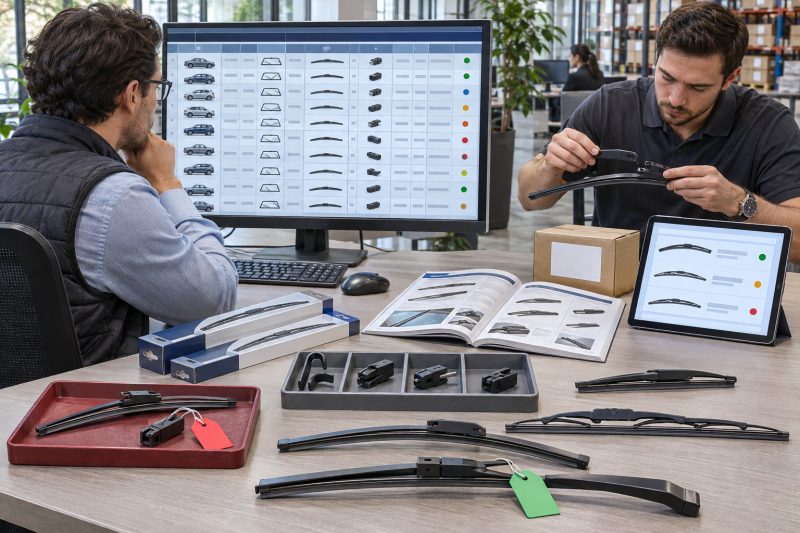
[Image Placeholder: Distributor comparing vehicle fitment records, wiper-arm connectors, adapters and physical blades before updating an online catalog]
How Product Pages, Packaging and Installation Support Prevent Wrong Orders
Accurate internal data cannot prevent returns if the customer cannot understand the application before purchasing. Product pages and packaging should help buyers confirm the vehicle, position and connector without relying on assumptions.
Show Essential Fitment Information Together
A product page should clearly display:
- Compatible make and model
- Vehicle generation
- Production period
- Relevant sales market
- Driver, passenger or rear position
- Blade length in inches and millimeters
- Arm connection
- Required adapter code
- Package contents
- Product SKU
- Important exclusions
- Installation instructions
Do not hide essential fitment information inside a long downloadable file. The customer should be able to confirm the application close to the purchase button.
Use Accurate Connector Photographs
Connector images help customers recognize the physical arm more easily than technical names alone. Useful photographs should show:
- The exposed wiper-arm end
- The adapter from several angles
- The release button or locking tab
- The correct entry direction
- The blade after installation
- The adapter code printed on the component
Images must represent the exact product and adapter supplied. A generic connector photograph copied from another range can increase confusion.
Explain Package Contents
Customers need to know whether the package includes:
- One blade or a pair
- A pre-installed adapter
- Several loose adapters
- A rear blade
- Installation instructions
- Protective components that must be removed
If several adapters are provided, identify each one clearly. Numbering on the physical adapter should match the product page, packaging and instructions.
Keep Packaging Synchronized with Fitment Data
Packaging errors can continue causing returns after a digital listing has been corrected. Before printing or reordering packaging, confirm the:
- SKU
- Blade size
- Installation position
- Connector information
- Included adapters
- Application claims
- Barcode
- Instructions
- QR-code destination
- Language
- Revision number
Packaging artwork should carry a controlled file number and approval date. When fitment changes, the business must determine whether existing packaging can be relabeled or must be withdrawn.
Add Product-Specific Installation Support
Installation instructions should show the exact connector and adapter. A generic video demonstrating a J-hook is not useful to a customer who purchased a push-button application.
A practical installation guide should show:
- Identification of the original arm
- Selection of the required adapter
- Removal or installation of the adapter
- Correct blade orientation
- Engagement of the locking feature
- A gentle retention check
- Safe lowering of the wiper arm
- Wet-windshield testing
Short videos can reduce installation mistakes, but they must remain linked to the correct product version.
For applications where a covered supporting structure matches the intended vehicle and market position, buyers may also review the TOPEX hybrid wiper blade range. Product-page claims should still identify the exact supported vehicles and connectors.
Give Customer-Service Teams the Same Information
Support representatives should not depend on separate spreadsheets. Their interface should display:
- Current approved applications
- Verification status
- Connector and adapter images
- Installation instructions
- Known exclusions
- Replacement SKUs
- Revision history
When an application cannot be confirmed, the representative should request the model year, body style, blade position and arm photograph instead of guessing.
How to Turn Returns and Customer Questions into Better Fitment Data
A general return reason such as “does not fit” is too broad to support corrective action. It may describe a wrong length, incompatible connector, missing adapter, installation problem or product-performance issue.
| Customer feedback | Possible root cause | Recommended action |
|---|---|---|
| Wrong size | Incorrect year, position or length record | Recheck the application and driver/passenger assignment |
| Connector does not fit | Incorrect arm or adapter mapping | Review connector photographs, dimensions and adapter code |
| Adapter missing | BOM, packaging or warehouse-picking error | Correct package contents and outgoing inspection |
| Difficult to install | Unclear instructions or confusing adapter identification | Add diagrams, video and visible adapter numbering |
| Blade fits but leaves gaps | Curvature, pressure or structural problem | Conduct a controlled vehicle wiping test |
| Wrong front or rear product | Position data is missing or unclear | Create position-specific application records |
| Item not as described | Product page, image or packaging conflict | Synchronize all channels to the approved version |
Create Specific Return Categories
Fitment-related problems should be separated from product defects and customer preferences.
Recommended categories include:
- Wrong vehicle application
- Wrong model year
- Wrong blade length
- Incorrect installation position
- Incompatible connector
- Incorrect adapter
- Missing adapter
- Installation difficulty
- Poor windshield contact
- Wiping-performance defect
- Transport damage
- Customer ordered incorrectly
- Product description mismatch
This classification makes recurring patterns visible.
Collect Enough Evidence
A confirmed fitment investigation should capture:
- Sales market
- Vehicle make and model
- Model year
- Generation or body type
- Driver, passenger or rear position
- Ordered SKU
- Adapter used
- Photograph of the arm
- Photograph of the original blade
- Photograph or video of the installation attempt
- Description of the problem
- Production batch where relevant
A complaint stating only “does not fit my car” should not automatically trigger a database correction. The application must first be identified.
Separate Installation Problems from Data Problems
A correct blade may be returned because:
- The wrong adapter was selected
- The adapter was installed backward
- The locking tab was not fully engaged
- The blades were fitted to the wrong sides
- A protective strip remained on the rubber
- The installation instructions were unclear
These cases may require better packaging or instructions rather than a change to vehicle coverage.
Look for Recurring Patterns
One return may result from customer error. Several returns involving the same vehicle, SKU and adapter suggest a systemic problem.
Analyze returns by:
- Vehicle application
- Product SKU
- Adapter
- Installation position
- Market
- Sales channel
- Production batch
- Failure description
A repeated connector complaint may require retesting, revised instructions or temporary removal of the application.
Correct the Master Database First
Once an error is confirmed, update the master record before editing individual channels. The approved correction should then flow to:
- Company websites
- Marketplaces
- Vehicle finders
- ERP systems
- Warehouse labels
- Printed catalogs
- Packaging artwork
- Customer-service systems
- Distributor data feeds
Record the effective date and affected inventory. Existing packaging or listings may need temporary labels while a permanent update is prepared.
Use Unsuccessful Searches to Recover Lost Sales
Returns identify products shown incorrectly. Search data reveals products that are not shown at all.
Monitor:
- Vehicle searches with no results
- Connector searches with no matching product
- Frequently requested unlisted model years
- Rear-blade searches without available products
- Abandoned product-finder sessions
- Customer-service fitment enquiries
If a compatible SKU already exists, verify the application and add it to the master database. If no product covers the vehicle, repeated demand may justify a new adapter, exact-fit blade, rear-wiper SKU or complete vehicle set.
This creates a continuous improvement cycle:
- Capture search and return data.
- Identify repeated gaps or errors.
- Verify the vehicle application.
- Correct the master record.
- Synchronize every channel.
- Monitor results after the update.
Conclusion
Reducing fitment-related returns requires more than adding a vehicle list to a product page. Distributors need a controlled fitment record that connects each SKU to the correct market, vehicle generation, production period, blade position, length, arm connection and adapter.
That information must remain consistent across online listings, printed catalogs, retail packaging, warehouse systems and installation instructions. Returns should also be classified by their actual causes instead of being grouped under a general “does not fit” label.
By combining verified application data, representative physical testing, clear connector images and a structured correction process, wiper blade businesses can prevent wrong orders, identify missing coverage and protect return-adjusted profit.
Frequently Asked Questions
What Information Is Required for Accurate Wiper Blade Fitment Data?
A complete record should include the sales market, vehicle make and model, generation, production period, body style, installation position, blade length, arm connection, required adapter and exact product SKU. It should also record the verification source, approval status and revision date.
Why Is Blade Length Alone Insufficient for Confirming Fitment?
Blades with the same length may use different connectors, adapter dimensions, structural curves and installation positions. The blade must attach securely, sit at the correct angle and maintain windshield contact throughout the sweep.
How Can Distributors Verify Wiper Blade Connector Compatibility?
Compare the original arm with connector photographs and dimensional references, confirm the required adapter and perform a physical installation where practical. The blade should lock completely without modification or excessive force.
Can Multi-Fit Wiper Blades Reduce Fitment-Related Returns?
They can consolidate inventory and cover several arm types, but only when each adapter and vehicle application has been verified. Poor adapter identification or unsupported coverage claims can increase installation errors.
What Should a Wiper Blade Product Page Show Before Customers Order?
It should show the supported vehicle, production period, sales market where relevant, blade position, length, connector, required adapter, package contents and product-specific installation guidance.
How Should Distributors Analyze “Does Not Fit” Returns?
Divide them into specific causes such as wrong length, incorrect position, incompatible connector, missing adapter or installation difficulty. Connect every case to the vehicle, SKU and adapter so recurring patterns can be identified and corrected.

--- END ---
Prev: Commercial Fleet Wiper Blades: A Sourcing Guide for Maintenance Buyers
Already the latest article