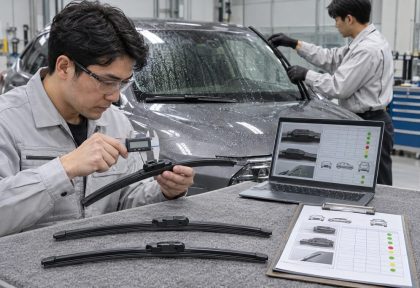
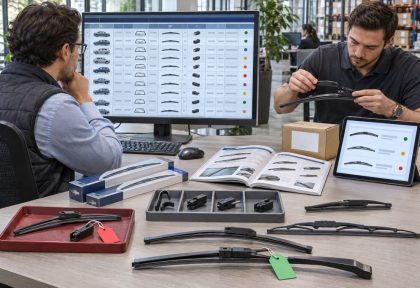
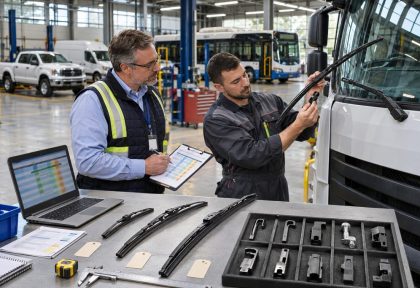
How to Approve New OE Exact-Fit Wiper Blade Models Before Bulk Purchasing
Nov 13, 2026
Adding new OE exact-fit wiper blade models can help distributors cover recently launched vehicles, specialized connectors and applications that multi-fit products cannot serve efficiently. However, a blade that looks similar to the original part is not automatically an exact-fit replacement.
Before bulk purchasing, buyers must confirm the complete vehicle application, connector geometry, blade length, installation position, windshield contact and wiping performance. They must also verify that the approved sample can be reproduced consistently during mass production.
A structured approval process reduces the risk of purchasing blades that fit only part of the listed vehicle range, require excessive installation force or create poor wiping performance. It also provides measurable standards for production inspections, repeat orders and future quality claims.
Why Visual Similarity Is Not Enough to Approve an Exact-Fit Blade
An OE exact-fit wiper blade is designed for a defined vehicle application. It should connect directly to the intended wiper arm, sit at the correct height and angle, follow the windshield curvature and reproduce the expected wiping path.
Visual similarity alone cannot confirm these requirements. Two connectors may appear nearly identical but differ in width, locking-tab position or arm-entry depth. A small dimensional difference can prevent secure installation or allow the blade to move during operation.
Approval should consider the complete system:
- Vehicle make and model
- Vehicle generation
- Production period
- Sales market
- Left-hand-drive or right-hand-drive version
- Driver, passenger or rear position
- Blade length
- Wiper-arm interface
- Connector dimensions
- Blade curvature
- Spoiler orientation
- Windshield geometry
- Sweep pattern
Exact-fit does not necessarily mean genuine OEM
An aftermarket manufacturer can produce an OE exact-fit blade without being the original supplier to the vehicle manufacturer. The term describes vehicle-specific fitment, not necessarily the commercial identity of the producer.
Buyers should distinguish among:
- Genuine vehicle-brand parts: Sold through or for the vehicle manufacturer
- OE supplier products: Manufactured by a company that supplies original-equipment programs
- Aftermarket OE exact-fit products: Designed to replace a defined original application
- Multi-fit products: Use adapters to cover several arm connections
Each category can provide acceptable performance when properly engineered and verified. The “OE exact-fit” label by itself does not prove material quality, durability or production consistency.
One correct installation does not validate every listed application
A supplier may list one SKU for several vehicles using similar connectors. Testing it on one vehicle confirms only that specific application.
Other vehicles may differ in:
- Connector dimensions
- Blade position
- Windshield curvature
- Arm pressure
- Sweep direction
- Spoiler requirements
- Driver/passenger pairing
Every application does not necessarily require a separate full laboratory program, but the buyer should identify application families and verify representative high-risk vehicles before approving broad coverage.
Poor exact-fit approval creates expensive inventory
Exact-fit products normally require more SKUs than multi-fit ranges. If an application is incorrect, the resulting inventory may have limited alternative use.
An incorrectly approved SKU can create:
- Fitment returns
- Marketplace complaints
- Opened and unsaleable packaging
- Rework or relabeling
- Customer-service costs
- Obsolete inventory
- Lost confidence in the product range
- Missed sales for correct applications
The cost of verification before purchasing is usually lower than the cost of correcting a bulk-order mistake.
The Approval Mistakes That Lead to Fitment Claims and Dead Stock
Approving from supplier data alone
Supplier application tables are a useful starting point, but they should not be the only source of evidence. Data may have been copied from another catalog, applied across regions or built from connector appearance without physical vehicle verification.
High-volume and uncertain applications should be cross-checked against:
- OE part references
- Reliable regional fitment databases
- Original blades
- Original wiper arms
- Established aftermarket catalogs
- Actual vehicles
When sources disagree, the record should remain pending until the difference is resolved.
Checking length without measuring the connector
Correct blade length does not confirm correct fitment. Buyers should measure the connector and compare it with the original arm.
Important measurements may include:
- Connector width
- Connector height
- Arm-entry depth
- Button width
- Pin diameter
- Locking-tab position
- Distance from the connector to the blade body
- Installed angle
This guide to wiper blade connector types and fitment can help buyers identify the interface family, but application-specific dimensions must still be verified.
Testing only the easiest vehicle
A buyer may test the sample on the most accessible vehicle rather than the application carrying the greatest commercial risk. This can hide problems with long blades, curved glass or different installation positions.
Representative testing should prioritize:
- High-volume local vehicles
- Newly introduced models
- Vehicles with conflicting catalog data
- Long driver-side blades
- Strongly curved windshields
- Unusual connectors
- Rear-wiper applications
- Left-hand-drive and right-hand-drive variants
- Applications with high return exposure
Ignoring the blade position
Driver-side, passenger-side and rear blades should be treated as position-specific products. A connector may physically fit both front arms while the spoiler, length or curvature is intended for only one side.
Each application record should state:
- Physical left or right position
- Driver or passenger designation
- Front or rear location
- Blade length
- Product SKU
- Connector
- Paired blade where applicable
This prevents left/right reversal during catalog creation and warehouse picking.
Approving an engineering sample without production controls
A carefully prepared sample may not represent normal mass production. The supplier could use different rubber, spring steel, connector resin or assembly methods in the bulk order.
The buyer should connect sample approval to:
- A controlled bill of materials
- Material specifications
- Dimensional drawings
- Approved suppliers for critical components
- Defined assembly methods
- Final inspection criteria
- Change-notification requirements
- Batch traceability
Without these controls, a golden sample becomes only a visual reference.
Ignoring packaging and application labels
The blade may be correct while the packaging sends the wrong product to the customer. Common problems include:
- Incorrect model-year range
- Wrong driver/passenger position
- Mismatched SKU and barcode
- Incorrect connector illustration
- Missing installation instructions
- Product image showing another model
- Outdated application claims
Packaging must be approved as part of the complete saleable product.
How to Verify Vehicle Fitment and Wiping Performance Step by Step
A repeatable approval process allows purchasing, technical and quality teams to evaluate every new SKU using the same criteria.
Step 1: Define the exact vehicle application
Create a controlled application record before requesting samples.
| Fitment field | Information to confirm | Approval risk if omitted |
|---|---|---|
| Sales market | Country or regional vehicle specification | A similar vehicle may use a different wiping system |
| Make and model | Complete vehicle identity | Similar model names may be incorrectly combined |
| Generation | Vehicle platform or generation code | A model redesign may change the connector or blade size |
| Production period | Starting and ending year or month | Mid-year changes may be missed |
| Body style | Sedan, hatchback, SUV, van or another version | Rear and front applications may differ |
| Drive orientation | LHD or RHD where relevant | Blade position and spoiler direction may change |
| Blade position | Driver, passenger or rear | Sizes or directional products may be reversed |
| Blade length | Inches and millimeters | Incorrect length can reduce coverage or cause interference |
| Arm connector | Exact interface and dimensions | The blade may not install or lock |
| Product SKU | Saleable product number | Fitment may be assigned to the wrong blade |
| Verification source | Vehicle, OE reference or approved database | The application cannot be traced |
| Approval status | Pending, tested, approved or rejected | Unverified data may be published |
The record should identify one exact product SKU. Avoid attaching vehicle coverage to a general product family without defining the physical blade.
Step 2: Compare the sample with the original blade
Place the proposed sample beside the original blade and compare:
- Overall length
- Connector position
- Connector height
- Blade profile
- Curvature
- Spoiler direction
- End-cap design
- Wiping-element length
- Resting orientation
- Structural clearance
The replacement does not need to copy every cosmetic detail, but differences must not interfere with installation, airflow or wiping performance.
Step 3: Inspect sample construction
Before installation, examine the sample for:
- Damaged wiping edges
- Loose end caps
- Uneven molding
- Adapter or connector movement
- Coating defects
- Bent spring strips
- Inconsistent curvature
- Sharp edges
- Missing components
- Incorrect branding or labels
Record the sample model, batch, manufacturing date and package version before testing.
Step 4: Verify installation
The blade should install using the method that will be shown to customers. Do not modify the arm or connector to make the sample fit.
Confirm that it:
- Enters the arm in the correct direction.
- Moves into position without excessive force.
- Produces a clear locking action.
- Resists a gentle pull after installation.
- Sits at the intended height and angle.
- Avoids contact with the arm, trim and glass edge.
- Can be removed using the documented release procedure.
Excessive looseness, visible movement or incomplete locking should be treated as a fitment failure.
Step 5: Conduct a wet-windshield test
Clean the glass before testing. Oil, wax, dust or deteriorating hydrophobic coatings can create streaking unrelated to the blade.
Apply water or washer fluid consistently and observe several complete cycles.
Check for:
- Fine fixed streaks
- Cloudy smearing
- Broad missed areas
- Tip lift
- Mid-blade contact loss
- Judder
- Chattering
- Squeaking
- Connector movement
- Blade-to-blade contact
- Contact with trim or the glass boundary
Test low and high wiper speeds where available. A blade may appear stable at low speed but lift or chatter when the motion becomes faster.
Step 6: Record evidence
Use fixed-angle photographs and videos to document:
- Original arm and blade
- Connector dimensions
- Sample before installation
- Installed connector
- Resting position
- Complete sweep
- Wiping pattern
- Any noise or movement
- Final approval result
Evidence should be stored with the application record rather than in an individual employee’s phone or email.
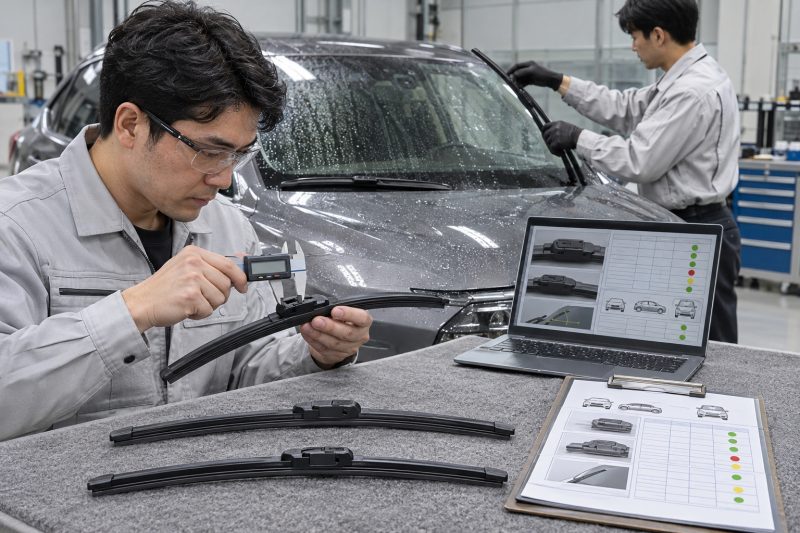
[Image Placeholder: Quality engineer comparing an OE wiper blade, exact-fit connector, original vehicle arm and documented fitment measurements beside a vehicle windshield]
How to Build a Representative Sample and Validation Program
Testing every vehicle in a global application catalog may not be practical. Buyers can manage the workload by grouping applications according to shared physical and technical characteristics.
Build application families
Applications may be grouped by:
- Connector design and dimensions
- Blade length
- Windshield curvature
- Blade position
- Vehicle platform
- Spoiler orientation
- LHD or RHD layout
- Front or rear location
A representative vehicle can validate important characteristics within a family, but the buyer should document why the applications are considered equivalent.
Choose samples by risk
A representative sample program should not contain only the easiest or shortest blades.
Include:
- Short, medium and long blades
- Driver-side and passenger-side models
- Front and rear applications
- Flat and strongly curved windshields
- The newest connector designs
- High-volume local vehicles
- Applications with limited alternative supply
- Models with conflicting fitment records
- Different structures included in the order
Long beam blades are valuable test products because they can reveal pressure-distribution and end-contact problems. Buyers evaluating relevant designs can review products within the TOPEX flat wiper blade range before selecting samples for vehicle-specific validation.
Test more than one sample
One carefully selected sample cannot prove consistency. For commercially important SKUs, test multiple pieces and, where possible, samples from more than one production run.
This helps identify:
- Dimensional variation
- Connector inconsistency
- Uneven curvature
- Assembly variation
- Rubber-edge defects
- Packaging errors
- Batch-to-batch differences
A defect repeated across several pieces is more likely to indicate a design or process problem than an isolated handling issue.
Separate initial performance from durability
A short vehicle test confirms initial fitment and wiping behavior. It cannot prove long-term durability, weather resistance or service life.
The validation plan may include:
- Initial vehicle installation
- Repeated wiping cycles
- Extended field use
- High- and low-temperature exposure
- Ozone or weather-aging checks
- Corrosion testing
- Rubber-property verification
- Retention testing
- Packaging and transport testing
Laboratory tests should use documented methods and suitable equipment. A supplier’s unsupported statement that a blade passed “durability testing” is not enough; buyers should request the method, number of cycles, conditions and result.
Verify the complete vehicle set
When a vehicle uses different driver, passenger and rear blades, test the complete set where commercially important.
A complete-set test confirms:
- Correct left/right pairing
- Blade-to-blade clearance
- Sweep overlap
- Spoiler orientation
- Rear-arm compatibility
- Packaging accuracy
- Vehicle-level customer experience
This is particularly useful when the products will be marketed as a vehicle-specific kit.
How to Convert an Approved Sample into a Bulk-Purchase Standard
Sample approval should create a measurable production standard. The bulk order must reproduce the approved fitment, construction and performance—not merely the general appearance.
Create an approval specification
| Approval area | Items to freeze or define | Production verification |
|---|---|---|
| Product identity | SKU, model, length and application | Label and PO comparison |
| Connector | Dimensions, resin, locking design and orientation | Measurement and installation test |
| Blade structure | Spring steel, frame, spoiler and end caps | BOM and physical comparison |
| Wiping element | Material, profile, coating and edge quality | Specification and sample inspection |
| Curvature | Approved blade profile and tolerances | Fixture or dimensional check |
| Appearance | Color, finish, logo and acceptable defects | Golden sample and limit samples |
| Packaging | Structure, artwork, barcode and contents | Approved packaging file |
| Instructions | Vehicle position and installation method | Controlled document version |
| Performance | Fitment, retention, wiping and noise criteria | Defined test procedure |
| Traceability | Batch, production date and inspection records | Carton and product identification |
Dimensions and tolerances should be agreed before production. “Same as sample” is not precise enough for characteristics that can be measured.
Retain a golden sample
The final approved sample should be signed, dated and retained in protected condition. Where possible, both the buyer and supplier should hold matching references.
The golden sample should include:
- The approved blade
- Connector or adapter
- Packaging
- Labels
- Instructions
- Sample identification
- Approval date
- Related specification number
The golden sample supports appearance and construction comparisons but should not replace written measurements and test criteria.
Approve a production sample
Before completing the entire order, request samples produced with normal tooling, materials, workers and processes. A production sample is more representative than an early prototype prepared by an engineering team.
Verify that the production sample matches the approved standard in:
- Connector dimensions
- Blade curvature
- Rubber profile
- Materials
- Surface finish
- Packaging
- Labels
- Installation
- Wiping performance
If the supplier changes a component after sample approval, the affected tests should be repeated.
Use a controlled trial order
A smaller first production order allows buyers to evaluate:
- Factory consistency
- Mixed-SKU accuracy
- Packaging quality
- Barcode reliability
- Vehicle fitment
- Field performance
- Delivery timing
- Supplier response to problems
The trial should still be large enough to represent normal production. A few engineering samples do not demonstrate repeat-order capability.
Define pre-shipment inspection requirements
Pre-shipment inspection should cover representative cartons and SKUs rather than only one convenient model.
Inspection may include:
- Product identity
- Quantity
- Dimensions
- Appearance
- Connector assembly
- Locking security
- Rubber retention
- Blade curvature
- Wiping performance
- Packaging
- Barcodes
- Instructions
- Batch traceability
Long blades, complex connectors and high-volume SKUs should receive appropriate representation in the inspection sample.
Establish change control
The purchase agreement should require written approval before changes to:
- Rubber formulation
- Rubber coating
- Spring steel
- Connector resin
- Connector dimensions
- Spoiler material
- End-cap design
- Adhesives
- Tooling
- Sub-suppliers
- Production location
- Packaging
- Application data
The supplier should explain the reason for the proposed change, identify affected SKUs and provide samples for revalidation.
Monitor performance after launch
Approval continues after the product enters the market. Track:
- Sales by SKU
- Fitment returns
- Installation complaints
- Wiping-performance claims
- Connector failures
- Batch numbers
- Vehicle applications
- Inventory age
- Stockouts
- Complete-set conversion
A slow-selling SKU is not automatically unsuitable if it protects strategically important vehicle coverage. However, repeated fitment claims should trigger immediate review.
Return reports should distinguish among:
- Incorrect catalog data
- Wrong installation position
- Connector mismatch
- Installation difficulty
- Missing components
- Wiping-performance failure
- Product defect
- Customer ordering error
This evidence improves both the product and the fitment database.
Conclusion
Approving a new OE exact-fit wiper blade requires more than comparing its appearance with an original part or confirming that it installs on one convenient vehicle. Buyers should verify the exact sales market, vehicle generation, production period, blade position, length, connector dimensions, windshield contact and complete wiping path.
Representative samples should cover high-volume and high-risk applications, including long blades, curved windshields, specialized connectors and rear positions where relevant. Once approved, the sample must be converted into a controlled production standard covering materials, dimensions, construction, packaging, performance and traceability.
A retained golden sample, frozen specifications, production-sample review, controlled trial order and representative pre-shipment inspection help ensure that bulk products reproduce the quality originally approved. This process reduces fitment claims, prevents dead stock and gives distributors stronger evidence for expanding their OE exact-fit range.
Frequently Asked Questions
What makes a wiper blade an OE exact-fit product?
An OE exact-fit blade is designed for a defined vehicle application and normally uses a dedicated connector that attaches directly to the intended arm. It should also match the required length, profile, installation position and windshield geometry.
Is an OE exact-fit blade the same as a genuine OEM blade?
No. An aftermarket manufacturer can produce an OE exact-fit replacement. “Exact-fit” describes application-specific compatibility, while “genuine OEM” generally refers to a product supplied through or for the vehicle manufacturer.
How should buyers verify an exact-fit connector?
Compare the connector with the original arm, measure critical dimensions and install the sample on the intended vehicle. It should engage without excessive force, lock fully, resist a gentle pull and remain stable through the complete sweep.
How many vehicles should be tested before bulk purchasing?
The number depends on the size and risk of the application range. Buyers should test high-volume vehicles, uncertain applications and representative groups covering different lengths, connectors, positions and windshield curvatures.
Can one approved sample represent the entire bulk order?
No. One sample confirms only its own initial condition. Buyers should freeze the approved specification, review normal production samples and inspect representative units from the bulk order to verify consistency.
What should buyers do if fitment databases disagree?
Keep the application pending and investigate the vehicle generation, production period, sales market, installation position and connector. Use physical vehicle inspection, an original blade or another reliable reference before publishing the application.

--- END ---
Already the last article
Already the latest article