Custom Colour Wiper Blades: A Buyer’s Guide to Colours, Patterns, Logos and Packaging
Nov 18, 2026
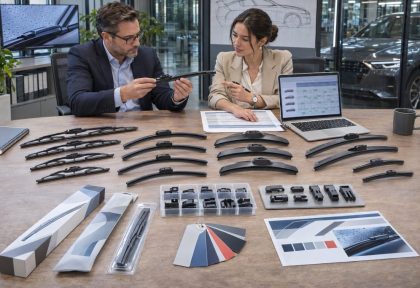
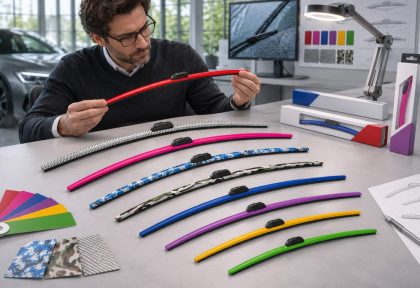
Custom colour wiper blades can help a private-label range stand out, but appearance changes also add decisions about colour control, logo placement, pattern consistency, packaging and inventory. Poorly defined requirements can create visible differences across the same order.
Before requesting a quotation, buyers should define which components need custom colours, how those colours will be approved, where the logo will appear, whether a pattern is required and how the packaging should present the finished product. Fitment and wiping performance must remain the priority throughout the customization process.
This guide is intended primarily for private-label wiper blade brands and automotive retail buyers. It explains how to prepare a practical design brief, compare supplier proposals and approve samples without allowing visual customization to create unnecessary SKU or quality risks.
Start with the Product and Market Position, Not the Colour Chart
Colour should support a clear product role. It should not be selected before the buyer has decided which blade structure, customer group and sales channel the product will serve.
A brightly coloured blade may suit a promotional retail line, enthusiast market or recognizable private-label program. A more restrained accent colour may be easier to integrate into a mainstream automotive range. The right decision depends on the brand and customer, not on which sample appears most unusual.
I recommend defining these points first:
- Target country or region
- Primary sales channel
- Intended customer group
- Retail price position
- Blade structure
- Required size range
- Connector or adapter strategy
- Expected quantity by size
- Planned brand identity
- Packaging format
A custom design should be applied to a blade that already suits the intended vehicle coverage. Colour cannot correct weak fitment data, an unsuitable connector or poor windshield contact.
Decide what “custom colour” actually means
The phrase can describe several different requests. Buyers may want to customize:
- Spoiler sections
- Frame or cover
- End caps
- Connector housing
- Adapter components
- Decorative inserts
- Wiping-element appearance
- Printed logo
- Retail packaging
These parts may use different materials and production methods. A colour that is practical on one component may not produce the same result on another.
The RFQ should identify each customized part rather than asking for a “fully coloured blade.” This avoids disagreement over which components remain black and which follow the brand colour.
Buyers exploring this product direction can review the custom colour one-piece spoiler wiper blade range when preparing their initial product brief.
Protect the core product requirements
Visual customization should not change the basic approval criteria. The blade must still:
- Match the intended vehicle application
- Use the correct length
- Connect securely to the wiper arm
- Maintain appropriate windshield contact
- Remain stable through its sweep
- Protect the wiping edge during storage and transport
- Include the correct adapters and instructions
The buyer should approve fitment and wiping performance alongside appearance, not as separate projects.
Define Colours and Patterns in a Reproducible Way
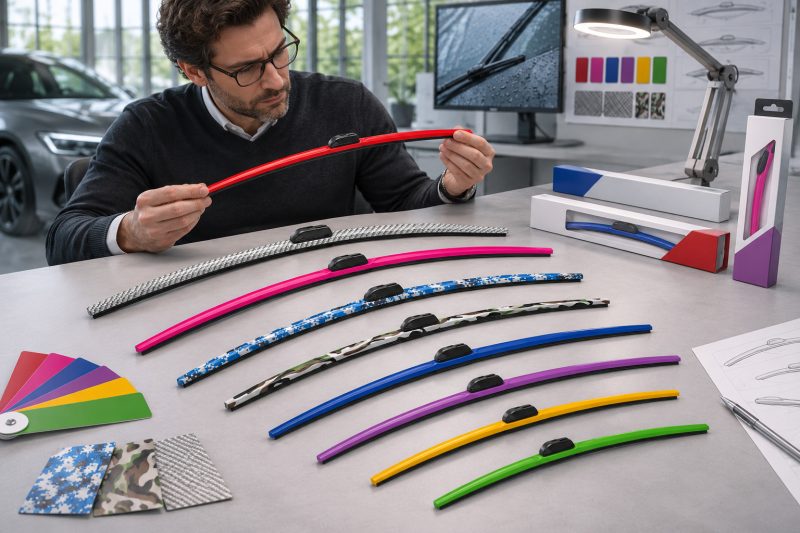
Descriptions such as “bright red,” “deep blue” or “close to our logo” are not adequate production standards. Different monitors, materials and lighting conditions can make the same colour appear different.
A more reliable colour brief combines a recognized reference with a physical approval sample.
Prepare a colour specification
The colour specification should state:
- Component to be coloured
- Reference colour system or approved sample
- Finish, such as matte or gloss
- Acceptable visual variation
- Viewing conditions for approval
- Whether several components must match
- Whether the same colour will be used across multiple blade sizes
- Whether the packaging must use the same brand colour
The supplier should explain if a requested colour behaves differently on the selected material or surface. The buyer can then approve a suitable alternative before samples are produced.
Compare the colour on the actual product
A digital mock-up is useful for choosing a direction, but it does not prove how the colour will look on a finished blade. Product shape, material, texture and lighting can change the result.
I would review colour samples under:
- Natural daylight
- Normal indoor lighting
- Retail-style lighting where relevant
- Side-by-side comparison with the brand reference
- Side-by-side comparison across blade components
The final approved colour should be recorded through photographs and a retained physical sample. Photographs alone can be misleading because camera settings and screen displays vary.
Define patterns separately from solid colours
A pattern adds another layer of control. The design may include graphics, repeated brand elements, decorative lines or another visual treatment.
The brief should confirm:
- Pattern artwork
- Scale
- Orientation
- Starting and ending position
- Coverage area
- Relationship to the connector and spoiler
- Acceptable alignment variation
- Appearance across different blade lengths
- Method proposed by the supplier
Do not assume that one pattern file can be applied identically to every size. A graphic designed for a short blade may appear stretched, cropped or poorly positioned on a longer product.
| Design element | Buyer should define | Sample approval should confirm |
|---|---|---|
| Main colour | Reference and target component | Colour on the actual product |
| Accent colour | Location and relationship to main colour | Consistency across components |
| Surface finish | Matte, gloss or approved alternative | Appearance under normal lighting |
| Pattern | Artwork, scale and orientation | Alignment on different lengths |
| Logo | File, position, size and colour | Legibility and attachment |
| Blade size | Length range to be customized | Consistent visual balance |
| Connector area | Coloured or standard finish | No interference with installation |
| Packaging colour | Brand palette and print reference | Relationship to the physical blade |
A pattern should also be checked after normal handling. The buyer should define acceptable appearance based on the proposed application method rather than assuming every decorative process has the same resistance to abrasion or weather exposure.
Plan Logo Placement Without Affecting Product Use
The logo should remain visible enough to support the brand without interfering with installation, movement or product identification. Its position must be defined for every relevant blade structure and length.
Choose the purpose of the logo
A product logo can serve several roles:
- Brand recognition on the vehicle
- Product-series identification
- Retail differentiation
- Private-label ownership
- Coordination with packaging
- Easier product photography
A large decorative logo may suit a promotional range, while a smaller mark may be more appropriate for mainstream retail.
Prepare suitable logo files
Send controlled artwork rather than screenshots or images copied from a website. The logo package should include:
- Vector artwork where available
- Approved colour version
- Single-colour alternative
- Minimum permitted size
- Clear-space requirement
- Correct proportions
- File revision number
- Written approval of the final placement
If the logo contains small text or fine lines, ask the supplier to confirm whether it will remain legible at the intended size.
Approve logo position by blade size
A position that works on a 24-inch blade may appear crowded on a shorter product. The buyer should review at least one short, one medium and one long sample when the same logo is used across a full range.
Check:
- Distance from the connector
- Relationship to the spoiler
- Orientation when installed
- Visibility from outside the vehicle
- Alignment across left and right blades
- Appearance on different lengths
- Clearance from moving or locking components
The logo should not cover adapter codes, product labels or fitment information required during installation.
Confirm the application method
Different suppliers may propose different ways to apply a logo. The quotation should identify the method and the components involved.
Ask the supplier to explain:
- Which surface receives the logo
- Whether the logo is applied before or after assembly
- How the sample will be approved
- What visual variation is considered acceptable
- Whether the process changes with order quantity
- How repeat-order consistency will be controlled
Do not approve a logo only through a digital rendering. The final decision should be based on the actual product sample.
The T-PRO SC custom wiper blade can provide a useful reference when discussing customized appearance, but the buyer should still confirm the exact blade configuration, branding method and range included in the quotation.
Match Custom Packaging to the Product and Sales Channel
Packaging should explain the product clearly and protect the customized surface. It also needs to connect the blade colour, logo, SKU and vehicle application without creating confusion.
Decide what the customer needs to see
Retail packaging for a custom colour blade may benefit from showing part of the product, but visibility should not come at the expense of protection.
The package may need to display:
- Brand
- Product-series name
- Blade structure
- Blade length
- Product colour
- Installation position
- Connector or adapter information
- Package contents
- SKU
- Barcode
- Installation instructions
- Fitment reference
- Responsible-party information where required
A product image should represent the colour and components inside the package. Using the same generic image for several colour variants can create picking and customer-service errors.
Coordinate product and packaging colours
The packaging does not need to match the blade perfectly, but the relationship should look intentional. Buyers should decide whether the package will:
- Use the same primary colour
- Use a neutral background to highlight the blade
- Assign different colours to product tiers
- Use a colour swatch for SKU identification
- Show the full blade through a window
- Use product photography instead of visibility
Printed colour and molded or coated product colour may not appear identical because the materials and finishes differ. Approval should focus on a consistent brand presentation rather than expecting different materials to look exactly the same.
Separate design versions carefully
Every additional blade colour, pattern, logo variation or package language can create another packaging SKU.
Before expanding the range, calculate the number of combinations:
Blade structure × length × colour × connector × package version
A simple product program can become difficult to manage when every length uses several colours and separate artwork.
I recommend launching with a controlled colour range and using common packaging components where practical. Additional variants can be introduced after sales data confirms demand.
Test the physical packaging
A digital artwork proof cannot confirm whether the package protects the blade. Approve a physical package containing the actual product, adapters and instructions.
Check:
- Product retention
- Internal clearance
- Protection of coloured surfaces
- Protection of the wiping edge
- Adapter placement
- Instruction-sheet fit
- Package balance
- Sealing
- Barcode position
- Carton fit
- Product removal
Packaging should not place excessive pressure on the blade or allow the customized surface to rub repeatedly against an abrasive component.
For buyers considering a spoiler-style range, the one-piece spoiler wiper blade category provides another reference for comparing structures before finalizing product and packaging dimensions.
Control MOQ, SKU Count and Repeat-Order Consistency
Customization can create commercial risk even when the product sample looks correct. Colours, patterns, logos and packaging may each have separate quantity requirements and setup considerations.
Ask for quantities by combination
Do not rely only on the total order quantity. Ask the supplier to state requirements for:
- Each blade structure
- Each blade length
- Each product colour
- Each pattern
- Each logo version
- Each connector
- Each packaging design
- Each language version
A total order of several thousand blades may still be divided into small quantities across too many combinations.
Build a controlled launch range
A practical first range may use:
- One blade structure
- A limited number of proven lengths
- One or two main colours
- One logo version
- One shared packaging system
- Verified connector coverage
The exact range should follow target-market demand. The objective is to create a recognizable assortment without building slow-moving inventory.
Retain approved references
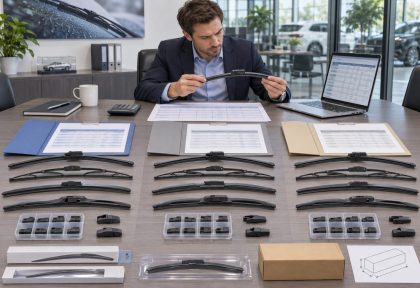
The final approval package should include:
- Finished blade sample
- Approved colour reference
- Pattern artwork
- Logo artwork
- Product specification
- Packaging sample
- Barcode data
- Installation instructions
- Approval date
- Revision number
Both buyer and supplier should use the same controlled references for repeat orders.
Require change notification
Written approval should be required before changes to:
- Colour formulation or reference
- Base material
- Surface finish
- Pattern artwork
- Logo size or method
- Product structure
- Connector or adapter
- Packaging material
- Printing file
- Production location where relevant
A visually similar substitute may still create noticeable differences when old and new inventory appear together on a retail shelf.
Approve Samples and Inspect Bulk Production
Sample approval should cover appearance, fitment and packaging as one complete product. A colour sample alone does not approve the saleable blade.
Build a representative sample set
Include samples that reveal the main risks:
- Short, medium and long lengths
- Main colour options
- Patterned version where applicable
- Complete logo treatment
- Important connectors
- Final retail package
- Full adapter set
- Installation instructions
Use the same approval form for every sample so decisions remain consistent.
Check appearance under controlled conditions
Inspect samples for:
- Colour consistency
- Surface finish
- Pattern position
- Logo clarity
- Scratches
- Marks
- Molding defects
- Component alignment
- Packaging accuracy
The buyer and supplier should agree on acceptable cosmetic limits before production.
Verify fitment and wiping performance
Customization should not prevent the functional checks required for a standard blade.
Confirm that the blade:
- Uses the correct connector or adapter.
- Locks securely to the intended arm.
- Remains correctly oriented.
- Avoids contact with trim or the other blade.
- Maintains windshield contact.
- Completes a wet wiping test without recurring missed areas.
- Can be removed using the documented method.
A clean windshield and correct installation are necessary for a meaningful wiping assessment.
Inspect representative bulk units
Pre-shipment inspection should include different sizes, cartons and visual variants.
Inspection may cover:
- SKU and quantity
- Blade length
- Colour
- Pattern
- Logo
- Assembly
- Connector retention
- Adapter contents
- Wiping-edge condition
- Packaging
- Barcode
- Carton marks
- Batch traceability
Inspection should compare the shipment with the approved product and packaging references, not with a general statement such as “same colour family.”
Frequently Asked Questions
What information is needed to quote custom colour wiper blades?
Provide the blade structure, size range, target components, colour references, finish, logo files, pattern artwork, estimated quantity by SKU and packaging requirements. The supplier also needs to understand the target market and sales channel.
Can every wiper blade component use the same colour?
Not necessarily. Components may use different materials, textures and production methods, so the same colour reference may appear different. Buyers should approve the actual components together instead of relying only on a digital mock-up.
How many colours should a new private-label range launch?
There is no universal number. I recommend starting with a controlled selection based on realistic demand and quantity per SKU. Too many colours can divide the order, increase packaging versions and create slow-moving inventory.
Should the packaging colour match the blade exactly?
It should create a consistent brand presentation, but exact visual matching may not be practical across different materials and finishes. Approve the physical blade and printed package together under normal viewing conditions.
How can buyers maintain colour consistency in repeat orders?
Retain an approved physical sample, colour reference, specification and artwork version. Require written approval before the supplier changes materials, colour formulation, finish, application method or production details that could affect appearance.
Conclusion
Custom colour wiper blades work best when colour, pattern, logo and packaging are developed around a verified blade structure and realistic product range. Buyers should approve physical samples, control every design version and keep fitment and wiping performance central to the decision.
To discuss a custom range with TOPEX, provide your target market, proposed blade structure, preferred colours, logo artwork and estimated quantity by size. These details help define a workable product and packaging scope before quotation.

--- END ---