
Multi-Fit vs. OE Exact-Fit Wiper Blades: Profit, Coverage and SKU Strategy
Sep 07, 2026
For wiper blade distributors, vehicle coverage is important—but coverage alone does not guarantee profit. A product range can theoretically fit thousands of vehicles and still generate weak results if customers select the wrong adapter, employees require too much installation training, or low-demand SKUs remain in inventory for years.
Multi-fit and OE exact-fit wiper blades solve different commercial problems. Multi-fit products use one blade platform with several adapters to cover multiple arm types. OE exact-fit products normally use a dedicated connector designed for a defined group of vehicle applications.
The first format can reduce SKU count, while the second can simplify product selection and installation. The more profitable choice depends on the target market, sales channel, vehicle population, return rate, inventory cost, and supplier support.
Multi-fit blades usually provide broader baseline coverage with fewer core SKUs, while OE exact-fit blades provide more application-specific installation with a larger number of dedicated products. Neither format guarantees higher profit. Distributors should compare return-adjusted margin, sell-through, inventory age, fitment errors, and gross profit per SKU before deciding how much inventory to assign to each format.
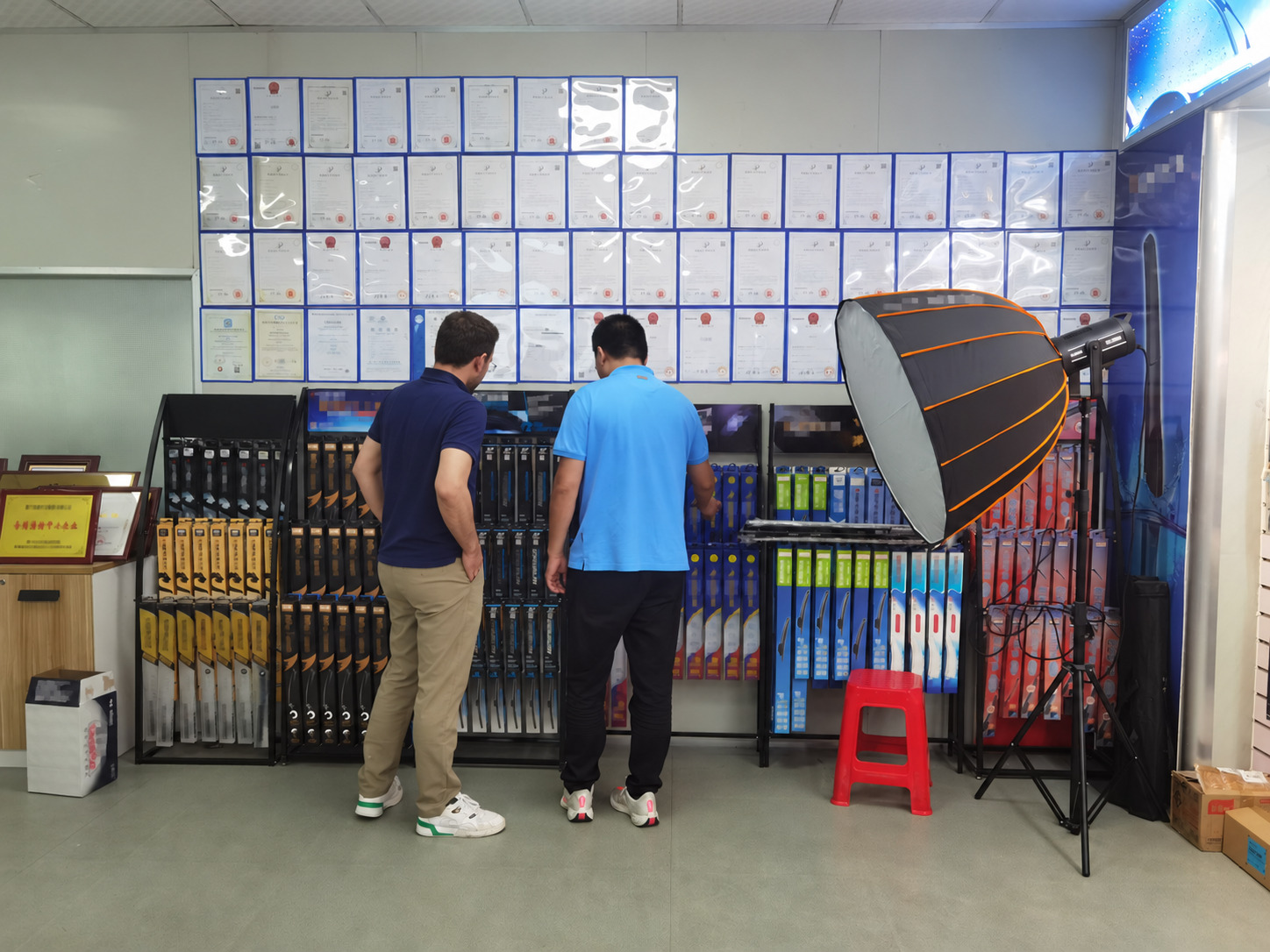
I am Jacky Huang, CEO of Xiamen TOPEX Auto Parts Co., Ltd. When buyers ask me whether multi-fit or OE exact-fit blades are better, I do not recommend choosing only one format. In many markets, they perform different roles within the same profitable product range.
The most practical approach is often to use multi-fit products for broad coverage and add OE exact-fit blades where local vehicle demand justifies dedicated inventory.
Why Better Vehicle Coverage Does Not Always Mean Better Profit
Vehicle coverage is frequently presented as a percentage. A supplier may state that a product range covers most vehicles in a market, but that figure does not explain how easily customers can identify the right blade, select the correct adapter, or complete the installation.
A high coverage percentage can also hide unprofitable inventory. A catalogue may technically cover many low-volume vehicles while failing to maintain availability for the applications customers request every week.
Better theoretical coverage does not always produce better profit because coverage must be converted into successful installation, reliable wiping, sell-through, and repeat purchases. A product that covers more vehicles but generates more fitment returns may be less profitable than a smaller, more accurate range.
How Multi-Fit Coverage Works
A multi-fit program normally combines blades in common lengths with interchangeable or integrated adapters. One blade platform may therefore work with several arm types, such as:
- U-hook
- Push button
- Pinch tab
- Side pin
- Bayonet
- Top lock
- Narrow push button
- Other compatible arm variations
This approach can reduce the number of base products required for a distributor to serve a mixed vehicle population.
Potential benefits include:
- Fewer core SKUs
- Lower baseline inventory
- Simpler purchasing
- Better use of shelf space
- Easier mixed-SKU ordering
- More flexible replenishment
- Broader coverage from common blade lengths
However, the customer or installer must identify the correct adapter. If the package, application data, or instructions are unclear, the distributor may receive more questions and returns.
How OE Exact-Fit Coverage Works
OE exact-fit blades use a connector intended for particular arm systems and vehicle applications. The product may resemble the original blade’s connector and installation method, but “OE exact-fit” does not automatically mean it is a genuine automaker-branded component.
The TOPEX article on OEM and aftermarket wiper blades explains why buyers should distinguish branding, manufacturing source, and fitment description.
OE exact-fit products may provide:
- More direct installation
- Fewer loose adapters
- Clearer vehicle-specific positioning
- Familiar connector appearance
- Stronger workshop confidence
- Lower selection complexity for known applications
Their main commercial limitation is inventory fragmentation. Every dedicated connector, length, or vehicle pair may require another product code.
Coverage Must Be Measured Against Demand
A distributor should not ask only, “How many vehicles can this range fit?” More useful questions include:
- How many registered local vehicles are covered?
- Which applications generate the most replacement demand?
- How many SKUs create that coverage?
- How many units does each SKU sell?
- What percentage of sales comes from core applications?
- How many fitment-related returns occur?
- How much inventory is older than the target period?
- How frequently can the supplier replenish each SKU?
Coverage becomes commercially valuable only when customers can find, install, and use the correct product.
The Stocking Mistakes That Distort Margin and Coverage
Multi-fit and OE exact-fit blades can both produce poor results when buyers evaluate them with incomplete information. The most common mistake is comparing purchase prices while ignoring the additional costs created after the products enter inventory.
The stocking mistakes that distort performance include comparing only unit prices, treating coverage percentages as verified demand, assuming OE exact-fit means genuine OEM, ignoring fitment returns, and failing to include packaging space, employee training, inventory aging, and replenishment in the margin calculation.
Comparing Theoretical Gross Margin
A basic gross margin calculation is:
Gross Margin = Selling Price − Landed Product Cost
This calculation is useful, but it does not show the complete commercial result. A more practical comparison is:
Return-Adjusted Gross Profit = Sales Revenue − Landed Cost of Sold Units − Fitment Returns − Warranty Replacements − Markdowns − Direct Support Costs
A multi-fit blade may have a strong theoretical margin but require more support because customers select the wrong adapter. An OE exact-fit blade may have a higher landed cost but produce fewer installation questions for the correct application.
| Cost factor | Multi-fit impact | OE exact-fit impact |
|---|---|---|
| Base SKU count | Usually lower | Usually higher |
| Adapter complexity | Higher | Lower for the intended application |
| Application-data requirement | High | High |
| Installation training | May cover several adapters | Usually focused on one connector |
| Inventory fragmentation | Lower potential | Higher potential |
| Long-tail stock risk | More consolidated | More application-specific |
| Packaging content | Must explain adapter selection | Must identify exact applications clearly |
| Replenishment | Can be easier for shared lengths | Depends on demand for each dedicated SKU |
The actual result depends on supplier design, product data, customer type, and local vehicles.
Treating OE Exact-Fit as Genuine OEM
OE exact-fit generally describes compatibility and connector design in the aftermarket. It does not automatically establish that the blade was manufactured by the original vehicle manufacturer or supplied in automaker-branded packaging.
Distributors should confirm:
- Product brand
- Manufacturing source
- Vehicle applications
- Connector design
- Whether OE references are cross-references
- Packaging claims
- Warranty provider
- Product specification
Clear terminology reduces the risk of misleading customers.
Selecting Multi-Fit Products by Adapter Count
A product with more adapters does not automatically provide better coverage. Some included connectors may have limited relevance in the distributor’s market, while additional pieces can make packaging and installation more complicated.
Buyers should verify:
- Which local vehicles use each adapter
- Whether the adapter locks securely
- Whether the blade sits at the correct angle
- Whether the connector provides sufficient clearance
- Whether the instructions are understandable
- Whether employees can identify the correct part
- Whether opened packages can still be sold
The goal is useful coverage, not the highest adapter count.
Stocking OE Products for Unverified Long-Tail Applications
OE exact-fit products are valuable for popular vehicles, but dedicated inventory for rare applications may sell slowly.
A distributor should avoid giving equal quantities to:
- High-volume local vehicles
- New applications with growth potential
- Older models with declining populations
- Rare premium vehicles
- Unverified catalogue applications
Long-tail OE-fit products can be stocked lightly, centralized in one warehouse, or supported through special orders.
How to Compare Multi-Fit and OE Exact-Fit with Real Business Data
The comparison should use the same period, market, and product-quality level. A premium OE exact-fit blade should not be compared with an economy multi-fit blade without recognizing their different positions.
Distributors should compare both formats using vehicle coverage, SKU count, sell-through, inventory age, fitment returns, installation time, landed cost, gross profit, and return-adjusted margin. These measurements reveal whether reduced SKU complexity or installation simplicity creates more value in the actual channel.
Measure Coverage Efficiency
A useful metric is:
Coverage Efficiency = Relevant Vehicles Covered ÷ Active SKUs
This does not measure profitability by itself, but it shows how efficiently the range converts SKUs into useful local coverage.
Coverage data should include:
- Make
- Model
- Model year
- Driver and passenger positions
- Blade lengths
- Arm type
- Adapter or connector
- Rear application where relevant
Do not count a vehicle as covered simply because the adapter can physically attach. The installed product should also provide secure locking, correct blade angle, suitable clearance, and reliable windshield contact.
Measure Inventory Performance
Track each SKU rather than reviewing only total category sales.
Important measurements include:
| Metric | What it reveals |
|---|---|
| Sell-through rate | Speed of sales |
| Inventory age | Risk of slow-moving stock |
| Weeks of supply | Inventory relative to demand |
| Stockout frequency | Whether core products need more depth |
| Fitment-return rate | Accuracy of data and connector selection |
| Quality-return rate | Wiping or construction problems |
| Reorder frequency | Stability of demand |
| Gross profit per SKU | Contribution from each product code |
| Gross profit per shelf position | Productivity of physical retail space |
| Return-adjusted margin | Profit after direct product losses |
A multi-fit range may perform well when a small number of products generates high sales across many vehicles. An OE exact-fit range may perform well when dedicated products sell predictably and create fewer returns.
Measure Installation Experience
Installation time influences workshops, retailers, fleets, and customer satisfaction.
Review:
- Time required to identify the correct product
- Time required to choose the adapter
- Number of installation steps
- Need for tools
- Incorrect first attempts
- Connector locking confirmation
- Employee support time
- Customer questions
- Package-opening damage
OE exact-fit blades may have an advantage for known applications because the connector is already dedicated. Multi-fit products can still provide efficient installation when their adapters and instructions are well designed.
Calculate Return-Adjusted Margin by SKU
For each product code, record:
- Sales revenue
- Landed cost of sold units
- Fitment returns
- Quality returns
- Warranty replacements
- Markdowns
- Direct customer-support cost where measurable
Then calculate:
Return-Adjusted Margin % = Return-Adjusted Gross Profit ÷ Sales Revenue × 100
This provides a better commercial comparison than purchase price or theoretical margin alone.
How TOPEX Combines Multi-Fit Coverage with OE-Level Convenience
At TOPEX, I recommend building the range around the buyer’s target country, vehicle population, sales channel, price structure, and existing sales data. The objective is not to force every market into one product format.
TOPEX can combine multi-fit products for broad baseline coverage with OE exact-fit products for important vehicle-specific applications. Fitment information, adapter guidance, sample evaluation, packaging customization, and controlled trial orders help buyers reduce both inventory and installation risk.
Multi-Fit Products for Baseline Coverage
The TOPEX flat wiper blade range includes beam-style products and different adapter options for wholesalers, retailers, e-commerce sellers, and private-label programs.
When planning a multi-fit range, we can review:
- Common local arm types
- High-demand blade lengths
- Driver and passenger pairings
- Adapter requirements
- Package contents
- Installation instructions
- Quantity by SKU
- Replenishment needs
The goal is to use shared blade platforms where they provide verified coverage—not to make unsupported universal-fit claims.
OE Exact-Fit Products for Popular Vehicles
The TOPEX OE exact-fit wiper blade range can support dedicated applications where simpler installation and vehicle-specific positioning justify separate inventory.
OE exact-fit products are particularly relevant when:
- The vehicle population is large
- The connector is common in the target market
- Sales history is stable
- Customers prefer direct replacement
- Workshop installation speed matters
- The retailer can provide clear application lookup
These products should be introduced selectively rather than stocked equally across every available vehicle.
Fitment, Packaging, and Private-Label Support
Depending on the program, TOPEX can discuss:
- Application lists
- Connector and adapter information
- Representative samples
- Product specifications
- Private-label packaging
- Size and vehicle labels
- Barcodes
- Installation diagrams
- Carton information
- Mixed-SKU orders
Multi-fit packages must explain adapter selection clearly, while OE exact-fit packages must identify vehicle applications accurately. Both formats require controlled product data.
A Low-Risk Stocking Plan for Testing Both Product Formats
Distributors do not need to choose one format for their entire business. A controlled test can reveal which products perform best in each market segment.
A low-risk plan uses multi-fit blades to establish core length and connector coverage, adds OE exact-fit blades for proven high-volume vehicles, and tracks sell-through, returns, margin, and replenishment by SKU before changing the inventory ratio.
Step 1: Analyze the Local Vehicle Population
Identify:
- Common vehicle makes and models
- Important model years
- Vehicle age distribution
- Driver and passenger blade lengths
- Main arm types
- Popular rear applications
- Existing customer requests
- Current competitor coverage
This information establishes which applications need baseline coverage and which justify dedicated products.
Step 2: Build the Opening Range
A practical starting structure may include:
- Multi-fit blades in high-demand lengths
- Adapters for common local arm types
- OE exact-fit products for the most popular vehicles
- Limited rear-blade coverage
- Controlled quantities of new applications
Do not divide inventory equally. Core multi-fit products and proven OE applications should receive greater depth than trial products.
Step 3: Test Representative Products
Before ordering, verify:
- Connector security
- Adapter selection
- Installation time
- Blade angle
- Windshield contact
- Wiping performance
- Noise
- Driver and passenger pairing
- Package clarity
- Application accuracy
Testing should cover short, medium, and long blades because pressure distribution can change with length.
Step 4: Track Results by SKU and Format
After launch, measure:
- Units sold
- Sell-through rate
- Inventory age
- Landed cost
- Selling price
- Fitment returns
- Quality returns
- Support questions
- Reorder frequency
- Return-adjusted margin
The distributor should also record why each return occurred. A wrong vehicle listing, incorrect adapter choice, installation error, and wiping defect require different solutions.
Step 5: Adjust the Portfolio
The next order can:
- Increase successful multi-fit lengths
- Add OE exact-fit products for vehicles generating repeated requests
- Reduce slow OE applications
- Remove irrelevant adapters
- Improve installation instructions
- Correct fitment data
- Adjust packaging
- Change safety-stock levels
A combined range should evolve according to real performance rather than a fixed theoretical ratio.
Conclusion
Multi-fit and OE exact-fit wiper blades create value in different ways. Multi-fit products can cover several arm types with fewer core SKUs, helping distributors reduce shelf space and inventory complexity. OE exact-fit blades provide a dedicated connector and more direct installation, which may improve customer confidence and reduce selection errors for popular applications.
Neither format guarantees a better margin by itself. Buyers should compare sell-through, fitment returns, installation support, inventory age, landed cost, and gross profit per SKU. They should also distinguish OE exact-fit aftermarket products from genuine automaker-branded OEM parts.
In many markets, the most profitable strategy is a combined portfolio: multi-fit blades for broad baseline coverage and OE exact-fit products for high-volume vehicles where application-specific inventory is justified. Controlled trial orders and return-adjusted margin data provide the strongest basis for deciding the final balance.
Frequently Asked Questions About Multi-Fit and OE Exact-Fit Wiper Blades
What is the difference between multi-fit and OE exact-fit wiper blades?
Multi-fit blades use one product platform with several adapters to cover multiple arm types and vehicles. OE exact-fit blades use a dedicated connector for defined applications. Multi-fit products can reduce core SKU count, while OE exact-fit products can simplify installation for specific vehicles.
Do multi-fit wiper blades reduce the number of required SKUs?
Yes, they can consolidate several connector applications into common blade lengths and platforms. However, the benefit depends on verified fitment data, secure adapters, clear instructions, and local vehicle relevance. More theoretical coverage does not automatically mean fewer returns.
Are OE exact-fit blades the same as genuine OEM wiper blades?
Not necessarily. OE exact-fit normally describes an aftermarket product designed to match a particular vehicle connection and application. Genuine OEM blades are supplied under the vehicle manufacturer’s authorized branding and supply system. Buyers should verify branding and manufacturing source separately.
Which format creates fewer fitment-related returns?
Either format can produce fewer returns when supported correctly. OE exact-fit blades may simplify selection for known applications, while multi-fit blades can perform well when adapters and instructions are clear. The result should be measured through actual return data.
How should distributors calculate return-adjusted margin by SKU?
Subtract landed product cost, fitment returns, warranty replacements, markdowns, and measurable direct support expenses from sales revenue. Divide the resulting return-adjusted gross profit by sales revenue to calculate the percentage margin.
Should retailers stock both multi-fit and OE exact-fit blades?
In many markets, yes. Multi-fit products can provide broad core coverage with fewer SKUs, while OE exact-fit blades can serve popular vehicle-specific applications. The final mix should follow local vehicle data, sell-through, inventory age, return rates, and replenishment performance.

--- END ---


