
When Should Wiper Blade Distributors Change Suppliers?
Oct 12, 2026
Changing a wiper blade supplier creates new sampling, testing, artwork, inventory, and delivery risks. The current factory may already understand your specifications, applications, and schedule.
Remaining with an unreliable supplier can be more expensive. Repeated defects, fitment errors, delays, and inconsistent batches damage customer confidence.
A distributor should consider changing suppliers when recurring quality, fitment, delivery, or communication failures begin harming the business and the supplier cannot demonstrate effective corrective action. The decision should be based on documented performance and total commercial risk—not frustration after one isolated problem or excitement about a lower quotation.
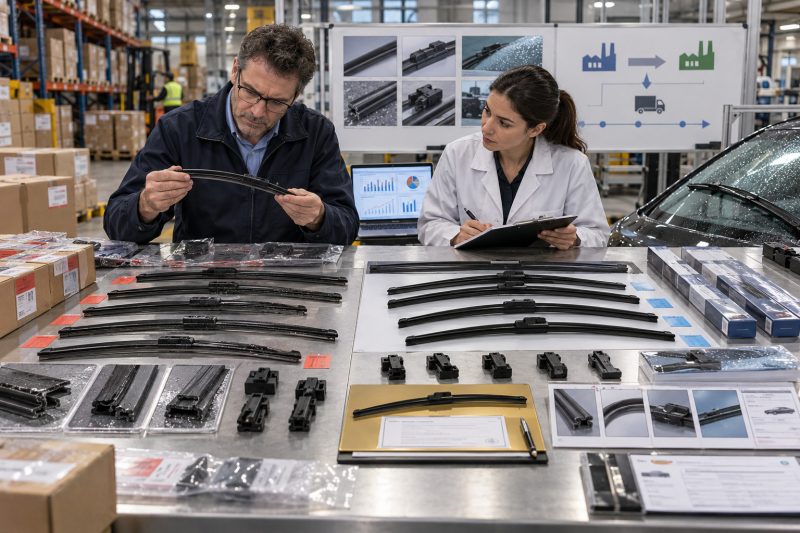
I am Jacky Huang, CEO of Xiamen TOPEX Auto Parts Co., Ltd. I evaluate both the product and the supplier’s ability to identify, contain, correct, and prevent failures.
The Warning Signs Your Wiper Blade Supplier Is Becoming a Business Risk
One complaint does not justify replacement because arms, glass, installation, or application errors can affect wiping. Similar failures across batches or vehicles are more serious.
DENSO’s guidance on worn wiper symptoms identifies streaking, squeaking, chattering, missed areas, and rubber damage. Record each symptom with its SKU, batch, vehicle, position, service time, and failure type.
Quality Drift Between Production Batches
Later batches may differ after changes to rubber, spring curvature, coating, adapter resin, tooling, assembly, or sub-suppliers.
Strong warning signs include:
- Growing complaints about streaking, chatter, skipping, or squeaking
- Premature cracking, deformation, or coating loss
- Loose adapters or inconsistent connector retention
- Uneven pressure distribution on longer beam blades
- Packaging damage or incorrect components inside the pack
- Different appearance or performance between repeat orders
- Supplier changes to materials or processes without approval
- Failure to identify which production lot is affected
Fitment and Data Failures
A good blade still fails commercially when its length, connection, adapter, model year, or position is listed incorrectly. Recurring errors reveal weak application control.
Delivery and Communication Failures
Delivery becomes risky when dates repeatedly change, status cannot be verified, or problems appear only after the planned shipping date.
| Warning sign | Possible business impact | Evidence to collect |
|---|---|---|
| Rising fitment returns | Freight, refunds, reviews, and lost trust | Vehicle, connector, position, and SKU |
| Inconsistent wiping by batch | Warranty cost and brand damage | Lot number and failure sample |
| Unapproved material change | Unpredictable durability or fit | Specification and change history |
| Repeated delivery delay | Stockouts and emergency freight | Confirmed versus actual dates |
| Packaging errors | Relabelling, repacking, or rejection | Artwork version and inspection photos |
| No traceability | Inability to contain affected stock | Production and shipment records |
| Generic explanations | Same failure may return | Root-cause and corrective-action report |
The greatest warning is recurrence without a verified cause or prevention.
Why a Lower Price Is Not Always a Good Reason to Switch Suppliers
A lower FOB price is only one switching-cost line. Quotations may use different materials, packaging, quantities, payment terms, or Incoterms.
Before switching for price, calculate:
- New samples and courier charges
- Vehicle fitment and performance testing
- Factory audit or independent inspection
- New moulds, tooling, or adapter development
- Packaging redesign, plates, printing, and obsolete stock
- Catalogue, marketplace, ERP, and compliance-document updates
- Additional safety stock during the transition
- Training, instructions, returns, warranties, and service exposure
- Emergency freight if the new supplier misses launch timing
- Claims or reputation damage if validation is incomplete
| Cost area | Existing supplier | Proposed supplier |
|---|---|---|
| Product and packaging | Current landed cost | Normalised landed cost at equal specification |
| Quality | Actual defect and return cost | Trial and projected failure cost |
| Fitment | Known application accuracy | Verification and data-rebuilding cost |
| Inventory | Current safety stock | Transition and duplicate-stock requirement |
| Operations | Established process | Onboarding, inspection, and training cost |
| Service | Proven claim handling | Unverified warranty response |
| Delivery | Historical on-time performance | Trial-order evidence only |
A price reduction can disappear after one incorrect batch. Compare total cost and risk at the same approved specification.
An uncompetitive price can justify qualification, but not an immediate full transfer.
How to Evaluate Whether the Supplier Can Still Fix the Problems
A capable supplier contains affected stock, identifies the lot, investigates the cause, implements corrective and preventive action, and verifies later production.
Separate an Isolated Event from a Systemic Failure
An isolated problem has a defined cause, limited scope, credible records, and effective correction. A systemic problem recurs or lacks traceability.
Ask the supplier to provide:
- Affected SKU, order, batch, and quantity
- Immediate containment of remaining goods
- Inspection results for warehouse and work-in-process stock
- Evidence-based root-cause analysis
- Corrective action with an owner and deadline
- Preventive action for related products or processes
- Verification results from a new sample or production run
- Updated specification, work instruction, or control plan
- Replacement, credit, sorting, or other commercial remedy
The TOPEX guide to repeat-order quality explains the value of locked specifications, golden samples, testing, change control, and traceability. Replacement goods alone do not prove prevention.
Use a Supplier Scorecard
| Performance area | Example measure | Escalation trigger |
|---|---|---|
| Product quality | Defect and warranty rate by batch | Repeated failure above the agreed limit |
| Wiping performance | Streaking, noise, contact, and durability | Same failure after corrective action |
| Fitment accuracy | Incorrect-application return rate | Recurring errors on priority vehicles |
| Delivery | On-time and complete shipment rate | Repeated late or partial deliveries |
| Communication | Response and resolution time | Delayed or incomplete incident updates |
| Traceability | Lot and material records | Supplier cannot isolate affected production |
| Change control | Approval before substitutions | Undisclosed material or process change |
| Corrective action | Closure and verified effectiveness | Generic explanation without prevention |
Set measurable improvement targets. Retain the supplier only when evidence and later batches confirm progress; qualify alternatives when failures or weak records continue.
When Dual Sourcing Is Safer Than an Immediate Full Switch
A new supplier may produce excellent samples but struggle with volume, mixed SKUs, delivery, or claims. Dual sourcing tests real production while protecting availability.
Dual sourcing is especially useful when:
- High-volume SKUs cannot stock out or seasonal demand is approaching
- Custom packaging requires a long transition
- The range has many variants and the new factory lacks repeat-order evidence
- The existing supplier remains usable for selected products
- Tooling or exact-fit applications need additional validation
Test products that expose technical weaknesses, not only an easy U-hook sample:
- Long beam blades for spring curvature and end contact
- Strongly curved windshields for pressure distribution
- Several adapters for locking security and installation clarity
- Driver/passenger pairs for interference and sweep coverage
- OE exact-fit or rear applications for connector accuracy
- Climate-relevant samples for heat, UV, cold, or corrosion exposure
The TOPEX supplier audit checklist covers manufacturing, quality, fitment, testing, traceability, packaging, and trial orders.
The TOPEX flat wiper blade range supports evaluation across lengths and adapters. One successful size cannot prove the complete range.
| Transition stage | Existing supplier role | New supplier role |
|---|---|---|
| Qualification | Maintains normal core supply | Provides documents and samples |
| Trial order | Protects critical availability | Produces selected SKUs in controlled volume |
| Early scale-up | Remains backup for priority products | Supplies verified high-volume items |
| Performance review | Reduced according to evidence | Completes repeat batches and claims review |
| Full or permanent dual source | Retained only where justified | Receives volume based on measured performance |
Dual sourcing can be temporary while buyers compare defects, delivery, communication, and sell-through.
A Step-by-Step Plan for Changing Wiper Blade Suppliers
A successful switch converts the current supplier’s failures into measurable requirements for every candidate.
1. Define the Switching Conditions
Document failures, batches, costs, corrective actions, escalation thresholds, and whether the goal is replacement or backup capacity.
2. Freeze the Product Specification
Freeze the blade structure, materials, dimensions, coatings, packaging, instructions, and acceptance criteria so candidates are compared fairly.
3. Audit Candidate Suppliers
Verify legal identity, manufacturing role, subcontracting, capacity, quality records, change control, traceability, testing, and complaint handling.
4. Approve Representative Samples and Golden Samples
Test representative lengths, adapters, vehicles, and climates for wiping, noise, contact, retention, durability, packaging, and fitment. Retain signed golden samples.
5. Run a Controlled Trial Order
Use normal production and commercial packaging. Inspect incoming goods and track timing, documentation, communication, and shipment performance.
6. Transfer SKUs in Phases
Begin with manageable SKUs, retain safety stock, and update systems, fitment data, packaging records, and warranty procedures before release.
7. Review Several Production Batches
Measure defects, fitment returns, delivery, packaging, and claim response across repeat batches.
A practical transition checklist should include:
- Documented exit and approval criteria
- Normalised quotation and landed-cost comparison
- Signed specifications and golden samples
- Application and connector verification
- Inspection plan and agreed acceptance limits
- Trial-order volume and responsible reviewers
- Safety stock and emergency supply plan
- Packaging and data migration schedule
- Warranty ownership for old and new inventory
- Review dates before each volume increase
Expand the new supplier’s share only when the data supports it.
Conclusion
A distributor should consider changing wiper blade suppliers when recurring quality, fitment, delivery, or communication problems begin damaging customer confidence and the current supplier cannot demonstrate effective corrective action. One defective shipment may be recoverable; repeated failures without batch traceability, root-cause analysis, or verified prevention indicate a deeper management problem.
However, changing suppliers also introduces new risks. Buyers should calculate the total switching cost, qualify the replacement supplier against documented specifications and approved golden samples, and begin with controlled trial orders.
A phased or dual-source transition protects product availability while real-world data confirms that the new supplier can deliver consistent quality, accurate fitment, dependable lead times, and responsive after-sales support.
Frequently Asked Questions About Changing Wiper Blade Suppliers
What warning signs indicate that a wiper blade supplier should be replaced?
Important signs include recurring batch inconsistency, rising fitment returns, unapproved material changes, repeated delivery failures, packaging errors, weak traceability, and corrective actions that do not prevent recurrence. The pattern and supplier response matter more than one isolated complaint.
How should distributors measure wiper blade supplier performance?
Track defect and return rates by batch, wiping-failure types, fitment accuracy, on-time delivery, complete shipment rate, response time, corrective-action effectiveness, traceability, packaging accuracy, and total claim cost. Review trends rather than relying only on annual averages.
Is repeated product failure more important than the overall return rate?
It can be. A low overall return rate may conceal the same serious failure recurring in one important SKU, vehicle application, or production batch. Root-cause categories and recurrence provide more useful information than one blended percentage.
Should a distributor dual-source before changing suppliers completely?
Usually, yes, when availability is critical and the current supplier remains usable. Dual sourcing allows the new factory to prove bulk consistency and delivery performance while the existing source protects priority SKUs during the transition.
What tests should a new wiper blade supplier pass?
Testing should cover representative lengths and adapters, connector retention, installation, glass contact, wet wiping, noise, missed areas, durability, climate-relevant resistance, packaging strength, labelling, and vehicle-application accuracy. Repeat production batches should also match the golden samples.
How can distributors switch suppliers without creating stock shortages?
Build transition safety stock, move SKUs in phases, retain temporary backup supply, align production and shipping schedules, and delay volume expansion until trial goods pass incoming inspection. Monitor inventory coverage and lead times throughout the change.

--- END ---


