
TecDoc Wiper Blade Data: What Brands and Distributors Need to Know
Sep 21, 2026
Selling a wiper blade through an electronic catalogue requires both a reliable product and complete, current application data.
An incomplete linkage can hide a compatible blade and lose a sale. An incorrect linkage can recommend the wrong blade and cause a return.
TecDoc can improve product visibility and parts identification, but it cannot create accurate wiper blade fitment from an article number and length alone. Brands must prepare detailed product and vehicle information, verify the physical application, and maintain the records throughout the product lifecycle.
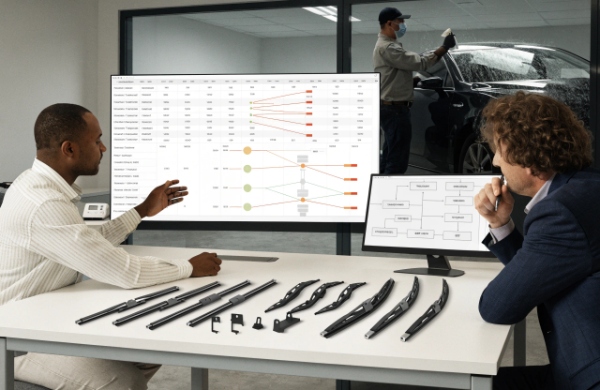
I am Jacky Huang, CEO of Xiamen TOPEX Auto Parts Co., Ltd. I treat catalogue data as part of the product because a good blade that cannot be identified accurately still creates commercial problems.
Why Incomplete Wiper Fitment Data Creates Lost Sales and Returns
Blade length is only one part of compatibility. Two 24-inch blades may use different connections, adapters, positions, or applications. A physically attachable adapter can still produce the wrong angle, clearance, or sweep.
A reliable fitment record may need to identify:
- Sales country or region
- Vehicle make, model, generation, and variant
- Production year or date range
- Driver, passenger, or rear position
- Blade length for the specified position
- Wiper-arm and connector type
- Required adapter and included components
- Blade structure or product family
- OE reference where available and verified
- Installation instructions and product images
Missing information creates false positives that recommend incompatible blades and false negatives that hide compatible products. False negatives often remain invisible because no transaction occurs.
| Data problem | Customer experience | Commercial result |
|---|---|---|
| Product linked only by length | Connector or position may be wrong | Return and support cost |
| Model-year range is incomplete | Compatible product does not appear | Lost sale |
| Driver and passenger positions are reversed | Wrong blade is ordered | Installation complaint |
| Regional vehicle version is ignored | Listing works in one market but not another | Repeated fitment returns |
| Adapter code is missing | Customer cannot complete installation | Return of a correct blade |
| Obsolete SKU remains active | Order cannot be fulfilled reliably | Delays and lost confidence |
TecAlliance describes the TecDoc Catalogue as standardized aftermarket data connecting product information with vehicle linkages and search options. Data quality therefore affects whether buyers can find the correct article.
The same relationship may appear in an ERP, webshop, marketplace, catalogue, package, and service system. Correcting only one channel leaves the risk elsewhere.
The TecDoc Assumptions That Mislead Wiper Blade Brands
The key misconception is that a TecDoc listing proves product quality. Standardized catalogue data does not replace factory audits, specifications, connector tests, wet wiping, durability evaluation, or inspection.
Listing Is Not Product Certification
A complete record can describe a poor blade, while a strong blade can be difficult to sell because its linkages are incomplete. Assess data and product quality separately.
| Question | TecDoc data process | Supplier qualification process |
|---|---|---|
| Is the article represented consistently? | Yes | Reviewed as supporting information |
| Is it linked to the intended vehicles? | Yes, based on submitted and validated data | Must also be physically verified |
| Does the adapter lock securely? | Not proven by a listing | Requires sample and vehicle testing |
| Does the blade wipe without streaks? | Not proven by a listing | Requires wet performance testing |
| Is production consistent? | Not established by catalogue inclusion | Requires quality controls and inspections |
| Is warranty support reliable? | Not established by catalogue inclusion | Requires commercial and supplier review |
Uploading Basic Article Data Does Not Create Complete Coverage
Uploading a product number, description, and size does not automatically create accurate vehicle applications. Linkages require verified article-to-vehicle relationships.
Other misleading assumptions include:
- One global application list works for every sales region.
- An OE reference alone proves interchangeability.
- Every included adapter is suitable for every arm it can physically accept.
- Multi-fit coverage can be claimed from adapter count without vehicle testing.
- Product images and installation instructions are optional.
- A successful initial upload removes the need for future maintenance.
- A deleted or superseded SKU will disappear correctly from every customer system automatically.
Because TecDoc data is distributed through catalogues, apps, web services, and partner solutions, accurate records gain reach—but source errors can also spread widely.
What Wiper Blade Data Must Be Prepared for TecDoc
Begin with one controlled product master. Every article needs a stable identity connected to its physical specification.
Build the Article Master
For each SKU, prepare its brand, article number, description, length, construction, position, connector, adapter, contents, status, and references. Images should show the blade, connection, adapters, and identifying features.
Build Vehicle Linkages
Connect the article to the correct make, model, generation, production period, relevant regional variation, and position. Distinguish verified applications from assumptions.
Control References and Lifecycle Changes
OE references, cross-references, replacements, and discontinued items need documented sources. A successor must provide equivalent verified fitment.
| Data group | Examples for wiper blades | Main control |
|---|---|---|
| Article identity | Brand, SKU, description, barcode | One stable record per sellable article |
| Physical specification | Length, structure, rubber, spring system | Match approved product specification |
| Installation position | Driver, passenger, front pair, rear | Never infer from length alone |
| Connection | Arm type, connector, adapter code | Verify locking and installation direction |
| Vehicle linkage | Make, model, generation, year, region | Confirm against physical applications |
| References | OE number and replacement mapping | Use traceable sources |
| Media | Product, connector, adapter images | Keep current and article-specific |
| Instructions | Installation sequence and cautions | Match included components |
| Lifecycle | Active, superseded, or discontinued | Define effective date and successor |
Multi-fit and exact-fit blades should not use identical data logic. A multi-fit article needs clear adapter selection and instructions for every approved application. An exact-fit blade needs precise vehicle, connector, position, and model-year linkages so its installation advantage is preserved.
How High-Quality TecDoc Data Helps Distributors Choose Your Brand
Distributors also evaluate how much work a product requires. Structured, reusable data is easier to integrate than a PDF application list.
TecDoc supports search by vehicle identifiers, part numbers, and OE references, with distribution through interfaces, APIs, and data packages. Accurate linkages support faster identification across channels.
For distributors, high-quality data can provide:
- Faster onboarding of a new product range
- More complete vehicle-search results
- Fewer manual compatibility enquiries
- Lower risk of incorrect-fit orders
- Clearer comparison of alternative suppliers
- Easier integration with e-commerce and catalogue tools
- Better management of replacement and discontinued SKUs
- Greater confidence in extending the brand to additional branches or channels
At TOPEX, the flat wiper blade range includes product formats that can support mainstream and multi-fit programs. These products require verified adapter and application relationships rather than one broad universal claim.
The TOPEX OE exact-fit wiper blade range serves vehicle-specific applications where connector and position precision are especially important. For both product groups, the catalogue description, vehicle linkage, supplied components, images, and instructions should describe the same physical product that the distributor receives.
Clear sources, verification status, and update history help distributors distinguish controlled data from unsupported coverage claims. Samples and quality systems still require evaluation.
How to Launch and Maintain a TecDoc Data Program
Manage TecDoc as an ongoing program. Assign responsibility for master data, linkages, media, submissions, corrections, and lifecycle changes.
Start with a Controlled Scope
Begin with priority markets and important SKUs. A verified core range is better than a large catalogue containing uncertain applications.
A practical launch process is:
- Assign a data owner and approval responsibilities.
- Standardize article numbers, descriptions, and lifecycle statuses.
- Clean duplicate, outdated, and conflicting records.
- Map core SKUs to verified vehicles and installation positions.
- Confirm connector, adapter, images, and instructions.
- Prepare traceable OE and replacement references.
- Submit the records in the required structure.
- Review errors, rejected fields, and coverage gaps.
- Check how products appear in real searches.
- Distribute approved corrections to other sales channels.
Maintain the Data After Publication
New vehicles, connector changes, supersessions, and discontinued products require maintenance. Returns and failed searches should become data-quality inputs.
The TecAlliance downloads page provides current interface descriptions, change reports, deletion-related reports, request templates, and delivery schedules. These resources demonstrate why a brand needs version control, scheduled reviews, and documented submission dates.
| Review frequency | Recommended activity |
|---|---|
| Monthly | Check submission errors, returns, and urgent application corrections |
| Quarterly | Review new vehicles, missing linkages, media, and replacement mappings |
| Before a product change | Confirm whether SKU, specification, images, or instructions must change |
| Before discontinuation | Define successor, effective date, remaining inventory, and channel updates |
| Annually | Audit the complete active range and remove unsupported applications |
Keep an audit trail of what changed, who approved it, why, and when it was distributed. This prevents conflicting answers across channels.
Conclusion
TecDoc can make a wiper blade brand easier for distributors, workshops, and online buyers to find, but visibility depends on the quality of the underlying fitment data. Each product must be connected to the correct vehicle, model year, market, installation position, blade length, arm type, and adapter—not simply uploaded as a part number.
Brands should also remember that TecDoc inclusion is not a certification of wiping performance or product durability. Distributors must still evaluate samples, documentation, production consistency, and warranty support.
The strongest approach is to treat TecDoc as an ongoing data-management program, with clear ownership and regular updates for new applications, superseded references, and discontinued SKUs.
Frequently Asked Questions About TecDoc Wiper Blade Data
What is TecDoc, and why does it matter to wiper blade distributors?
TecDoc is standardized automotive aftermarket data infrastructure that connects article information with vehicle linkages and search functions. It helps distributors, workshops, and digital sellers identify products through vehicles, product references, and OE numbers while reusing consistent data across systems.
Does a TecDoc listing certify the quality of a wiper blade?
No. Catalogue inclusion concerns product data and vehicle relationships. It does not replace physical testing, factory qualification, production inspection, durability evaluation, or warranty review. A distributor should validate both the data and the actual blade.
What fitment data should a wiper blade brand provide to TecDoc?
Relevant fields include brand, article number, length, blade structure, installation position, connector, adapter, vehicle make and model, generation, production period, regional variation, OE references, images, instructions, replacement relationships, and lifecycle status.
Can accurate TecDoc data reduce wiper blade returns?
It can reduce selection errors by helping buyers identify the correct article before ordering. The benefit depends on accurate vehicle linkages and supporting information. Data cannot prevent returns caused by physical defects, inconsistent production, damage, or unsupported fitment claims.
How often should wiper blade brands update their TecDoc records?
Urgent errors should be corrected promptly. Brands should also conduct scheduled monthly or quarterly reviews and update records whenever applications, specifications, media, replacement relationships, or lifecycle statuses change.
Should multi-fit and OE exact-fit wiper blades be catalogued differently?
Yes. Multi-fit records must identify the correct supplied adapter and verified applications with clear instructions. OE exact-fit records need precise vehicle, model-year, connector, and installation-position links. Neither format should claim applications based only on length or theoretical attachment.

--- END ---
Prev: Engineering Conventional Frame Wiper Blades: Materials, Coatings, and Performance
Already the latest article


