
Fleet Standardization with Flat Wiper Blades: Covering 90%+ Vehicles with One SKU Set
Aug 12, 2026
Your mixed fleet runs many brands and model years. Each vehicle seems to need its own wiper part number. Stock rooms fill with slow-moving blades. Technicians waste time searching for the right connector. Holding costs rise while stock-outs still happen.
Flat wiper blades with multi-fit universal connectors routinely cover 90%+ of passenger cars and light commercial vehicles with a compact set of standardized lengths. Fleets cut SKU count, simplify replacements, lower carrying costs, and improve overall TCO while keeping high-speed and all-weather performance.
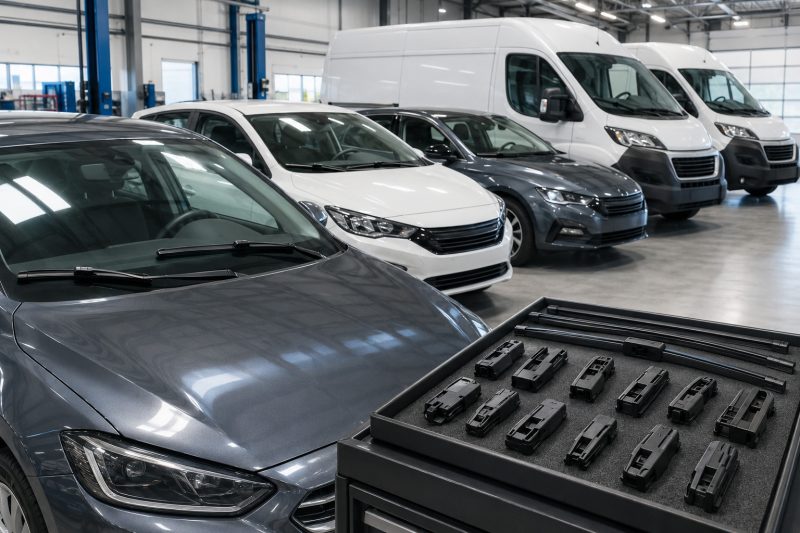
You now see that standardization is possible without sacrificing coverage or safety. Let’s examine why mixed-fleet procurement becomes a cost and efficiency trap, how flat universal blades plus multi-fit connectors deliver 90%+ coverage with minimal SKUs, the economic impact on space, cost, maintenance time and TCO, the step-by-step roadmap from pilot to full standardization, and why flat blade performance supports reliable fleet-wide use even in extreme weather.
The Reality of Mixed-Fleet Procurement: Why Multi-Brand Inventory Becomes a Cost and Efficiency Trap
I speak with fleet managers who operate mixed passenger cars and light commercial vans. The wiper category looks small until the part numbers are counted.
Mixed-fleet procurement becomes a cost and efficiency trap because multiple brands, arm types, and lengths create redundant stock, slow replacements, high holding costs, and frequent mismatches that interrupt maintenance schedules.
Multi-Brand and Multi-Year Complexity
Fleets often run vehicles from several manufacturers across many model years. Each platform may use different arm styles and blade lengths. Exact-fit logic turns this variety into dozens of separate SKUs.
Connector Variety Multiplies Stock
J-hook, side-pin, push-button, bayonet, top-lock and other arms each historically required their own blade. The result is a long list of low-velocity items that still occupy space and capital.
Replacement Efficiency Drops
Technicians spend extra time identifying the correct part and locating it in the stock room. What should be a five-minute job becomes longer, raising labor cost per replacement.
Holding Cost and Obsolescence Risk Rise
Slow-moving exact-fit blades tie up money and shelf space. When vehicles leave the fleet, some of that stock becomes obsolete and must be written down.
Stock-Outs Still Occur
Despite high total inventory, the exact blade needed for a particular vehicle is sometimes missing. Vehicles sit waiting or technicians improvise, both of which hurt uptime.
| Mixed-Fleet Problem | Immediate Effect | Cost Impact |
|---|---|---|
| Many brands & model years | Dozens of exact-fit SKUs | High complexity |
| Multiple arm types | Redundant stock | Capital tied up |
| Slow part identification | Longer maintenance time | Higher labor cost |
| Low-velocity items | Space and cash locked | Elevated holding cost |
This table shows how normal fleet variety turns into permanent inefficiency. The root is the exact-fit approach itself.
My Fleet Manager Conversation Pattern
A regional fleet operator once counted more than fifty active wiper SKUs across his locations. Many moved only a few units per year. The capital and space consumed by those slow items were larger than the value of his fast-moving core.
Operational Reality in 2026
Fleets continue to mix passenger cars and light vans from different makers. Without a standardization strategy the wiper category remains fragmented and expensive to manage.
The trap is real. Flat blades with multi-fit connectors offer a direct way out.
How Flat Universal Blades + Multi-Fit Connectors Deliver 90%+ Coverage with Minimal SKUs
The solution combines a high-performance flat beam with interchangeable adapters.
Flat universal blades plus multi-fit connectors deliver 90%+ coverage by using a small set of standardized lengths (typically 14–24 inches) and a kit of adapters that fit the major arm types. One compact SKU set replaces dozens of model-specific blades for passenger cars and light commercial vehicles.
Standardized Length Core
Most passenger cars and light vans fall into a limited length range. A core set of four to six lengths (commonly covering 350–600 mm) already serves the bulk of the fleet when paired with the right adapters.
Multi-Fit Adapter System
Interchangeable adapters handle J-hook, side-pin, push-button, bayonet, top-lock and other common arms. The same flat blade body accepts different connectors, removing the need for a separate SKU per arm type.
Realistic Coverage Rates
Well-designed multi-fit flat systems routinely achieve 90–95% coverage of passenger cars and around 89–93% of light commercial vehicles. Strong programs reach 95–99% in markets where the adapter mix matches local arm prevalence.
Dual-Inventory Approach for the Remainder
Heavy trucks and buses often need a small number of model-specific blades because of more varied arm designs. Most fleets keep a limited exact-fit buffer for those units while standardizing the passenger and light-commercial majority on multi-fit flat blades.
Performance Consistency Across the Set
Because every core SKU is a true flat beam, high-speed stability, even pressure, and quiet operation remain consistent. Standardization does not mean accepting lower performance.
- Select 4–6 high-volume lengths that match your fleet’s vehicle distribution.
- Equip them with a multi-adapter kit covering the dominant arm types.
- Aim for 90%+ coverage of passenger cars and light vans.
- Maintain a small exact-fit buffer only for heavy or rare applications.
- Review coverage annually as the fleet composition changes.
These elements turn a fragmented category into a controllable standard.
Practical Coverage Example
European-style mixed fleets commonly move from 40–60 individual blade SKUs per location down to a core of 4–6 multi-fit lengths while still covering more than 90% of the cars and light vans in daily operation.
Fitment Confidence
Clear packaging and simple adapter instructions keep installation straightforward for technicians. Fitment-related errors drop because the wrong-connector risk is largely eliminated.
Coverage is high. The economic effects make the case for change.
The Economic Impact of Standardization: Inventory Space, Procurement Cost, Maintenance Time & TCO
When the number of SKUs falls and coverage stays high, several cost lines improve at once.
Standardization with multi-fit flat blades reduces inventory space and carrying cost, lowers procurement and administrative effort, shortens maintenance time per replacement, and improves total cost of ownership while protecting vehicle uptime and safety.
Inventory Space and Holding Cost
Fewer SKUs mean fewer bin locations and less capital locked in slow-moving stock. Warehouse or stock-room space is released for higher-value parts. Obsolescence write-offs decline.
Procurement Simplification
Buyers manage a short list of core lengths instead of dozens of exact-fit codes. Order frequency on the remaining items becomes more regular and predictable. Volume consolidation often improves pricing over time.
Maintenance Time Reduction
Technicians no longer search through many near-identical blades. Part identification and installation become faster. Labor cost per wiper replacement falls and vehicles return to service sooner.
Return and Error Cost Decline
Wrong-connector shipments and fitment complaints drop. Handling, inspection, and re-stocking costs that previously eroded the category margin are reduced.
Total Cost of Ownership Improvement
When holding cost, labor time, error cost, and vehicle downtime are added to the purchase price, the multi-fit flat approach frequently shows a lower true TCO than a fragmented exact-fit inventory—even if the unit price of the flat blade is somewhat higher.
| Cost Area | Fragmented Exact-Fit Model | Standardized Multi-Fit Flat |
|---|---|---|
| Active SKUs | 40–60+ per location | 4–6 core lengths |
| Space & carrying cost | High | Substantially lower |
| Procurement complexity | High | Simplified |
| Maintenance time per job | Longer | Shorter |
| Fitment error & return cost | Higher | Lower |
| Overall TCO | Elevated by hidden costs | Improved |
This table summarizes the measurable economic differences. The gains appear in both the parts budget and the maintenance budget.
My Review of Fleet Results
Fleet operators who completed the shift consistently report the same pattern: less capital tied up in wipers, faster bay times for replacements, and fewer stock-related delays. The category moves from a chronic inconvenience to a controlled process.
Uptime Link
Faster, more reliable replacements support higher vehicle availability. For fleets that measure uptime closely, this operational gain often outweighs small differences in unit price.
Economics support the change. A clear roadmap makes implementation low-risk.
Implementation Roadmap: From Pilot Fleet to Full Standardization
A staged approach protects service continuity while proving the benefits.
Fleets can move from fragmented inventory to standardization by mapping current vehicle and connector volumes, selecting a high-coverage multi-fit flat range, running a controlled pilot on core groups, validating fitment and durability, and then expanding while keeping a small buffer for special applications.
Step 1: Map the Current Fleet Mix
List vehicle makes, model years, and the arm types and lengths currently in use. Identify the highest-volume groups and the long-tail items that consume space while moving slowly.
Step 2: Choose Core Lengths and Adapter Set
Select 4–6 lengths that cover the bulk of the passenger cars and light vans. Pair them with a multi-adapter kit matched to the dominant arm types in the fleet.
Step 3: Run a Focused Pilot
Equip a representative subset of the fleet (or one location) with the multi-fit flat blades. Track fitment success, installation time, any early performance feedback, and stock movement.
Step 4: Validate and Adjust
Confirm that coverage meets the 90%+ target for the pilot group. Adjust adapter mix or add one extra length if a meaningful gap appears. Document technician feedback.
Step 5: Expand to Full Standardization
Roll the proven core set out across the remaining passenger and light-commercial vehicles. Reduce or eliminate the old exact-fit long-tail stock as it is consumed.
Step 6: Maintain a Small Special Buffer
Keep a limited number of model-specific blades only for heavy trucks, buses, or rare arm types that fall outside the multi-fit coverage. Review the buffer size annually.
- Start with data on your actual vehicle distribution.
- Prioritize high-volume lengths and dominant arm types.
- Pilot before full rollout to protect uptime.
- Measure fitment success and technician time.
- Scale only what the pilot confirms.
- Retain a minimal exact-fit buffer for true exceptions.
These steps turn standardization into a controlled project rather than a risky leap.
My Recommended Pilot Scope
I advise fleets to begin with their top two or three vehicle groups that already represent a large share of the total park. Success on those groups builds confidence and creates early inventory relief.
Ongoing Governance
Once the core set is established, resist the urge to add every new exact-fit variant that appears. Treat specials as exceptions and keep the standard range stable.
Implementation is manageable. Performance data gives fleets the confidence to standardize.
Extreme Weather Performance & Safety: Why Flat Blades Support Reliable Fleet Standardization
Standardization only works if the chosen blade performs under real operating conditions.
Flat blades support reliable fleet standardization because they deliver high-speed stability against wind lift, even pressure on curved glass, strong rain clearing, and dependable behavior in snow and cold—meeting the safety and uptime requirements that fleets cannot compromise.
High-Speed Stability
The frameless beam and integrated spoiler resist wind lift at highway speeds. Contact remains consistent when vehicles travel at 100–140 km/h in rain, reducing streaking and chatter that can impair vision.
Even Pressure Distribution
Continuous spring pressure follows modern curved windshields more evenly than multi-point frames. Clearing stays complete across the wiped area, supporting safe operation in heavy rain.
Winter and All-Weather Capability
Quality flat blades maintain flexibility in cold temperatures and resist ice buildup better than many exposed-frame designs. Fleets operating in snow or mixed conditions retain reliable wiping without frequent winter-specific changeovers.
Low Noise and Driver Comfort
Reduced vibration and chatter improve the cabin environment for drivers who spend long hours on the road. Fewer noise-related complaints reach the maintenance desk.
Durability Under Fleet Duty Cycles
Premium flat constructions with good rubber compounds and coatings commonly deliver 12–24 months of service under mixed fleet use. Longer intervals mean fewer scheduled replacements and lower interruption risk.
- High-speed downforce keeps the blade on the glass.
- Even pressure reduces streaks on curved windshields.
- Cold flexibility and ice resistance support winter operations.
- Quiet running improves driver acceptance.
- Proven service life protects uptime schedules.
These performance traits justify standardizing on flat blades rather than accepting a lower-spec compromise.
Safety Link to Standardization
When the same high-performing blade is used across most of the fleet, vision-related risk becomes more consistent and easier to manage. Maintenance teams gain confidence that the standard part will clear effectively in rain, spray, and light snow.
My Field Observation
Fleets that standardized on quality multi-fit flat blades report fewer weather-related vision complaints and more predictable replacement intervals. The combination of coverage and performance removes the old trade-off between simplicity and safety.
For proven multi-fit flat platforms that support fleet standardization, explore the Topex flat wiper blade category. You can also review specific models such as the Topex T-PRO-F one-piece spoiler and the T-PRO-SC custom for designs that combine aerodynamic stability with practical multi-fit coverage.
Conclusion
Fleet operators managing mixed vehicle pools no longer need to maintain dozens of model-specific wiper SKUs. Flat blades equipped with multi-fit universal connectors routinely cover 90%+ of passenger cars and light commercial vehicles with a compact set of standardized lengths. The result is simpler inventory, faster replacements, lower carrying costs, and improved overall TCO—while maintaining the high-speed stability and all-weather performance fleets require. Start with a focused pilot on your highest-volume vehicle groups, validate fitment and durability, then expand. Standardization turns a fragmented maintenance item into a controllable, cost-efficient process.
Frequently Asked Questions About Fleet Standardization with Flat Wiper Blades
How can one set of flat wiper blades cover 90%+ of a mixed fleet?
By combining a small number of standardized lengths with multi-fit adapters that fit the major arm types (J-hook, side-pin, push-button, bayonet, etc.). The same blade body serves many vehicles, eliminating the need for dozens of exact-fit SKUs.
What length range and adapter types are typically needed for high fleet coverage?
Most fleets achieve strong coverage with 4–6 lengths in the 14–24 inch (350–600 mm) range plus adapters for the dominant local arm types. Exact mix depends on the vehicle park.
How much can fleet operators reduce SKU count and inventory holding costs?
Many mixed fleets move from 40–60 individual blade SKUs down to a core of 4–6 multi-fit lengths. Holding costs, space requirements, and obsolescence risk fall in proportion to the SKU reduction.
Are universal flat blades suitable for both passenger cars and light commercial vehicles?
Yes. Coverage is typically 90–95%+ for passenger cars and around 89–93% for light commercial vans. Heavy trucks and buses may still need a small exact-fit buffer.
How should fleets handle the remaining 5–10% of vehicles that require special fitment?
Maintain a limited dual-inventory buffer of model-specific blades only for those units. Review the buffer size annually so it does not grow back into a large fragmented stock.
What performance advantages (high-speed, winter, durability) support standardization on flat blades?
Flat blades resist wind lift at highway speeds, apply even pressure on curved glass, maintain flexibility in cold weather, and commonly deliver 12–24 months of service. These traits meet fleet safety and uptime requirements.

--- END ---


