
Regional Wiper Blade Assortments: Europe vs. Latin America vs. Asia-Pacific
Sep 15, 2026
A wiper blade assortment that performs well in one country may create stockouts, fitment returns, and dead inventory in another. Vehicle brands, model years, arm connections, windshield designs, climates, customer budgets, and distribution channels vary too widely for one global SKU list to work equally well everywhere.
The most effective regional assortment is not the largest catalog. It is a country-specific range that covers commercially important vehicles with verified products and appropriate inventory depth. Distributors should use multi-fit blades for efficient mainstream coverage, OE exact-fit and rear blades for proven applications, and sales data to refine the range continuously.
I am Jacky Huang, CEO of Xiamen TOPEX Auto Parts Co., Ltd. When discussing product planning, I first ask about the country, vehicle parc, channels, climate, price levels, applications, and replenishment cycle. These factors reveal which products deserve deep inventory.
Why One Global Wiper Blade Assortment Creates Regional Inventory Problems
Global catalogs are useful references, but a distributor earns money only from applications demanded in its market.
Copying one international assortment can create three problems simultaneously:
- Popular local vehicles remain uncovered or frequently out of stock.
- Products with incorrect connectors or positions generate fitment returns.
- Long-tail applications absorb cash and warehouse space without selling.
Length alone cannot solve the problem. Two vehicles using a 24-inch blade may have different J-hook, push-button, pinch-tab, top-lock, bayonet, or side-lock arms. Even when the connector attaches, the blade angle, spring-rail curvature, arm pressure, and driver/passenger pairing must still be suitable.
| Global-assortment mistake | Regional consequence | Commercial result |
|---|---|---|
| Same sizes in every country | Local high-volume sizes receive insufficient stock | Lost sales and emergency replenishment |
| Length-only selection | Connector or installed angle is wrong | Returns and installation complaints |
| Equal quantity per SKU | Long-tail products receive excessive inventory | Slow turnover and tied-up cash |
| One product tier everywhere | Local price expectations are ignored | Weak conversion or margin pressure |
| Global vehicle names without regional validation | Model-year or configuration differences are missed | Incorrect application listings |
| Front-blade focus only | Popular rear applications remain unavailable | Lower basket value and incomplete coverage |
A distributor needs strong availability for core applications, controlled stock for developing demand, and a practical way to supply long-tail products.
The Regional Assumptions That Lead Buyers to the Wrong Product Mix
Regional labels support initial research but should not become purchasing rules. Europe is not one premium beam-blade market, Latin America is not one economy-only market, and Asia-Pacific is not uniform.
Assuming Europe Requires Only Premium Flat Blades
Modern European vehicles commonly use flat blades and diverse connections, but Europe also contains older vehicles, fleets, price-sensitive buyers, and conventional applications. Nordic winter exposure and Southern European heat create different product requirements.
Assuming Latin America Requires Only Low-Cost Framed Blades
Conventional blades remain relevant in many Latin American channels, but an economy-only range can miss newer vehicles and upgrade demand. Vehicle origin, production history, purchasing power, and retail structures also differ among countries.
Treating Asia-Pacific as One Market
Japan, South Korea, China, India, Australia, New Zealand, and ASEAN markets have different fleets, climates, connectors, and purchasing power. They require separate application plans.
Buyers should question assumptions such as:
- Japanese brands always use simple hook connections.
- European-brand vehicles use identical interfaces worldwide.
- Tropical countries need the same rubber specification.
- A high regional growth forecast identifies the right local SKUs.
- Premium products will automatically replace conventional blades.
- One multi-fit coverage percentage is valid in every country.
Market research can indicate direction but cannot replace application planning. Future Market Insights identifies Asia-Pacific growth and continued demand across blade structures; distributors must still translate broad trends into country-level decisions.
How Vehicle Parc, Climate and Fitment Shape Regional Demand
The local vehicle parc should be the foundation of assortment planning. Useful data includes registered makes, models, model years, body types, front and rear positions, blade lengths, arm connections, and replacement demand. Brand origin is only a starting point because manufacturers can use several connector systems across different models and years.
Build a Country-Level Application Map
For every priority vehicle, the distributor should record:
- Country or sales region
- Make, model, generation, and year range
- Driver-side, passenger-side, and rear position
- Blade length for each position
- Wiper-arm connection and adapter
- Blade structure and relevant product SKU
- Verification source and last review date
- Sales volume, return rate, and stock status
This information prevents regional mismatches and reveals where multi-fit or OE exact-fit products are justified.
Translate Climate into Measurable Requirements
Climate should affect testing and seasonal inventory, not merely marketing language.
| Climate condition | Product stress | Purchasing priority |
|---|---|---|
| High UV and heat | Rubber hardening, cracking, and deformation | UV, ozone, and high-temperature testing |
| Heavy rain or monsoon | Frequent cycles and large water volume | Stable contact, clean wiping, and core-SKU availability |
| Snow and ice | Frozen joints and restricted blade movement | Winter-capable structures and cold flexibility |
| Coastal exposure | Salt, moisture, and corrosion | Coating, metal protection, and connector durability |
| Dust and sand | Abrasion and contaminated glass | Durable wiping edge and cleaning guidance |
| High-speed motorway use | Wind lift and unstable contact | Aerodynamic structure and retention testing |
A product labeled “all-weather” should still be tested for wiping quality, rubber flexibility, adapter security, temperature performance, and consistency under local conditions.
Include Price and Channel Structure
Channels also differ. Workshops prioritize availability and installation speed; retail needs clear positioning; e-commerce depends on accurate fitment content; and fleets emphasize total cost and consistent supply.
A practical range may therefore contain:
- Conventional blades for entry-level and older-vehicle demand.
- Multi-fit flat blades for broad mainstream coverage.
- Hybrid blades for mid-range or upgrade positioning.
- OE exact-fit blades for popular dedicated applications.
- Selected rear blades for common hatchbacks, SUVs, and crossovers.
- Seasonal products where winter or monsoon demand justifies them.
The TOPEX flat wiper blade range supports different connector programs, but the selection should be validated against local vehicles.
How Product Priorities Differ Across Europe, Latin America and Asia-Pacific
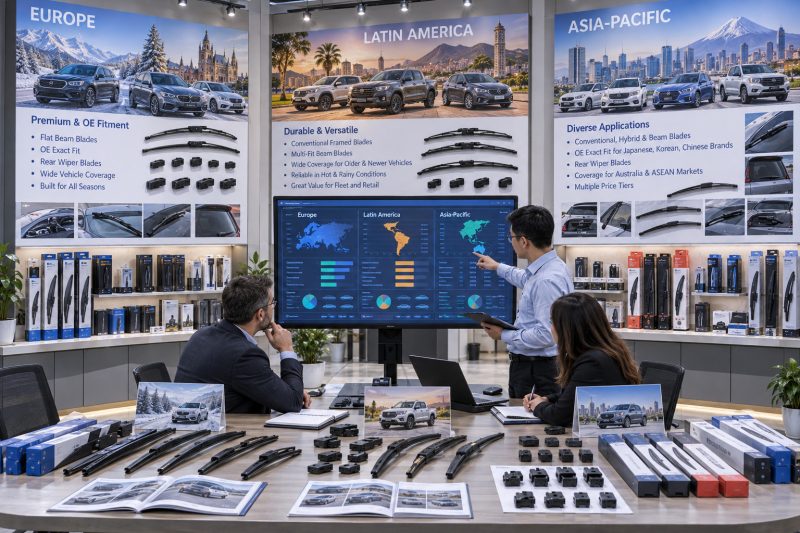
Regional comparison is most useful as a starting framework. Final quantities still need to be decided by country and channel.
| Planning factor | Europe | Latin America | Asia-Pacific |
|---|---|---|---|
| Vehicle parc | Mature but varied by country and age | Mixed-origin and mixed-age | Extremely diverse across mature and developing markets |
| Connector priority | Deep coverage of vehicle-specific systems | Hooks plus growing modern-interface coverage | Hook, multi-fit, and country-specific OE interfaces |
| Product mix | Strong flat and OE-fit demand with retained legacy coverage | Conventional, multi-fit, flat, hybrid, and selective OE-fit | Country-dependent mix of all major structures |
| Climate | Nordic cold, Atlantic rain, southern heat | Tropical rain, heat, UV, altitude, dust, and coastal exposure | Monsoon, tropical heat, desert, temperate, alpine, and winter conditions |
| Price architecture | Economy through premium | Strong economy and mainstream tiers plus selected premium demand | Wide range from price-sensitive to highly premium |
| Main risk | Insufficient connector depth | Oversimplifying a mixed parc | Treating the region as one assortment |
Europe: Prioritize Connector and OE-Application Depth
European assortments commonly require push-button, top-lock, side-lock, bayonet, pinch-tab, and other dedicated solutions. Flat blades are important for modern vehicles, while conventional products remain relevant where vehicle age and value demand support them. Climate and country-level data should decide inventory depth.
Latin America: Balance Price, Durability and a Mixed Vehicle Parc
Latin American ranges may combine conventional products for older vehicles, multi-fit flat blades for newer applications, and selective hybrid or OE-fit upgrades. Buyers should verify rubber, adapters, packaging, and fitment against local heat, UV, rain, dust, and vehicle configurations.
Asia-Pacific: Plan Country by Country
Asia-Pacific requires particular caution. Domestic Japanese and Korean applications may be important in some markets, while Chinese, European, American, and locally assembled vehicles matter elsewhere. Tropical ASEAN demand also differs from the seasonal conditions of Japan, Korea, Northern China, Australia, and New Zealand.
The TOPEX hybrid wiper blade range can provide a differentiated option where customers want frame-supported construction with an aerodynamic cover. Its inventory role should nevertheless be confirmed by local price positioning and sell-through rather than regional assumptions.
How to Build and Continuously Adjust a Regional Assortment
Regional assortment planning should begin with a controlled trial rather than a complete catalog. At TOPEX, I recommend that buyers first identify their most important countries, vehicles, connectors, and price tiers. We can then discuss product structures, quantities by SKU, packaging, application data, and sample validation.
Classify SKUs by Commercial Role
- Core SKUs: Proven, high-demand applications requiring deep and reliable stock.
- Growth SKUs: Promising applications that deserve controlled trial quantities.
- Long-tail SKUs: Low-frequency products held lightly, centrally, or by special order.
- Seasonal SKUs: Products stocked according to winter, rainy-season, or promotional timing.
The opening order should record each SKU’s application, connector, length, position, quantity, cost, margin, and lead time. Samples should be tested for installation, retention, glass contact, noise, and wiping.
Use Market Feedback to Revise the Range
| Metric | Decision it supports |
|---|---|
| Sell-through rate | Increase or reduce inventory depth |
| Inventory age | Identify slow-moving and dead stock |
| Stockout frequency | Find understocked core products |
| Fitment-return rate | Correct vehicle or adapter data |
| Quality-return rate | Investigate product consistency |
| Unsuccessful searches | Identify missing applications |
| Customer inquiries | Detect emerging vehicle demand |
| Return-adjusted margin | Compare real SKU profitability |
| Replenishment frequency | Confirm recurring demand |
Every review should assign an action: expand, maintain, correct, reduce, seasonalize, or discontinue. The second order should not repeat the first allocation automatically.
Distributors should adjust assortments by country rather than continent. This protects important applications without creating an unlimited SKU count.
Conclusion
A successful wiper blade assortment should be designed for a specific country and customer base rather than copied from a global catalog. European markets may require deeper coverage of flat blades and vehicle-specific connectors, but Nordic and Southern European needs still differ. Latin American distributors often serve mixed-age vehicles from several origins and across multiple price tiers. Asia-Pacific is even more diverse, combining mature markets with rapidly developing and price-sensitive aftermarket channels.
Buyers should analyze local registrations, connectors, climate, channels, and returns before allocating inventory. Begin with proven applications and expand only when sales data justifies more SKUs.
Frequently Asked Questions About Regional Wiper Blade Assortments
Why do wiper blade assortments differ between global regions?
Vehicle brands, ages, model configurations, arm connections, climates, customer budgets, and sales channels vary by country. These differences change which blade structures, lengths, adapters, and price tiers deserve inventory.
Which wiper blade types are most important for European markets?
Flat and OE-fit blades are important for many modern European vehicles, particularly those using push-button, top-lock, side-lock, bayonet, or pinch-tab connections. Conventional products may still be required for older vehicles, fleets, and value-focused channels.
What should distributors consider when sourcing for Latin America?
Buyers should review the local mix of European, Japanese, Korean, American, Chinese, and domestically produced vehicles. They should also balance economy and premium tiers while verifying heat, UV, rainfall, dust, connector, and packaging requirements.
Why is Asia-Pacific not a single uniform wiper blade market?
Countries across Asia-Pacific have different vehicle manufacturers, model years, climates, purchasing power, and aftermarket structures. Japan, India, Australia, China, and ASEAN markets therefore require separate application and inventory plans.
How does climate affect regional wiper blade selection?
Heat and UV can accelerate rubber aging, heavy rain increases wiping frequency, snow and ice can restrict structures, and coastal salt may increase corrosion exposure. Testing and seasonal quantities should reflect these local stresses.
What data should buyers use to adjust their regional assortment?
Useful data includes local vehicle registrations, sales by SKU, inventory age, stockouts, fitment returns, quality returns, unsuccessful searches, customer inquiries, replenishment frequency, and return-adjusted margin. These results should guide every addition or discontinuation.

--- END ---
Prev: Front vs. Rear Wiper Blades: Where Distributors Are Missing Sales
Already the latest article


