
Commercial Vehicle Wiper Blades: Is the Van, Truck and Bus Market Worth Entering?
Sep 16, 2026
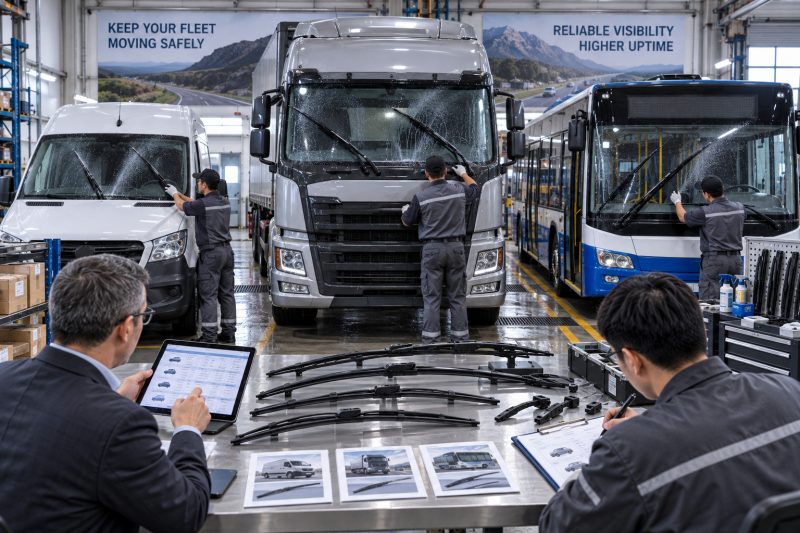
Commercial vehicle wiper blades can create repeat business, but the segment is not a simple extension of a passenger-car catalog. Vans, trucks, and buses have different windshields, maintenance systems, and purchasing requirements.
Although unit volume is lower than for passenger cars, fleets operating similar vehicles can create standardized demand, bulk orders, and predictable replenishment.
The commercial vehicle market is worth evaluating when a supplier can identify specific fleets or popular platforms, verify the complete blade-and-arm system, and demonstrate reliable performance under actual operating conditions. The opportunity comes from uptime, fitment accuracy, and repeat supply—not from stocking every long commercial blade available.
I am Jacky Huang, CEO of Xiamen TOPEX Auto Parts Co., Ltd. I recommend beginning with vehicle applications and a controlled fleet program rather than a long size list.
Why Commercial Vehicle Wiper Blades Offer More Than Additional Sales Volume
A van, truck, or bus earns value while operating. Visibility problems, maintenance delays, and unavailable parts can affect schedules and uptime.
For this reason, fleet buyers may evaluate more than the lowest blade price. Their priorities can include:
- Predictable replacement planning
- Fast and repeatable installation
- Stable fitment across standardized vehicles
- Consistent wiping quality between batches
- Reliable availability of approved SKUs
- Clear batch and warranty records
- Reduced driver complaints
- Fewer unplanned workshop visits
Market research separates light and heavy commercial vehicles from passenger-vehicle categories. Fortune Business Insights describes LCVs and HCVs as smaller-volume segments that still require rugged systems for demanding environments and extended service. For distributors, the practical value lies in concentrated, recurring demand rather than global headline volume.
| Commercial opportunity | Why it matters | Possible supplier value |
|---|---|---|
| Fleet standardization | Similar vehicles use repeatable parts | Focused SKU and inventory planning |
| Scheduled maintenance | Blades can be checked at defined intervals | Predictable replenishment |
| High vehicle use | Performance problems appear quickly | Faster product validation |
| Central purchasing | One approval may cover multiple depots | Larger repeat orders |
| Workshop installation | Time per vehicle affects labor cost | Clear, secure connectors |
| Service records | Complaints and replacement dates can be tracked | Evidence-based improvement |
Fleet records covering vehicle, route, mileage, installation date, failure mode, and replacement interval can distinguish fitment problems from wear or arm faults. The opportunity grows when a distributor supports maintenance rather than merely selling a long blade.
The Mistakes That Make Commercial Wiper Programs Unprofitable
Commercial demand can look attractive, but incorrect assumptions create expensive inventory and warranty exposure.
Treating a Commercial Blade as a Longer Passenger-Car Blade
Increasing length changes pressure distribution, frame loading, wind lift, vibration, and connector stress. A shorter design cannot simply be extended without validation.
Longer applications should be checked for:
- Contact at both blade ends
- Pressure distribution across the full length
- Frame or spring-rail stability
- Connector retention
- Sweep coverage
- Interference with paired blades
- Vibration and chatter
- Wind lift at representative speeds
Promising Coverage Without System-Level Verification
Trucks and buses may use paired blades, pantograph systems, large sweep areas, or specialized connections. Installed angle, arm tension, clearance, and curvature must also be correct.
Ordering Every Commercial Size Equally
Equal allocation can produce shortages for common fleet applications and dead stock for rare sizes.
| Mistake | Hidden cost | Better control |
|---|---|---|
| Buying by length alone | Connector or pressure mismatch | Verify the complete application |
| Equal stock per size | Capital trapped in uncommon products | Allocate by fleet and vehicle parc |
| Selecting on unit price | Failures increase labor and downtime | Compare total operating cost |
| Testing one vehicle | Variation remains undiscovered | Test representative vehicles and positions |
| Ignoring wiper arms | A good blade performs poorly | Inspect arm tension, angle, and condition |
| Accepting vague durability claims | Warranty expectations become unclear | Define test and acceptance criteria |
Ignoring Failure and Downtime Costs
A low-price blade becomes expensive when it creates repeated replacement, complaints, or workshop visits. Buyers should include labor, unscheduled service, warranty administration, and downtime, then compare return-adjusted rather than theoretical margin.
How to Evaluate Demand Across Vans, Trucks and Buses
Vans, trucks, and buses should be researched separately because they serve different routes and buying systems.
| Segment | Typical operation | Purchasing focus | Assortment implication |
|---|---|---|---|
| Service and delivery vans | Urban routes and frequent stops | Availability, price, fast installation | Focus on popular local fleet platforms |
| Long-distance vans | Extended motorway use | Aerodynamic stability and durability | Test at representative speeds |
| Regional trucks | Mixed roads and depot maintenance | Rugged construction and replenishment | Stock proven sizes and connectors |
| Long-haul trucks | High mileage and severe weather exposure | Reliability, reduced downtime, route coverage | Validate climate and high-speed performance |
| City buses | Frequent daily operation and centralized service | Repeatability, visibility, installation time | Standardize approved fleet SKUs |
| Coaches | Motorway travel and large windshields | Long-blade contact and stability | Test full sweep and end pressure |
Start with Identifiable Demand
Useful demand sources include:
- Local commercial vehicle registrations.
- Fleet lists by make, model, year, and quantity.
- Workshop replacement records.
- Distributor enquiries and lost-sale requests.
- Existing sales by blade size and connector.
- Public transport and logistics fleet information.
- Competitor product availability.
- Supplier MOQ and replenishment lead time.
A fleet with similar vans may be more attractive than theoretical coverage of thousands of unrelated models because concentrated demand supports deeper testing and focused stock.
Build a Complete Fitment Record
Each application should record country, vehicle, year, blade position, length, connector, arm type, OE reference, paired arrangement, approved SKU, source, and verification status.
For trucks and buses, useful additional fields may include:
- Flat or split windshield
- Single or paired wiping system
- Conventional or pantograph arm
- Arm length and spring tension where required
- Driver and passenger blade orientation
- Clearance around mirrors or body components
- Washer-nozzle arrangement
The TOPEX truck and bus wiper blade range provides a starting point, while final selection remains vehicle-specific.
What a Commercial-Grade Wiper Blade Program Must Deliver
“Commercial grade” should describe measurable performance and supply control, not stronger-looking construction.
Verify Mechanical and Wiping Performance
A commercial validation plan can include:
- Dimensional and visual inspection
- Connector installation and removal
- Retention or pull-force checks
- Wet wiping for streaks and missed areas
- Noise, chatter, and vibration observation
- End-pressure and windshield-contact checks
- Representative-speed stability
- Cycle or durability testing
- High- and low-temperature evaluation
- UV, ozone, or corrosion testing where relevant
Tests should reflect the market: coastal fleets may prioritize corrosion, northern trucks cold flexibility, and tropical vans UV, heat, and heavy rain.
| Program requirement | Evidence a buyer should request |
|---|---|
| Fitment accuracy | Vehicle application record and installation verification |
| Long-blade contact | Wet test and pressure observation across the glass |
| Connector security | Retention check and installation instructions |
| Material consistency | Approved specification and incoming inspection |
| Weather resistance | Tests selected for the destination climate |
| Batch control | Lot identification and inspection records |
| Repeat supply | Lead time, capacity, and replenishment agreement |
| Corrective action | Complaint, warranty, and root-cause process |
Control the Production Reference
The approved golden sample should be supported by drawings, materials, dimensions, connector specifications, packaging, and test criteria. Production should be compared with this reference.
At TOPEX, I recommend approving representative sizes and connectors. We can support target-fleet review, applications, packaging, samples, inspection, and replenishment planning.
Decide Whether Blades Alone Are Sufficient
Some projects need only blades; others require arms, adapters, washer parts, motors, or a complete system. Weak arm tension, corrosion, incorrect geometry, or damaged pivots may prevent a new blade from wiping correctly.
How to Enter the Market Through a Controlled Fleet Pilot
A fleet pilot converts product claims into operating evidence while controlling market-entry risk.
Define the Pilot Before Installation
The pilot plan should document:
- Vehicle make, model, year, and quantity
- Blade positions, lengths, arms, and connectors
- Existing product and replacement history
- Routes, mileage, climate, and parking conditions
- Sample identification and installation date
- Acceptance criteria
- Inspection schedule
- Driver and workshop feedback method
- Responsibility for failures and replacements
Technicians should inspect the glass, washer system, arms, and mechanism before installation so existing faults are not attributed to the blade.
Measure Performance in Service
| Pilot metric | What it reveals |
|---|---|
| Installation time | Labor efficiency and connector usability |
| Initial wet wiping | Streaking, chatter, and missed areas |
| Driver complaints | Real visibility and noise concerns |
| Inspection results | Wear, looseness, corrosion, or damage |
| Service duration | Actual replacement interval |
| Unscheduled replacement | Reliability and downtime risk |
| Cost per vehicle-month | Commercial performance beyond unit price |
| Reorder decision | Whether demand is repeatable |
Test more than one length when the intended order covers several sizes, and separate results by operating environment where necessary.
After the trial, each application can receive one decision:
- Approve and stock when performance and demand are proven.
- Approve with controlled quantity when demand remains moderate.
- Correct and retest when fitment or instructions need improvement.
- Use seasonally when demand is climate-specific.
- Reject when performance or commercial value is insufficient.
The first bulk order should focus on approved core applications. Sales, inventory age, returns, warranty claims, stockouts, and reorder frequency can guide expansion without a speculative catalog.
Conclusion
The commercial vehicle wiper blade market can be worth entering as a specialized fleet program. Vans, trucks, and buses may require longer blades, stronger structures, different connectors, and consistent high-mileage performance.
Buyers should begin with identifiable fleets or high-volume local applications, verify the complete arm-and-blade system, and run controlled vehicle trials before building inventory. The strongest opportunity often comes from reliable repeat supply, accurate fitment, and reduced downtime—not from carrying every possible commercial SKU.
Frequently Asked Questions About Commercial Vehicle Wiper Blades
How are commercial vehicle wiper blades different from passenger-car blades?
Commercial blades may be longer, use reinforced structures or specialized connectors, and operate on larger or differently shaped windshields. They must also support high vehicle use, fleet maintenance, and demanding weather conditions.
Which commercial vehicle segments offer the best aftermarket opportunity?
The best segment is usually a locally concentrated fleet or popular platform with identifiable replacement demand. Delivery vans, logistics fleets, city buses, and widely used trucks can offer recurring orders when their fitment is verified.
What should buyers test on truck and bus wiper blades?
Buyers should test installation, connector retention, pressure distribution, windshield contact, sweep coverage, noise, vibration, wet wiping, durability, corrosion resistance, and relevant high- or low-temperature performance.
Do longer wiper blades require stronger frames or different pressure distribution?
Longer blades can create greater frame loading, connector stress, wind lift, and pressure-distribution challenges. Their structure and curvature must be designed and tested for the specific arm, windshield, and operating speed.
How can distributors avoid overstocking commercial wiper SKUs?
Begin with known fleets and popular local vehicles, use controlled pilot quantities, and stock only approved core applications deeply. Handle uncertain or long-tail products through small quantities, special orders, or rapid replenishment.
Should a supplier provide complete wiper arms and systems as well as blades?
Not every project requires a complete system. However, the supplier should identify whether the blade, arm, connector, motor, washer equipment, or mechanism causes the problem and clarify which components it can supply and support.

--- END ---
Prev: Regional Wiper Blade Assortments: Europe vs. Latin America vs. Asia-Pacific
Already the latest article


