
Electric Vehicle Wiper Blade Fitment: New Opportunities for Distributors
Sep 18, 2026
Electric vehicles are adding aftermarket applications, but an EV does not automatically require a separate blade category. It still needs secure installation and stable wiping.
The opportunity comes from fitment. New platforms, regional versions, dedicated connectors, curved glass, concealed wipers, and incomplete catalogs can temporarily leave buyers without replacements.
An EV-ready assortment should be built around verified vehicle applications rather than “EV-only” marketing. Buyers should combine proven multi-fit products with OE exact-fit blades where specialized connectors or geometry require them, then expand according to local registrations, searches, sales, and returns.
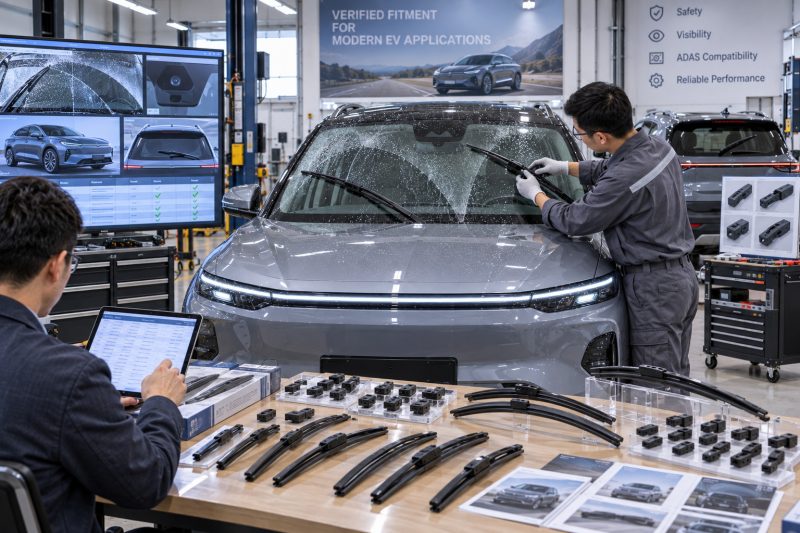
I am Jacky Huang, CEO of Xiamen TOPEX Auto Parts Co., Ltd. I begin EV planning with vehicles already operating in the buyer’s country.
Why New EV Models Are Creating Gaps in Aftermarket Wiper Coverage
New EVs may reach customers before aftermarket suppliers confirm every length, connector, model-year change, and regional configuration.
This delay can create several gaps:
- The vehicle does not appear in a distributor’s lookup tool.
- Only one model year or sales region is listed.
- The driver and passenger positions are reversed.
- A familiar blade length is paired with a new connector.
- Front blades are listed but the rear application is missing.
- A mid-year production change is not reflected in the catalog.
- A product fits physically but does not follow the glass correctly.
These gaps create false positives that cause returns and false negatives that hide compatible products.
| Coverage gap | Customer result | Distributor opportunity |
|---|---|---|
| New EV absent from catalog | No product appears | Verify and publish an early application |
| Connector revision overlooked | Blade cannot be installed | Confirm model year and interface dimensions |
| Regional version copied incorrectly | Listing works in one country but not another | Maintain country-specific records |
| Rear application missing | Only the front pair is sold | Offer complete vehicle coverage |
| Curvature not tested | Blade leaves missed areas | Complete a wet vehicle test |
| Instructions are unclear | Correct product is returned | Add connector images and installation guidance |
Early advantage may be temporary, so distributors should monitor registrations, model launches, customer searches, workshop requests, and failed enquiries. Repeated no-result searches for a popular local EV are stronger purchasing signals than global forecasts.
The “EV-Specific Wiper Blade” Assumptions That Can Mislead Buyers
The phrase “EV wiper blade” does not prove compatibility or performance. Electric powertrains do not create one universal specification.
Assuming Every EV Needs a Unique Blade Technology
EVs use beam, hybrid, conventional, and OE exact-fit designs already familiar in the aftermarket. Similar features also exist on combustion vehicles.
Buyers should avoid these assumptions:
- All EVs use frameless blades.
- An “EV-compatible” label guarantees correct fitment.
- Premium rubber automatically produces quiet wiping.
- Every EV uses a special connector.
- ADAS-equipped vehicles need a universally different blade category.
- A blade fitting one regional version fits the same model worldwide.
Treating ADAS as an EV-Only Requirement
Both electric and combustion vehicles may use forward-facing cameras behind the windshield.
The blade should clear the viewing area without persistent streaks or missed sections. It cannot guarantee ADAS operation, which also depends on glass, cameras, calibration, weather, washers, and other sensors.
Wiper Market’s discussion of EVs and ADAS highlights windshield geometry, aerodynamic performance, camera visibility, and lower cabin noise as important considerations. These should be treated as vehicle-level evaluation points rather than proof of a universal EV specification.
Assuming a Quiet Cabin Guarantees a Quiet Blade Market
Lower powertrain noise can make squeaking, chatter, and vibration more noticeable. Acoustic performance still depends on wetness, rubber, glass, arm pressure, angle, and temperature.
| Marketing claim | What the buyer should verify |
|---|---|
| “Designed for EVs” | Exact vehicle, year, region, position, and connector |
| “ADAS compatible” | Wiping coverage and vehicle-specific requirements |
| “Ultra-quiet” | Wet noise, chatter, friction, and vibration testing |
| “Aerodynamic” | Stable contact at representative vehicle speeds |
| “Universal fit” | Adapter retention, angle, curvature, and instructions |
| “Long life” | Defined durability method and climate conditions |
How to Verify Wiper Blade Fitment for Electric Vehicles
EV fitment requires a disciplined vehicle-level process.
Build a Complete Application Record
Each record should include:
- Sales country or region
- Vehicle make, model, generation, and year
- Production date or revision where relevant
- Driver, passenger, and rear positions
- Blade length for every position
- Wiper-arm type and connector dimensions
- Required adapter or dedicated interface
- Blade structure and curvature
- Parked position and installation clearance
- Product SKU and included components
- Data source, verification status, and review date
The same model name may cover regional differences. Update one controlled database before distributing changes across sales channels.
Inspect the Complete Wiping System
Testers should inspect the glass, washer system, arms, pivots, parked position, and sweep path before blaming the blade.
Physical verification should cover:
- Removing the original blade without damaging the concealed arm or connector.
- Confirming the supplied adapter and installation direction.
- Checking engagement and locking security.
- Verifying blade angle and clearance.
- Confirming complete glass contact, including both ends.
- Testing driver and passenger blade interaction.
- Operating the system on wet glass at several speeds.
- Observing streaks, films, chatter, noise, and missed areas.
- Checking the camera-viewing area where applicable.
- Confirming that the blades return to the intended parked position.
| Verification point | Why it matters |
|---|---|
| Region and model year | Captures market and production differences |
| Connector retention | Prevents loosening or failed installation |
| Spring-rail curvature | Supports contact across shaped glass |
| Driver/passenger pairing | Prevents collision and incomplete coverage |
| Wet wiping | Reveals streaking, chatter, and missed areas |
| Parked position | Checks concealed-system clearance |
| Camera-zone clearing | Supports a clear optical path through the glass |
| Rear application | Enables complete vehicle replacement |
The TOPEX OE exact-fit wiper blade range supports vehicle-specific programs, but every application still requires verification.
How TOPEX Can Support an EV-Ready Wiper Blade Range
At TOPEX, EV coverage begins with the buyer’s country, priority models, channels, price tier, and customer enquiries.
Support can include:
- Vehicle application and position review
- Blade-length and connector references
- Multi-fit and OE exact-fit product options
- Adapter images and installation guidance
- Samples for representative EVs
- Wiping and connector evaluation
- Product and packaging customization
- Mixed-SKU order planning
- Catalog and e-commerce content
- Updates when new applications are confirmed
Combine Multi-Fit Efficiency with Exact-Fit Convenience
A verified multi-fit platform covers common arm types with fewer base SKUs when adapter and vehicle data are reliable.
OE exact-fit blades suit popular EVs with dedicated connectors or unusual geometry but should focus on proven local demand.
| Product approach | Best role in an EV range | Main control needed |
|---|---|---|
| Multi-fit flat blade | Broad mainstream coverage | Verified adapter and application data |
| OE exact-fit blade | Popular specialized applications | Demand by vehicle and model year |
| Hybrid blade | Selected upgrade or climate-specific demand | Vehicle and channel validation |
| Rear blade | SUVs, hatchbacks, and crossovers | Body-style and connector accuracy |
| Seasonal blade | Cold or severe-weather markets | Climate-specific testing and timing |
The TOPEX flat wiper blade range supports different connector programs, but every flat blade is not automatically EV-ready.
Control Samples and Production
The golden sample should document rubber, spring rails, adapter, dimensions, wiping, packaging, labels, and instructions. Small changes in adapter dimensions or curvature can create returns.
How to Expand EV Coverage Without Overbuilding Inventory
The opening assortment should focus on locally significant EVs already generating enquiries.
Classify EV Applications by Commercial Priority
- Core EV applications: Meaningful local registrations, frequent searches, and verified products.
- Growth applications: New models with increasing demand but limited sales history.
- Specialized applications: Dedicated connectors or geometry requiring exact-fit products.
- Long-tail applications: Low local volume, handled through light stock or special orders.
Record every SKU’s coverage, connector, position, quantity, cost, margin, and lead time. Keep new exact-fit quantities controlled.
Use Market Data to Decide Expansion
| Metric | Decision it supports |
|---|---|
| Local EV registrations | Identifies the available vehicle base |
| Vehicle-fitment searches | Reveals active replacement interest |
| No-result searches | Shows possible coverage gaps |
| Sales by application | Confirms real demand |
| Stockout frequency | Identifies understocked core products |
| Fitment-return rate | Reveals connector or data problems |
| Quality-return rate | Reveals wiping or consistency problems |
| Inventory age | Identifies slow-moving EV SKUs |
| Return-adjusted margin | Measures profit after avoidable losses |
Expand products with healthy sales and low returns, correct weak fitment information, and reduce products that remain slow.
A practical expansion sequence is:
- Identify the most common local EV models.
- Confirm all front and rear positions.
- Use verified multi-fit products where they genuinely simplify coverage.
- Add exact-fit SKUs for important specialized applications.
- Test representative samples on actual vehicles.
- Launch controlled quantities through selected channels.
- Track searches, sales, stockouts, returns, and inventory age.
- Expand only after the evidence supports more inventory.
Conclusion
Electric vehicles are creating genuine opportunities for wiper blade distributors, mainly through new-model applications and fitment gaps rather than a universal category of “EV-only” blades.
The strongest opportunity lies in identifying popular EVs before competing catalogs become complete, verifying their connectors and windshield requirements, and offering dependable front and rear coverage. Distributors should combine proven multi-fit products with OE exact-fit blades where specialized connections or geometry require them.
By starting with locally registered EV models, testing samples on actual vehicles, and expanding according to sales, search, and return data, businesses can enter this growing segment without creating excessive inventory.
Frequently Asked Questions About Electric Vehicle Wiper Blade Fitment
Do electric vehicles require special wiper blades?
Not necessarily. EVs still require correct length, secure connection, suitable curvature, and stable wiping. Some models use specialized connectors or geometry, but compatibility must be verified by vehicle rather than an EV marketing label.
Why can wiper blade fitment differ between EV and gasoline models?
They may use different platforms, model years, windshields, arms, connectors, parked positions, and rear configurations. The difference comes from vehicle design, not simply the powertrain.
What EV fitment information should distributors verify?
Verify the country, vehicle, model year, production revision, blade position, length, connector, arm type, adapter, curvature, parked position, sweep coverage, rear application, and approved SKU.
Can multi-fit wiper blades cover most electric vehicles?
Multi-fit products can cover many shared arm types, but no percentage should be accepted without validation. Buyers must test adapter retention, angle, clearance, glass contact, and instructions on priority vehicles.
How do ADAS cameras affect wiper blade selection?
Where a camera looks through the windshield, the blade should clear its viewing area without persistent streaks or missed sections. Wiper performance alone cannot guarantee ADAS operation, which also depends on glass, weather, sensors, mounting, and calibration.
How can distributors expand EV coverage without overstocking?
Begin with locally common EVs, use multi-fit products for verified shared applications, and reserve exact-fit SKUs for proven specialized demand. Expand through sales, search, stockout, return, and inventory-age data.

--- END ---
Already the last article
Already the latest article


