
How to Verify Wiper Blade Fitment Data Before Adding New SKUs: A Distributor’s Checklist
Nov 06, 2026
Adding a new wiper blade SKU is not simply a purchasing decision. It is also a fitment-data decision that can affect returns, inventory turnover, customer confidence and future sales.
I am Jacky Huang, CEO of Xiamen TOPEX Auto Parts Co., Ltd. From our experience supporting wiper blade distributors and private-label buyers, many application problems begin before the product reaches the warehouse. The physical blade may meet its quality specification, but the associated vehicle data may contain an incorrect production year, position, connector or adapter.
A supplier’s coverage list is a useful starting point, but it should not be treated as automatic approval. Before adding a product, distributors need to verify that every vehicle application is connected to the correct blade position, length, connector, adapter and SKU.
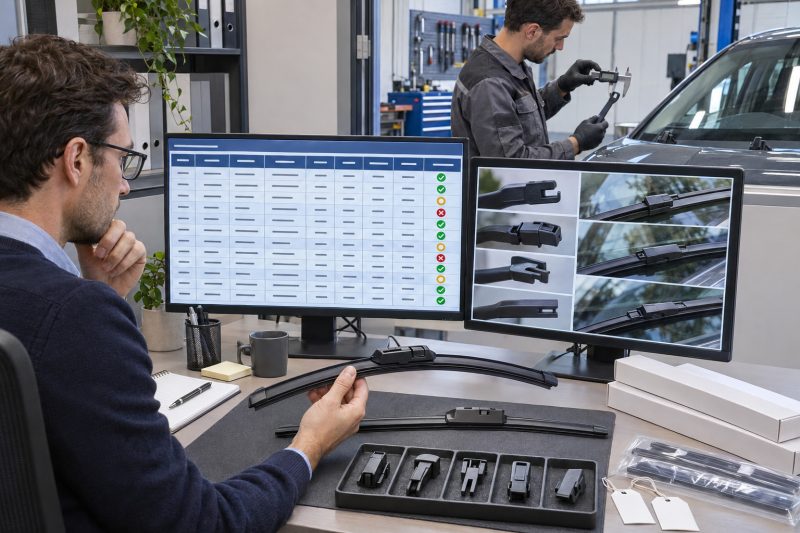
## Why Unverified Fitment Data Turns New SKUs into Returns and Dead Stock
A wiper blade can be well manufactured and still become an unsuccessful SKU if it is listed for the wrong vehicles.
An incorrect application may allow a customer to order a blade that:
– Has the correct nominal length but the wrong connector
– Fits the arm but does not lock securely
– Belongs on the passenger side rather than the driver side
– Uses an adapter that is not included in the package
– Contacts the cowl, trim or opposite blade during operation
– Does not follow the windshield curvature
– Is intended for another vehicle generation or regional version
– Uses a front-blade structure for a vehicle-specific rear application
These errors create false positives: the catalogue recommends a product that does not fit. The result may include a refund, return shipping, inspection, repacking, customer-support work and a negative review.
Fitment data can also create false negatives. In this situation, a compatible blade is missing from the application list, so the customer sees no suitable result and buys from another supplier. Unlike a return, this lost sale may never appear in the distributor’s quality reports.
The commercial impact extends beyond one transaction. If customers repeatedly receive incorrect products, they may stop trusting the distributor’s vehicle finder or catalogue. Workshops can also lose installation time when technicians must open several packages to find the correct adapter.
Unverified applications can turn inventory into dead stock when:
1. A new SKU is purchased for vehicles that do not actually use it.
2. A regional application list is copied into a market with different specifications.
3. The product is correctly designed but cannot be found because its catalogue records are incomplete.
4. Returns lead the sales team to stop recommending the SKU.
5. Replacement data is not updated after a connector or product revision.
A new SKU should therefore be evaluated on both physical-product quality and data quality. Passing a wiping test does not correct an inaccurate application record, just as accurate catalogue data cannot compensate for a poorly manufactured blade.
## The Fitment Data Gaps Distributors Often Miss
Year, make and model are the beginning of verification, not the complete answer. The same model name may cover several generations, body styles, production periods and regional specifications.
A distributor should be cautious when a supplier file contains only four columns: make, model, year and blade size. That format may conceal important differences between vehicles that appear similar in a basic catalogue search.
### Production period and generation
A vehicle manufacturer may introduce a new generation during a calendar year. Two vehicles registered in the same year could therefore use different blade lengths or connectors.
Whenever possible, record the production period by month and year instead of using a broad model-year range. The generation or platform code provides another useful control against accidentally combining old and new applications.
### Sales market and vehicle configuration
A vehicle sold in Europe may not use the same wiper system as a similarly named vehicle sold in Asia-Pacific or Latin America. Differences may involve:
– Left-hand-drive and right-hand-drive layouts
– Local production versions
– Body configurations
– Windshield geometry
– Arm connectors
– Driver- and passenger-side positions
– Rear-wiper designs
Fitment records should identify the relevant sales market. “Global coverage” should not be accepted unless the supplier can provide evidence for the individual regional versions.
### Blade position
Driver, passenger and rear blades must be stored as separate positions. Terms such as “left” and “right” can become ambiguous when data moves between LHD and RHD markets.
For international catalogues, it is safer to record both the physical side and functional position where possible. Rear applications also require separate validation because they commonly use compact, vehicle-specific arms and connectors.
### Connector family and dimensions
A connector name alone may not be precise enough. Push-button, top-lock, side-pin, bayonet and J-hook systems can include different widths, diameters or locking arrangements.
Distributors can review common [wiper blade connection types](https://www.topexwiper.com/blog/wiper-blade-connector-types-fitment-guide/) when creating standardized connector fields. However, the database should also store important dimensions and the required adapter number rather than relying only on a general connector-family name.
### Complete fitment-data checklist
| Fitment field | Information to confirm | Common risk if omitted |
|—|—|—|
| Sales market | Country or region where the application is valid | A similarly named vehicle uses a different wiper system in another market |
| Make and model | Manufacturer and exact vehicle name | Similar model names are incorrectly combined |
| Generation | Vehicle generation or platform code | Data continues across a redesign that changed the wipers |
| Production period | Start and end month and year | A mid-year production change is missed |
| Body style or trim | SUV, hatchback, sedan, estate or relevant version | Rear-wiper or windshield differences remain hidden |
| Blade position | Driver, passenger or rear | Different lengths and product structures are mixed |
| Blade length | Nominal length in millimetres and inches | A correct length is treated as complete proof of fitment |
| Arm connector | Connector family, dimensions and locking method | A visually similar connector does not engage securely |
| Required adapter | Adapter number and installation orientation | The package contains adapters, but the wrong one is selected |
| LHD/RHD relevance | Drive orientation and applicable wiping layout | Data is copied directly from a market with another configuration |
| Product SKU | Exact saleable product linked to the application | The correct vehicle data points to the wrong item |
| Evidence and status | Source, test evidence and approval status | Errors cannot be traced to their origin |
| Revision date | Date of the latest review or change | Obsolete information continues circulating |
Every approved row should link these fields together. Keeping vehicle data, sizes and adapter information in separate uncontrolled spreadsheets increases the risk that one file will be updated while another remains unchanged.
## A Step-by-Step Process for Validating Each Vehicle Application
A repeatable validation process prevents purchasing teams from approving applications on instinct or accepting incomplete coverage claims under time pressure.
### Step 1: Define the exact saleable SKU
Begin with the product, not the vehicle list. Record the SKU’s:
– Blade structure
– Available length
– Installed connector
– Included adapters
– Adapter revision
– Intended blade position
– Spoiler direction, if applicable
– LHD or RHD restrictions
– Packaging contents
– Installation instructions
This step confirms what customers will actually receive. An application cannot be approved if the product definition or adapter contents are still changing.
### Step 2: Normalize the supplier’s vehicle data
Supplier files may use different spellings, year formats and position descriptions. Standardize these records before comparing them with another source.
For example, “front left,” “LH” and “driver side” should not automatically be treated as identical. Their meaning can change according to market and steering position.
Create controlled values for:
– Country or sales region
– Vehicle make and model
– Generation
– Production start and end dates
– Body style
– LHD or RHD
– Driver, passenger or rear position
– Connector code
– Adapter code
– Validation status
### Step 3: Cross-check against independent evidence
Compare the supplier’s application against at least one reliable independent source. Depending on the market, this might include:
– An OE parts catalogue
– A professional automotive aftermarket database
– A trusted regional wiper catalogue
– An established brand’s application finder
– The original blade or OE reference number
– Verified workshop or fleet records
If two sources disagree, do not choose the result that creates the broadest coverage. Mark the record for investigation.
### Step 4: Confirm the original vehicle configuration
Where practical, inspect the vehicle or original blade. Record:
– Original driver-, passenger- and rear-blade lengths
– Arm-end shape and dimensions
– Connector release mechanism
– Original blade orientation
– Wiper-arm layout
– Spoiler direction
– Parked position
– Clearance from the trim and opposite blade
Photographs should show the complete arm, connector close-up, original blade and installed replacement. Measurements should include a scale or calliper where connector dimensions matter.
### Step 5: Conduct an installation test
A blade that can be pushed onto the arm is not necessarily correctly fitted. During installation, verify that:
1. The specified adapter is present in the package.
2. The adapter enters in the correct direction.
3. The locking mechanism closes completely.
4. The blade resists a gentle pull.
5. The connector does not create excessive height or movement.
6. The blade remains correctly oriented on the arm.
7. Installation does not require abnormal force or modification.
Record the adapter number and installation sequence. If a trained technician cannot identify the correct adapter using the supplied instructions, an ordinary customer may face an even greater risk of error.
### Step 6: Test the complete wiping path
Use washer fluid or a controlled water supply rather than testing on dry glass. Observe several complete cycles at different speeds.
Check for:
– Secure connector retention
– Full windshield contact
– End lift
– Fixed streaks
– Missed areas
– Chatter or judder
– Abnormal noise
– Contact with trim or the other blade
– Correct return to the parked position
– Stable spoiler orientation
The record should note the vehicle, glass condition, temperature, blade position and test result. Consistent documentation is central to maintaining [accurate wiper blade fitment data](https://www.topexwiper.com/blog/wiper-blade-fitment-data-reduce-returns-lost-sales/) across purchasing, catalogue and sales systems.
### Step 7: Assign an evidence-based status
Not every record must be approved immediately. A practical status system could include:
– **Verified:** Cross-checked and physically tested
– **Data-verified:** Confirmed through reliable sources but not physically tested
– **Conditional:** Evidence exists, but a field or regional variation requires confirmation
– **Rejected:** Testing or research shows that the application is incorrect
– **Pending:** Critical information is missing
Never convert “pending” into “approved” simply to complete a catalogue. An unavailable listing is usually less damaging than confidently recommending the wrong blade.
## Why Multi-Fit and OE Exact-Fit SKUs Require Different Validation
Multi-fit and exact-fit blades solve different coverage and inventory problems. Their validation procedures should reflect those differences.
| Validation area | Multi-fit blade | OE exact-fit blade |
|—|—|—|
| Connector system | Uses one or more interchangeable adapters | Uses a dedicated or integrated connector |
| Main benefit | Broad coverage with fewer core SKUs | Direct installation and OE-style appearance |
| Main data risk | Wrong adapter selection or overstated coverage | Incorrect vehicle, generation or position assignment |
| Testing requirement | Validate every claimed adapter and important application | Validate the dedicated connector on the specified applications |
| Packaging priority | Clear adapter identification and instructions | Clear vehicle, year and position identification |
| Inventory effect | Can consolidate several connector-specific products | Usually requires more application-specific SKUs |
| Approval evidence | Adapter-to-arm and SKU-to-vehicle validation | Precise SKU-to-vehicle-position validation |
### Validating multi-fit products
A multi-fit blade should not be approved merely because its package contains many adapters. Each claimed application must still satisfy the following conditions:
– The blade length is correct.
– The selected adapter matches the exact arm variation.
– The connector locks securely.
– The installed blade sits at the intended angle.
– The blade follows the windshield curvature.
– The spoiler faces the correct direction.
– The product clears surrounding components.
– The instructions clearly identify the adapter and installation steps.
One adapter may physically connect to several arms but perform poorly on a particular vehicle because of connector height, arm angle or windshield geometry. Physical attachment is only one part of fitment.
For high-volume vehicles, distributors should test the actual combination of SKU, adapter, position and vehicle. Lower-volume applications may initially rely on strong documentary evidence, but their validation status should remain visible.
### Validating exact-fit products
With [OE exact-fit wiper blades](https://www.topexwiper.com/category/oe-exact-fit-wiper-blade/), the connector is normally designed for a narrower group of applications. This can make installation easier, but it increases the importance of precise catalogue linking.
Exact-fit validation should confirm:
– Market-specific vehicle identity
– Generation and production range
– Driver, passenger or rear position
– Dedicated connector dimensions
– Original blade profile
– Spoiler orientation
– Relevant OE reference
– Model-year changes
– Any LHD or RHD limitation
Visual similarity is not sufficient. Two connectors may appear nearly identical while using different widths, locking tabs or installation angles.
“OE exact-fit” also should not automatically be interpreted as “genuine automaker-branded.” It describes the fitment approach. Product origin, branding, material quality and performance still require separate supplier qualification.
## How to Approve, Launch and Maintain New Fitment Records
Fitment approval should follow a documented workflow rather than an informal exchange of spreadsheets between purchasing and sales.
### Establish approval gates
Before a new application goes live, require confirmation that:
– Mandatory data fields are complete.
– The vehicle and product names follow controlled formats.
– Blade position and length are confirmed.
– Connector and adapter information is available.
– The application has been cross-checked.
– Conflicting evidence has been resolved.
– Required installation testing has passed.
– Supporting photographs or documents are stored.
– An owner has approved the record.
– The revision date has been assigned.
High-volume, technically uncertain or strategically important applications should receive stronger physical verification than low-risk records supported by several reliable sources.
### Maintain one master database
A controlled master database should be the source for the website, marketplace listings, printed catalogues, ERP records and customer-service tools.
The master record should contain:
– Unique application ID
– Vehicle and position fields
– Product SKU
– Connector and adapter codes
– Evidence source
– Test status
– Approval owner
– Revision date
– Change history
– Market restrictions
– Notes on installation or exceptions
Updates should be made in the master system first and then distributed to every channel. Correcting a website while leaving the marketplace listing and printed catalogue unchanged does not solve the underlying problem.
### Use a launch checklist
Before releasing a new SKU, confirm the following:
– [ ] Product specifications and packaging contents are frozen.
– [ ] Each priority application is linked to the correct SKU.
– [ ] Adapter numbers match the physical package.
– [ ] Driver, passenger and rear positions are separated.
– [ ] Market and LHD/RHD limitations are visible.
– [ ] Installation instructions use the correct connector images.
– [ ] Sales and customer-service teams can access the same data.
– [ ] Returns can be recorded by vehicle, position and reason.
– [ ] Replacement and supersession relationships are documented.
– [ ] A review date has been scheduled.
### Convert returns into fitment intelligence
A return marked only as “does not fit” provides limited value. The return process should capture:
– Vehicle identification
– Sales market
– Production year or VIN details where available
– Blade position
– Ordered SKU
– Adapter used
– Whether installation was attempted
– Photographs of the arm and connector
– Specific failure description
The problem may be an incorrect catalogue record, wrong customer vehicle selection, missing adapter, difficult instructions, incomplete locking or an actual product defect. Each cause requires a different corrective action.
If the data is wrong, update the master record, document the reason and synchronize the correction across all channels. If the product is difficult to install, revise the instructions or packaging. If the connector itself is defective, investigate the production batch.
### Review records throughout the SKU lifecycle
Fitment maintenance continues after launch. Review records when:
– A new vehicle generation enters the market
– A mid-cycle production change is reported
– The supplier changes an adapter
– Packaging contents are revised
– Returns cluster around one application
– Customer searches produce no results
– Workshops report difficult installation
– An SKU is superseded or discontinued
New products should receive an early review after initial sales. Established applications can follow a scheduled cycle, while high-return or high-volume records deserve immediate attention.
## Conclusion
Adding a new wiper blade SKU should be a data-verification decision, not simply a response to a supplier’s coverage claim. Before approval, distributors should confirm the target market, vehicle generation, production period, blade position, length, arm connector, required adapter and exact product SKU.
High-volume or uncertain applications should also be checked against an independent catalogue and, where practical, tested on the vehicle or original wiper assembly. Multi-fit products and OE exact-fit blades require different validation methods, but neither should be listed without traceable evidence.
Maintaining one controlled fitment database—with revision dates, approval status, source records and return feedback—helps distributors reduce incorrect listings, prevent avoidable returns and expand their assortments with greater confidence.
## FAQ
### 1. What information is required to verify wiper blade fitment?
A reliable record should include the sales market, make, model, generation, production period, body style, blade position, length, connector, required adapter, LHD/RHD relevance and exact product SKU. It should also record the evidence source, verification status and latest revision date.
### 2. Is year, make and model enough to confirm a wiper blade application?
No. Vehicles with the same name may use different wiper systems across generations, production periods, body styles and regional markets. Driver, passenger and rear positions must also be identified separately.
### 3. Why is blade length alone insufficient for confirming fitment?
A blade of the correct length may still have the wrong connector, adapter, installation angle or curvature. It could fail to lock, sit too high, contact surrounding components or leave part of the windshield uncleared.
### 4. How should distributors verify multi-fit wiper blade coverage?
They should validate the stated adapter for each important arm type and vehicle application. Testing should confirm secure locking, correct orientation, windshield contact, sweep clearance and clear installation instructions. The number of adapters in the package is not proof of complete vehicle coverage.
### 5. When is a physical vehicle installation test necessary?
Physical testing is especially important for high-volume vehicles, new models, conflicting catalogue records, unfamiliar connectors, regional variations and applications with uncertain windshield geometry. It is also advisable when the supplier’s coverage claim cannot be supported by an independent source.
### 6. How often should wiper blade fitment data be reviewed and updated?
Data should be reviewed whenever a new vehicle generation, connector change, adapter revision, product supersession or recurring return issue appears. Distributors should also conduct scheduled reviews of active records and ensure every approved application has a visible revision date.

--- END ---
Prev: Wiper Blade Refills vs Complete Blades: A Stocking Guide for Distributors
Already the latest article


