
Do Wiper Blades Affect Rain Sensors? Compatibility Issues Explained
Aug 19, 2026
Rain-sensing wipers can become confusing after a blade replacement. The automatic system may wipe too fast, respond too slowly, activate on a dry windshield, or ignore light rain. Drivers often blame the new blades or the sensor immediately. However, a structured check of settings, glass cleanliness, blade fitment, wiping quality, and recent windshield work can usually identify the real cause.
Wiper blades do not normally communicate electronically with a rain sensor, but they can affect how the system responds. A wrong blade size, weak glass contact, damaged rubber, or uneven wiping can leave water and streaks over the sensing area. The sensor may then appear too sensitive or unresponsive even though its electronic components are operating normally.
As the CEO of Xiamen TOPEX Auto Parts Co., Ltd., I have spent many years working with wiper blade production, fitment, sourcing, export, and aftermarket supply programs. I have learned that buyers should separate mechanical wiping performance from electronic sensor operation. This distinction prevents unnecessary sensor replacement, reduces product returns, and helps service teams solve customer complaints more efficiently.
Why Rain-Sensing Wipers Sometimes Behave Erratically After Blade Replacement
When automatic wipers behave differently after a blade replacement, the timing makes the new blades look responsible. That conclusion is understandable, but it is not always correct. The replacement process may reveal an existing problem with the glass, sensor area, control setting, wiper arm, or sensor mounting. The blades may also be the wrong size or may not contact the glass evenly.
Rain-sensing wipers can behave erratically after replacement when the new blades change the amount or pattern of water left over the sensor area. Incorrect length, poor pressure distribution, loose adapters, contaminated rubber, or skipping can create an uneven water film. However, settings, glass contamination, sensor mounting, wiring, and windshield replacement history must also be checked before blaming the blades.
How a Typical Rain Sensor Detects Water
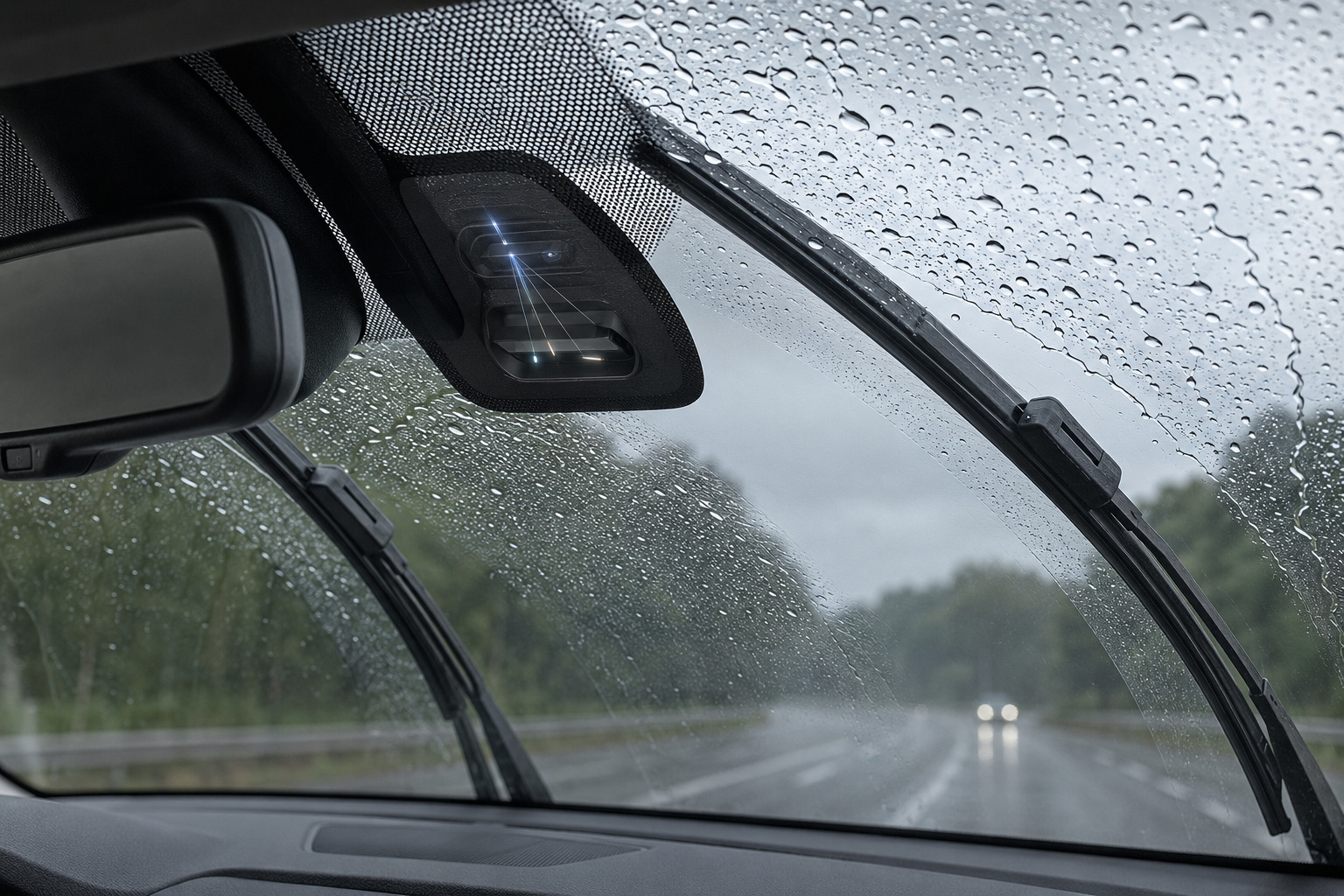
A common rain sensor is installed inside the vehicle near the rearview mirror. It sends light into the windshield and measures changes in reflected light. Water on the outer glass changes the optical condition, and the control system uses that information to determine when the wipers should operate and how frequently they should move.
The wiper blades and sensor are therefore connected through the condition of the glass rather than through direct electronic communication. The blades remove water from the sensor’s viewing zone. If they clear the area smoothly, the sensor receives a more stable optical condition after each pass. If they leave streaks or standing water, the sensor may continue detecting moisture and command additional wiping.
This indirect relationship is important for parts retailers, repair chains, and customer service teams. A blade does not need a special electronic connection to influence automatic operation. It only needs to change how water remains on the glass. I recommend explaining this point before discussing sensor replacement because it gives drivers a clearer and more realistic understanding of the system.
Why the Problem May Appear Immediately After Replacement
A new blade can expose compatibility problems within the first few wiping cycles. An incorrect blade length may not clear the intended area. A connector may appear attached but remain partly unlocked. A blade with unsuitable curvature may place too much pressure in one section and too little in another. Protective material or residue may also remain on the rubber edge.
The replacement process can also change the control setting accidentally. A driver or technician may move the wiper stalk from automatic mode to an intermittent or manual position. The sensitivity control may be adjusted without anyone noticing. For this reason, I always recommend confirming the vehicle controls before removing or replacing any additional component.
| Symptom after blade replacement | Possible blade-related cause | Possible non-blade cause | First practical check |
|---|---|---|---|
| Wipers operate too often | Water film remains over the sensor area | Sensitivity is set too high | Clean the glass and reduce sensitivity |
| Wipers respond too slowly | Blade pushes water unevenly near the sensor | Sensitivity is too low or the sensor is obstructed | Raise sensitivity and inspect the sensing area |
| Wipers do not start automatically | Wrong wiping coverage or severe smearing | Automatic mode is off or the sensor has lost its connection | Confirm automatic mode and test manual operation |
| Wipers chatter repeatedly | Poor rubber contact or wrong blade curvature | Dirty glass, dry wiping, or arm problems | Wet and clean the windshield before retesting |
| Wipers work manually but not automatically | Usually not caused by the blade motor function | Sensor, setting, wiring, mounting, or calibration issue | Check controls and recent windshield work |
I advise distributors and service businesses to document exactly when the behavior changed. The customer should describe whether the concern occurs in light rain, heavy rain, road spray, or all conditions. This information helps distinguish a repeatable blade-performance issue from a sensor response that changes with water intensity, sensitivity settings, or optical conditions.
The Compatibility Mistakes Drivers Often Blame on the Rain Sensor
Many drivers use the phrase “sensor problem” for any unusual automatic wiping behavior. However, the rain sensor is only one part of the system. Blade length, connector selection, windshield contact, glass cleanliness, wiper arm condition, control settings, sensor mounting, and vehicle electronics can all affect the final result. Replacing the sensor first can waste time and money.
The most common compatibility mistakes involve choosing the wrong blade length, using an unsuitable adapter, installing the blade incompletely, or accepting poor contact with the windshield. Drivers also overlook contamination near the sensor and problems caused by recent glass work. I recommend checking these mechanical and surface conditions before beginning electronic diagnosis or ordering a replacement sensor.
Wrong Length and Connector Selection
A blade that is too long can contact the windshield edge, vehicle trim, or the other blade. A blade that is too short may leave part of the intended wiping zone uncleared. Either problem can affect visibility, and incomplete coverage near the sensor may change the automatic system’s response. Length should always be confirmed by vehicle make, model, year, and wiping position.
Connector selection is just as important. Modern vehicles use several wiper arm designs, and a blade package may include multiple adapters. A connector that looks similar may still have different locking dimensions or installation steps. If the adapter does not lock correctly, the blade can move, tilt, chatter, or lose stable pressure during operation.
From a B2B purchasing view, unclear adapter identification creates a major return risk. E-commerce buyers may order the correct length but select the wrong connection. Retail employees may also recommend a visually similar product without checking the application guide. I recommend supporting every product with clear fitment data, adapter images, and simple installation instructions.
Uneven Pressure and Poor Windshield Conformity
A correctly sized blade can still perform poorly when its pressure pattern does not match the windshield. Modern windshields have different curves, and a blade needs to maintain contact across its complete wiping edge. Poor conformity can leave water in the center, at the ends, or through a section that crosses the rain sensor’s detection area.
Buyers should not judge conformity only by looking at a stationary blade. The blade must be tested while moving across a properly wet windshield. The test should show whether the rubber changes direction smoothly, whether the structure remains stable, and whether the complete sweep becomes clear without repeated streaks.
A practical compatibility inspection should cover these points:
- Confirm the vehicle make, model, year, and body version.
- Verify the correct driver-side and passenger-side blade lengths.
- Identify the exact wiper arm and required adapter.
- Check that the connector locks completely without loose movement.
- Confirm that the two blades do not contact each other during operation.
- Inspect whether the rubber edge touches the glass across its full length.
- Wet the windshield before testing to avoid misleading dry-wipe noise.
- Watch the sensor area for a water film, streaks, or missed sections.
- Repeat the test at more than one wiper speed.
- Confirm that the blade remains stable during normal road use.
Contamination Around the Sensor Area
Dirt, wax, insects, oily residue, and some glass-care products can change the optical condition near the sensor. A film may cause the system to react differently even when the blades are correctly fitted. The blade edge can also collect contamination and spread it through the sensing zone with every wiping pass.
I recommend cleaning both the outer windshield and the blade edge before diagnosing a sensor failure. The vehicle manufacturer’s instructions should guide the choice of cleaning products because glass treatments, tint materials, and sensor designs differ. Drivers should also avoid assuming that a surface is clean simply because it looks clear under indoor lighting.
Guidance on rain-sensing wiper diagnosis also identifies settings, windshield film, sensor mounting, glass work, and gel pads as areas to inspect. These checks support a simple principle that I use in troubleshooting: confirm low-cost and visible causes before replacing an electronic component.
How to Check Wiper Blade Compatibility with a Rain-Sensing System
A compatibility check should answer two separate questions. First, does the blade fit and operate correctly on the vehicle? Second, does it clear the sensor area without leaving an unstable water pattern? Drivers, retailers, and service technicians need both answers. A blade can attach securely but still produce poor wiping results on a particular windshield.
To check compatibility, I first verify the vehicle application, blade length, arm type, adapter, and installation. I then inspect pressure and wiping coverage on a wet windshield. The blade should pass through the sensor area smoothly without leaving repeated streaks, a water film, or a missed section. Automatic operation should only be evaluated after manual wiping performance is confirmed.
Begin with Application Data, Not a Visual Match
A visual match is not enough because small connector differences can affect security and blade angle. I recommend using current vehicle application information and confirming whether the product is intended for the front driver side, front passenger side, or rear window. Buyers should pay attention to model-year changes because one vehicle name may use different arms across generations.
Automotive wholesalers need application data that matches their sales region. A vehicle range in North America can differ from one sold under the same model name in Europe or the Middle East. National retail chains also need synchronized catalog and package data, while e-commerce sellers need accurate fitment records that support search filters and reduce avoidable returns.
The TOPEX flat wiper blade range includes different adapter and blade options for aftermarket programs. I work with buyers to narrow those choices according to their vehicle coverage, target price level, inventory plan, and packaging channel. The goal is not to offer the largest possible selection without control. The goal is to build useful coverage with clear application logic.
Test Manual Wiping Before Testing Automatic Mode
Manual wiping provides a direct view of the blade’s mechanical performance. The driver should wet the windshield evenly and operate the blades at a normal manual setting. If the blades streak, skip, chatter, or miss an area during manual operation, the problem should be corrected before the rain sensor is evaluated.
This order prevents confusion because automatic operation adds settings and electronic decisions to the test. A driver may interpret irregular wiping intervals as a blade problem when the mechanical pass is actually clean. The opposite can also happen. The automatic system may respond correctly to remaining water, but poor blades may make the repeated wiping appear like a sensor fault.
| Compatibility check | Acceptable result | Warning sign | Recommended decision |
|---|---|---|---|
| Blade length | Full intended coverage without interference | Contact with trim or incomplete wiping area | Reconfirm the application and size |
| Adapter fit | Positive lock with stable blade position | Loose movement or incomplete engagement | Select the correct connector |
| Glass contact | Continuous contact across the rubber edge | Raised center, lifted end, or uneven pressure | Try a more suitable blade structure |
| Manual wet test | Smooth and clear wiping | Streaking, skipping, smearing, or noise | Clean, reinstall, or replace the blade |
| Sensor-zone clearing | No repeated water film or missed section | Water remains over the sensing area | Investigate blade contact and glass condition |
| Automatic test | Response changes reasonably with water level and setting | No response or unrelated continuous activation | Check settings, sensor, mounting, and diagnostics |
Compare Blade Structures Without Making Assumptions
Flat, hybrid, and conventional blades can all work on rain-sensing vehicles when they are correctly fitted and provide suitable wiping performance. A rain sensor does not automatically require a flat blade or a product marked specifically for automatic wipers. Vehicle application and windshield performance matter more than a broad marketing label.
Flat blades can offer a low profile and distributed contact through their internal spring structure. Hybrid blades use a supporting frame with an external cover, which can provide a familiar pressure structure with a protected appearance. Conventional blades remain useful in many vehicle and price segments. Each option has advantages, but no structure can overcome incorrect length or poor adapter selection.
| Blade structure | Potential advantage | Compatibility concern | B2B purchasing consideration |
|---|---|---|---|
| Flat blade | Low profile and continuous pressure design | Curvature and adapter must match the vehicle | Useful for modern coverage and premium ranges |
| Hybrid blade | Framed support with an external protective cover | Additional components can affect weight and fit | Suitable for balanced mid-to-premium programs |
| Conventional blade | Familiar construction and broad market recognition | Exposed joints can collect contamination | Useful for economy and established applications |
| Multi-fit blade | Can reduce the number of stocked products | Instructions must clearly identify each adapter | Helpful when SKU reduction is a priority |
| OE-style blade | Vehicle-focused connector and appearance | Narrower application can increase SKU count | Useful when exact-fit confidence supports the channel |
I recommend that buyers approve a product through a complete sample process. The review should cover fitment, wiping, packaging, labeling, instructions, and application data. A good blade with an incorrect label can still create returns, while excellent fitment data cannot compensate for weak wiping quality. The physical product and information system must support each other.
Wiper Blade Problem or Rain Sensor Fault? How to Tell the Difference
A correct diagnosis starts with the symptom pattern. Blade faults usually remain visible during both manual and automatic wiping because the blade continues making the same physical contact with the glass. Sensor faults often affect when the blades start, stop, or change frequency. However, both problems can exist at the same time, so buyers and technicians should avoid relying on one symptom alone.
Streaking, chattering, skipping, scraping, and consistent missed sections usually point toward the blades, wiper arms, installation, or windshield surface. Manual wiping that remains smooth while automatic mode fails points more strongly toward settings, sensor contamination, optical mounting, wiring, calibration, or module communication. I recommend testing both modes and documenting the difference before selecting a replacement part.
Signs That Usually Point Toward a Blade Problem
A blade-related problem follows the movement of the blade. A streak may appear in the same position after every pass. A loose connector may produce repeated movement or noise. A damaged rubber edge may smear water across the same section, while poor curvature may leave a consistent area uncleared.
These symptoms can often be observed without diagnostic equipment. The technician should inspect the rubber, verify installation, clean the surfaces, and repeat a wet test. If a fresh and correctly fitted blade clears the problem during manual operation, the original concern was likely mechanical rather than electronic.
The following patterns usually justify closer inspection of the blade system:
- A streak appears in the same location after each wiping pass.
- The blade chatters or jumps on a properly wet windshield.
- One end of the blade does not remain in contact with the glass.
- The adapter moves or makes a clicking sound during operation.
- The rubber edge is cracked, torn, twisted, or permanently deformed.
- The blades touch each other, the vehicle trim, or the windshield edge.
- Manual and automatic modes show the same poor wiping result.
- Reinstalling or replacing the blade changes the symptom immediately.
For wholesale and retail buyers, repeated reports of the same symptom across different customers deserve a product review. The cause may involve adapter tolerance, rubber consistency, pressure distribution, packaging damage, or incorrect application data. I prefer to compare the complaint against retained samples and production information instead of treating every return as user error.
Signs That Usually Point Toward the Sensor System
A sensor-related concern often appears when the blades work correctly in manual mode but behave incorrectly in automatic mode. The system may fail to activate, respond only in heavy rain, wipe continuously on mostly dry glass, or ignore changes to the sensitivity control. These symptoms require checks beyond the blade itself.
The sensing area should be clean, and the automatic function should be enabled. If the concern began after windshield replacement, the technician should inspect whether the sensor was transferred correctly, whether its electrical connection is secure, and whether its optical coupling to the glass is free from bubbles, gaps, contamination, or unsuitable adhesive.
| Symptom pattern | More likely area | Reason | Next action |
|---|---|---|---|
| Poor wiping in manual and automatic modes | Blade, arm, glass, or installation | The physical wiping defect remains in both modes | Inspect fitment and perform a wet test |
| Good manual wiping but no automatic response | Setting, sensor, wiring, or control module | The motor and blades can operate normally | Confirm automatic mode and continue diagnosis |
| Problem starts after windshield replacement | Sensor mounting, glass, connection, or calibration | Glass work can disturb the optical and electrical installation | Return to the glass installer or qualified technician |
| Continuous wiping with clean blade passes | Sensitivity, contamination, or sensor interpretation | The blade clears correctly but the command continues | Clean the sensing area and check settings |
| One fixed section always remains wet | Blade pressure or windshield contact | The missed area follows the blade sweep | Test another correctly matched blade |
| Automatic response changes after cleaning | Surface contamination | The optical condition was affected by residue | Maintain the glass and monitor performance |
Why Windshield Replacement Deserves Special Attention
Routine blade replacement normally does not require rain sensor calibration because the blade is outside the vehicle and does not change the sensor’s electronic connection. Windshield replacement is different. The sensor may need to be removed, transferred, remounted, reconnected, or initialized according to the vehicle’s service procedure.
The optical pad between the sensor and glass is especially important. Bubbles, gaps, dirt, damage, or incorrect positioning can interfere with optical contact. Replacement glass may also have to meet vehicle-specific requirements around the sensor location. I advise drivers to return to the glass installer when the problem starts immediately after windshield work.
Calibration requirements vary by vehicle, so I would not apply one universal procedure. Some systems may initialize through a defined vehicle process, while others may need compatible diagnostic equipment and manufacturer-specific steps. A qualified technician should follow the correct service information instead of relying on a generic online calibration instruction.
How TOPEX Helps Buyers Reduce False Compatibility Complaints
At TOPEX, I focus on the part of this system that a wiper blade supplier can control. This includes blade construction, adapter selection, pressure distribution, wiping quality, application support, product labeling, and packaging information. We do not treat a rain sensor fault as a blade problem, but we help buyers reduce mechanical issues that can make sensor behavior appear unreliable.
A strong B2B program should connect product selection with the customer’s sales channel. Wholesalers need manageable SKU coverage. National retail chains need clear packaging and stable launch supply. E-commerce sellers need accurate application data and images. Service chains need quick installation and fewer repeat complaints. Each buyer may select a different product structure, but all need dependable fitment information.
The TOPEX hybrid wiper blade category provides another option for buyers comparing construction, appearance, application, and market position. I recommend testing representative vehicles before a large order and reviewing customer instructions at the same time. Good mechanical performance and clear fitment communication can prevent many complaints from being incorrectly described as rain sensor incompatibility.
A Step-by-Step Workflow for Fixing Rain-Sensing Wiper Problems
Random part replacement makes rain-sensing wiper diagnosis more expensive than necessary. A better process moves from simple checks to more technical checks. It begins with driver controls and surface cleanliness, continues through blade fitment and manual operation, and only then moves toward windshield history, sensor mounting, electrical diagnosis, and calibration.
I recommend following this order: confirm automatic mode and sensitivity, clean the sensor area, verify blade size and installation, test the blades manually on wet glass, review recent windshield work, and seek professional diagnosis if the problem remains. This workflow separates common maintenance problems from sensor-system faults and reduces unnecessary blade, sensor, or control-module replacement.
Step 1: Confirm the Controls and Reproduce the Complaint
The driver should first confirm that the vehicle has a rain-sensing function and that the control is in the correct automatic position. Some intermittent controls can look similar to rain-sensing settings. The owner’s manual should explain the exact control position, sensitivity adjustment, and any operating limits for the vehicle.
The symptom should then be reproduced under safe conditions. The driver should record whether the system responds to light water, heavier water, road spray, or no visible moisture. A short video can help a technician understand intermittent behavior, but the driver should never use a phone while controlling a moving vehicle.
Step 2: Clean the Windshield and Blade Edges
The outer glass near the sensor should be cleaned with a product suitable for the vehicle and windshield. Wax, oily films, insects, cleaner residue, and other contamination should be removed carefully. The blade edge should also be wiped because contaminated rubber can immediately spread residue back across clean glass.
Drivers should not apply an unfamiliar coating directly over the sensing area without checking vehicle and product guidance. Some coatings can change how water forms or moves across the glass. Even if the sensor still functions, the response pattern may feel different because droplet size and water movement have changed.
Step 3: Verify Blade Fitment and Installation
The next check should confirm the blade lengths, positions, adapters, and locking condition. The technician should make sure that no protective strip remains on the rubber and that the blade body has not been bent during installation or transport. The blades should move freely without touching each other or surrounding trim.
The inspection should also confirm glass contact along the full edge. A visible gap may explain a missed area, but some pressure problems only appear during movement. For this reason, the fitment inspection must be followed by a wet wiping test rather than ending with a stationary visual check.
Step 4: Compare Manual and Automatic Operation
The windshield should be wet before manual testing. The technician should observe wiping coverage, sound, smoothness, and water left near the sensor. If manual wiping is poor, the blade, adapter, arm, or glass surface should be corrected first. Automatic response cannot be evaluated reliably while the physical wiping result remains defective.
If manual wiping is clean and stable, the technician can switch to automatic mode and test different sensitivity settings according to the vehicle instructions. A failure limited to automatic mode makes the sensor system more likely, although contamination and glass condition still need to be considered.
Step 5: Review Recent Windshield or Electrical Work
The driver should identify whether the problem began after a windshield replacement, sensor removal, mirror-area repair, collision, battery service, wiring repair, or accessory installation. Timing does not prove the cause, but it gives the technician a useful direction for inspection.
After glass work, the technician should inspect the sensor’s position, mounting, optical pad, electrical connection, and surrounding windshield area. If a connector was left loose or the optical contact contains bubbles, installing another set of wiper blades will not correct the automatic function.
Step 6: Use Professional Diagnosis When Basic Checks Fail
A qualified technician may need to read diagnostic trouble codes, inspect live data, test wiring, confirm switch inputs, evaluate the rain sensor, and check calibration requirements. The exact process depends on the vehicle, so the technician should use appropriate service information and compatible equipment.
I recommend professional help when the blades work manually but automatic mode remains unavailable, when the problem began after windshield replacement, when the sensor area shows mounting defects, or when electrical warnings appear. Drivers should use manual control whenever necessary to maintain visibility until the automatic system is repaired.
A service team can use this final checklist:
- Confirm that the vehicle is equipped with factory or verified aftermarket rain sensing.
- Check the automatic-mode position and sensitivity setting.
- Clean the outer glass and blade edges.
- Verify blade length, adapter, installation, and wiping coverage.
- Test manual operation on a properly wet windshield.
- Compare manual and automatic symptom patterns.
- Review windshield, collision, battery, and electrical repair history.
- Inspect the sensor mount, optical coupling pad, and connector.
- Check vehicle-specific diagnostic codes and live data where available.
- Perform calibration only when required by the correct service procedure.
- Document the final cause before replacing components.
- Confirm reliable visibility in safe wet-test conditions after the repair.
For B2B buyers, the next step is to prepare the target market, vehicle application list, required blade structures, estimated quantities, packaging needs, and expected quality position. I can use this information to recommend samples and discuss production planning. A clear request shortens communication and helps both sides identify fitment or inventory risks before a full order.
Conclusion
Wiper blades do not normally communicate directly with a vehicle’s rain sensor, but incorrect size, weak glass contact, poor installation, or uneven wiping can leave water over the sensing area and make automatic operation appear inconsistent. I recommend confirming settings, cleaning the glass, checking blade fitment, and comparing manual with automatic operation before replacing the sensor. If the concern began after windshield replacement, the sensor mounting, optical pad, electrical connection, replacement glass, and vehicle-specific calibration requirements deserve closer inspection. This structured approach helps drivers restore reliable visibility, while helping retailers, wholesalers, and service chains reduce unnecessary returns, incorrect repairs, and avoidable customer complaints.
Frequently Asked Questions About Wiper Blades and Rain Sensor Compatibility
Can the wrong wiper blades affect how a vehicle rain sensor responds?
Yes, the wrong blades can affect the system indirectly. A rain sensor usually observes optical changes through the windshield, while the blades clear water from the outer surface. If an incorrect blade leaves a film, streak, or missed section across the sensing area, the system may wipe too often or respond too slowly. I recommend checking size, adapter, contact, and wet wiping performance first.
Do vehicles with automatic rain sensors require specially designed wiper blades?
Most rain-sensing vehicles do not require blades that communicate with the sensor or contain special electronics. However, they do require blades that match the vehicle and clear the windshield correctly. I select blades by make, model, year, length, arm type, windshield contact, and operating conditions. A “rain sensor compatible” label should never replace a proper vehicle application check.
Why did my automatic wipers stop working after I replaced the blades?
The control may have been moved out of automatic mode, or the sensitivity setting may have changed during replacement. The new blade may also have an incorrect adapter, length, or pressure pattern. I recommend testing manual wiping first. If manual operation is clean and normal but automatic mode remains inactive, the sensor area, settings, connection, mounting, or vehicle electronics need further inspection.
How can I tell whether my wiper blades or rain sensor are faulty?
I compare manual and automatic operation. If the blades streak, chatter, skip, or miss the same section in both modes, I first suspect a blade, arm, installation, or glass-surface issue. If manual wiping remains smooth but automatic activation fails or behaves strangely, I check the controls, sensor area, optical mounting, wiring, diagnostic codes, and calibration requirements.
Does every rain sensor need calibration after a windshield replacement?
Calibration requirements depend on the vehicle and the system design, so I do not recommend one universal answer. Windshield replacement can disturb the sensor, optical pad, electrical connection, or relationship with the new glass. A qualified technician should follow the vehicle manufacturer’s service procedure and confirm whether mounting inspection, initialization, static calibration, dynamic calibration, or diagnostic equipment is required.
Can windshield coatings, wax, dirt, or cleaner residue interfere with rain-sensing wipers?
Yes, contamination and surface treatments can change the optical condition or the way water forms near the sensing area. Dirt, insects, oily film, wax, and cleaner residue can also be spread by the blade. I recommend cleaning the windshield and rubber edge with suitable products before replacing components. Drivers should also check vehicle guidance before applying coatings over the sensor zone.

--- END ---


