
Truck and Bus Wiper Blades: A Distributor’s Sourcing Guide
Nov 04, 2026
Truck and bus wiper blades should not be selected simply by finding a heavy-looking product in a long size. Commercial vehicles use different windshield shapes, arm layouts, connectors and blade positions. A product that works on one truck cab may be unsuitable for another truck from the same manufacturer, while a city bus and a long-distance coach may require completely different wiping systems.
For distributors, the commercial opportunity extends beyond selling replacement blades. Fleet customers also need accurate fitment, predictable availability, consistent batches and packaging that helps maintenance teams identify and install the correct product quickly.
I am Jacky Huang, CEO of Xiamen TOPEX Auto Parts Co., Ltd. From our experience with commercial and aftermarket wiper programmes, successful sourcing begins with the exact vehicle and wiper system—not with a generic description such as “heavy-duty truck blade.”
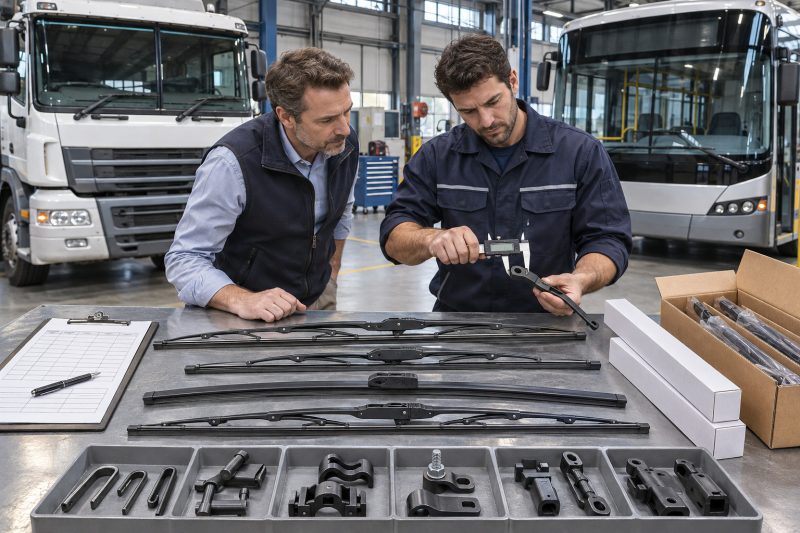
Why Commercial Vehicle Wiper Failures Cost More Than a Replacement Blade
The purchase price of a commercial wiper blade is only one part of its actual operating cost. When a blade fails on a fleet vehicle, the business may also face workshop labour, unscheduled maintenance, driver complaints and temporary vehicle unavailability.
A city bus, delivery truck or long-distance coach may operate on a fixed timetable. If a wiper cannot maintain acceptable visibility during rain, the vehicle may need to return to the depot or wait for a replacement.
The commercial effect can include:
- Vehicle downtime
- Disrupted delivery or passenger schedules
- Additional workshop labour
- Emergency replacement purchases
- Driver complaints
- Repeat maintenance
- Warranty claims
- Lost fleet contracts
- Damage to the distributor’s reputation
| Cost area | Example of commercial impact |
|---|---|
| Product replacement | Cost of another blade or complete pair |
| Workshop labour | Removal, diagnosis and reinstallation |
| Vehicle downtime | Missed route, delivery or service assignment |
| Emergency logistics | Express shipping or transfer from another depot |
| Inventory shortage | Correct blade unavailable when required |
| Driver dissatisfaction | Repeated complaints about streaking or noise |
| Fleet administration | Claim records and supplier communication |
| Customer retention | Fleet changes distributor after recurring failures |
For a private motorist, replacing a faulty blade may be a small inconvenience. For a fleet with dozens or hundreds of vehicles, the same defect can appear across multiple units and create an unexpected maintenance workload.
This is why fleet buyers often value consistency and availability more than a small reduction in unit price. A slightly cheaper blade becomes expensive if it produces more installation work, fitment claims or early replacements.
A distributor should therefore compare suppliers using a broader commercial model:
Total commercial cost = landed blade cost + installation labour + return handling + warranty replacements + emergency freight + downtime exposure
The best sourcing decision is not necessarily the most advanced product or the lowest quotation. It is the product and supply programme that provide dependable fitment, repeatable performance and predictable replenishment.
The Sourcing Mistakes That Create Fitment Problems and Dead Stock
Commercial wiper sourcing becomes risky when buyers treat all trucks and buses as one uniform category.
Treating a Commercial Blade as a Longer Passenger-Car Blade
A truck or bus blade contains the same basic functional elements as other wiper blades: a wiping edge, a supporting structure and a connector. However, commercial applications can introduce different mechanical demands.
These may include:
- Longer wiping spans
- Larger or flatter glass areas
- Split windshields
- Panoramic bus windshields
- Stronger or differently configured arms
- Sustained highway airflow
- Higher vibration
- Frequent daily use
- Commercial-vehicle connectors
The correct product must be matched to the actual system. Length alone does not turn a passenger-car blade into a commercial blade.
Ordering by Length Alone
There is no single standardized “truck size” or “bus size.” Different vehicles may use blades of the same nominal length but require different connectors, structures or installation angles.
For example, two 28-inch products may differ in:
- Connector width
- Mounting direction
- Pin diameter
- Bolt spacing
- Frame construction
- Curvature
- Refill profile
- Left or right position
- Wiper-arm pressure compatibility
Length should therefore be one field within a complete specification.
Assuming Connector Names Are Sufficient
Commercial vehicles may use U-hooks, side pins, saddle fittings, bolt-on connections, flat arms, buttons or OE-specific interfaces.
A description such as “side pin” may still be incomplete because the diameter, position and locking method can differ. Buyers should request or supply:
- A clear arm-end photograph
- Connector measurements
- Installation direction
- Locking details
- Original blade photographs
- OE reference number
- A physical sample when necessary
Ignoring Wiper Layout
Commercial vehicles may use:
- Tandem arms moving in the same general direction
- Opposed arms moving away from and toward the centre
- A single large arm
- Multiple blades on a wide windshield
- Pantograph-style arrangements in certain applications
The layout affects blade clearance, sweep overlap, parked position and potentially spoiler orientation. A blade that fits the arm may still interfere with another blade or fail to cover the intended area.
Assuming All Commercial Blades Must Be “Heavy-Duty”
“Heavy-duty” is often used as a broad marketing term. It does not replace a technical specification.
A reinforced framed blade may be suitable for one truck, while a lower-profile beam blade may perform better on another application. Some buses may use specialized structures or complete wiper systems.
Buyers should define the requirement through measurable factors rather than appearance:
- Vehicle application
- Connector retention
- Pressure distribution
- Wiping performance
- Corrosion protection
- Temperature performance
- Material consistency
- Durability test method
Buying Every Available Commercial Size
A large commercial catalogue can create dead stock if quantities are not connected to local fleets.
Distributors should not divide an opening order equally among all available lengths. They should identify the trucks, buses, vans and coaches operating in their territory and allocate inventory accordingly.
High-volume fleet applications deserve deeper stock. Uncommon applications can be handled through controlled quantities or special orders.
How to Specify Truck and Bus Wiper Blades Correctly
A complete specification allows the supplier to select or develop the correct blade and reduces repeated sample revisions.
Commercial Wiper Blade Specification Table
| Check item | Information the buyer should provide or confirm | Common risk if ignored |
|---|---|---|
| Vehicle application | Make, model, year, body or cab version | Different vehicles from the same brand may not share fitment |
| OEM reference | OE part number or verified cross-reference | Product selected by appearance alone |
| Blade position | Driver side, passenger side or single-arm position | Left and right structures installed incorrectly |
| Blade length | Actual blade length and measurement method | Contact with seals or incomplete wiping |
| Connector | Type, dimensions, entry direction and locking method | Installation failure or detachment |
| Wiper layout | Tandem, opposed or single-arm system | Incorrect clearance or sweep geometry |
| Windshield design | Split, relatively flat or panoramic curved glass | Tip lift or uneven pressure |
| Arm pressure | Arm downforce and mechanical condition | Judder, noise or missed centre section |
| Operating conditions | Highway, city, mine, cold or coastal use | Wind, dust, temperature or corrosion problems |
| Blade construction | Framed, beam, hybrid or OE-specific | Structure unsuitable for the application |
| Refill material | Rubber, silicone or specific coating construction | Material label does not reflect actual performance |
| Packaging | Individual, paired, fleet bulk or retail package | Warehouse and installation errors |
Begin with Vehicle Identity
Provide the complete vehicle information:
- Manufacturer
- Model
- Model year
- Cab, body or coach version
- Destination market
- Left- or right-hand drive
- Driver, passenger or other position
A model name alone may be insufficient. The same truck platform can use different cabs, windshields or wiper systems.
Use the OEM Number Where Available
An OEM part number or reliable cross-reference provides a stronger starting point than length alone. It can help distinguish between products that look similar but use different connections.
The reference should still be checked against the exact vehicle, because part numbers can be superseded or vary by market.
Measure the Blade Correctly
Measure the blade itself from end to end, excluding the wiper arm. Record whether the measurement includes projecting end caps or another specific reference point.
Do not measure from the arm pivot. Photograph the measurement so that the supplier understands how it was taken.
Document the Connector
Take photographs from several angles:
- Complete arm and blade
- Arm end after blade removal
- Connector from both sides
- Locking mechanism
- Pin, hook or bolt dimensions
- Installation direction
- Any product number moulded into the component
A ruler or digital caliper should appear in photographs of critical dimensions.
Identify the Windshield and Sweep
A split truck windshield usually creates a different contact and clearance requirement from a panoramic coach windshield. The supplier should know whether the glass is relatively flat, strongly curved or divided by a centre post.
Record whether the blades move in tandem, in opposed directions or through another arrangement.
Evaluate the Arm
A new blade cannot compensate for a bent, loose or weak arm. Before declaring a sample defective, inspect:
- Arm alignment
- Pivot condition
- Downforce
- Connector wear
- Corrosion
- Installed blade angle
- Movement through the complete sweep
If arm pressure is part of the specification, use an agreed measurement method rather than judging it only by hand.
Define the Operating Environment
Commercial vehicles operate under very different conditions. A city bus may wipe frequently at low speed, while a long-haul truck experiences sustained airflow. A mining vehicle may face abrasive dust, and a coastal fleet may require greater corrosion resistance.
The sourcing specification should identify:
- Typical vehicle speed
- Daily operating hours
- Rainfall
- Dust or mud exposure
- UV intensity
- Snow and ice
- Road salt
- Coastal conditions
- Outdoor parking
- Washer-fluid chemistry
This information helps determine which material, coating and construction should be evaluated.
What Makes Commercial Wiper Requirements Different from Passenger-Car Applications
Commercial blades are not automatically superior to passenger-car blades, and not every commercial vehicle requires the same reinforced structure. The difference is that the application may expose the wiping system to a more demanding combination of geometry, duty cycle and operating conditions.
Larger Windshields and Longer Sweep Arcs
Longer blades are more difficult to keep in continuous contact with the glass. A design that performs well at 18 inches may develop centre gaps, tip lift or uneven pressure at 32 or 40 inches.
Long samples should therefore be tested separately rather than approved from a shorter version of the same product family.
Different Windshield Designs
| Windshield format | Possible sourcing concern |
|---|---|
| Split truck windshield | Centre-post clearance and independent blade positions |
| Relatively flat truck glass | Pressure distribution across a long span |
| Panoramic bus windshield | Curvature and end contact |
| Tall coach windshield | Long sweep arc and aerodynamic stability |
| Multiple-blade system | Interference, overlap and parked positions |
| Single-arm system | Connector load and application-specific geometry |
A product should be evaluated against the actual windshield instead of being selected from a generic commercial-vehicle label.
Sustained Airflow
Long-haul trucks and coaches may operate for extended periods at highway speed. Airflow can expose weaknesses in:
- Spoiler design
- Frame stiffness
- Adapter retention
- Blade angle
- Arm pressure
- End contact
A stationary wet test is necessary for initial evaluation, but it cannot confirm every aspect of high-speed performance.
Vibration and Connector Retention
Commercial vehicles may experience continuous vibration from the engine, road and chassis. The connector must remain secure during service.
Sample testing should include:
- Lock engagement
- Gentle pull verification
- Movement between blade and arm
- Repeated installation where relevant
- Inspection after operational testing
A connector that feels loose when new should not be accepted on the assumption that it will stabilize during use.
Dust, Salt and Environmental Aging
Dust can abrade the wiping edge, while UV and temperature cycling can accelerate rubber aging. Road salt and coastal exposure may attack frames, rivets and connectors.
Buyers should ask what was tested, under which method and on which exact product. A material name alone does not prove resistance.
For example, “silicone” may describe a solid silicone wiping element, a blended compound or a surface treatment. The exact construction and supporting data should be documented.
Frequent Fleet Maintenance
Commercial fleets may replace blades according to inspection results or planned maintenance intervals. This makes supply continuity especially important.
Fleet customers may value:
- Stable product codes
- Repeatable fitment
- Consistent materials
- Bulk workshop packaging
- Clear position labels
- Batch traceability
- Dependable lead times
- Quick replacement support
The TOPEX truck and bus wiper blade range provides commercial product options that distributors can evaluate against specific vehicles, connectors and operating conditions.
How to Qualify a Supplier and Plan a Lower-Risk First Order
Supplier approval should combine factory evaluation, representative sample testing and a controlled production order.
Verify the Supplier’s Manufacturing Role
Confirm:
- Legal company identity
- Factory address
- Production processes
- Assembly capability
- Adapter production or sourcing
- Quality-control responsibilities
- Subcontracted operations
- Export experience
- Production capacity
- Batch traceability
A catalogue does not demonstrate manufacturing control. The supplier should be able to explain where frames, rubber elements, adapters and packages are produced and inspected.
Review Production and Quality Controls
A commercial wiper supplier should control:
- Incoming materials
- Rubber profile and wiping edge
- Frame or spring structure
- Surface treatment
- Connector dimensions
- Adapter assembly
- Riveting or fastening
- Finished-product appearance
- Wiping performance
- Packaging accuracy
- Batch identification
The TOPEX supplier audit checklist provides a broader framework for checking manufacturing identity, fitment data, testing, traceability and corrective-action systems.
Build a Representative Sample Set
Do not approve the programme from one convenient blade.
Test:
- Short, medium and long commercial lengths
- Driver- and passenger-side applications
- U-hook, side-pin, bolt-on and OE-specific connectors
- Split truck and panoramic bus windshields
- LHD and RHD vehicles where relevant
- Framed, beam and other structures included in the order
- High-volume fleet models in the local market
- Complete blades and refills if both will be sold
Each sample should be identified by product code, size, connector, vehicle and batch.
Test on Clean, Wet Glass
Record:
- Secure installation
- Connector retention
- Sweep clearance
- Full-length contact
- Fine streaks
- Cloudy smearing
- Missed bands
- Tip lift
- Noise
- Judder
- Parked position
- Interference with seals or other blades
Use fixed-angle photographs to record wiping patterns and videos with sound to capture noise, jumping or loss of contact.
A short test confirms initial fitment and wiping behaviour. It does not prove service life or batch consistency.
Approve a Golden Sample
After revisions are complete, retain a signed Golden Sample representing the final:
- Blade structure
- Length
- Rubber specification
- Frame or spring
- Connector
- Adapter
- Coating
- Logo
- Package
- Barcode
- Instructions
- Carton markings
The Golden Sample should be supported by written specifications and measurable acceptance criteria.
Begin with a Mixed-SKU Trial Order
The first commercial order should prioritize proven local applications rather than the supplier’s entire truck and bus catalogue.
A lower-risk mix may include:
- Deeper quantities for high-volume fleet models
- Moderate quantities for developing applications
- Limited quantities for long-tail products
- Representative connector types
- Several important lengths
- Standard packaging where customization is not yet necessary
This approach allows the distributor to verify actual demand, fitment claims and supplier execution before expanding.
Complete a Pre-Shipment Inspection
Random production units should be compared with the approved references before shipment.
Inspect:
- Product identity and quantity
- Length and connector dimensions
- Appearance and assembly
- Adapter operation
- Sample wiping performance
- Package contents
- Labels and barcodes
- Carton protection
- Batch information
- Shipping documents
After the goods arrive, monitor fitment returns, wiping complaints, reorder frequency and inventory age by SKU.
Conclusion
Sourcing truck and bus wiper blades requires more than selecting a heavy-looking blade in the correct nominal length. Distributors should identify the exact vehicle application, blade position, OEM reference, connector dimensions, wiper-arm layout, windshield geometry and operating environment before requesting samples or quotations.
Commercial fleets also value predictable availability, consistent batch quality and packaging that simplifies warehouse and workshop handling. The safest sourcing process is to test representative applications, document the approved materials and construction, retain a Golden Sample and begin with a controlled mixed-SKU order.
This approach helps distributors reduce fitment claims, prevent slow-moving inventory and build a reliable replacement programme for fleet customers.
Frequently Asked Questions
How are truck and bus wiper blades different from passenger-car blades?
Commercial applications may use longer sizes, different connectors, larger windshields and more demanding operating cycles. However, the exact requirements depend on the vehicle. A commercial blade should not be defined simply as a longer passenger-car blade.
What information is needed to identify a commercial wiper blade?
Provide the vehicle make, model, year, cab or body version, market, drive orientation, blade position, OEM number, length, connector photographs and dimensions, windshield design and wiper layout.
Are truck and bus wiper blade sizes standardized?
No single size fits all trucks or buses. The required length depends on windshield geometry, arm reach, pivot position and sweep pattern. Use an OEM reference, verified fitment record or accurately measured original blade.
Which connectors are commonly used on commercial vehicle wipers?
Applications may use U-hooks, side pins, saddle fittings, buttons, flat arms, bolt-on connections or proprietary OE systems. Connector dimensions and locking direction must be confirmed in addition to the connector name.
How should distributors test truck and bus wiper blade samples?
Test representative lengths and connectors on actual high-volume fleet vehicles. Check installation, retention, sweep clearance, windshield contact, streaking, missed areas, noise, judder and parked position on clean, wet glass.
What should buyers check when evaluating a commercial wiper blade supplier?
Verify manufacturing identity, material control, connector and adapter production, assembly, inspection, fitment data, traceability, capacity, lead-time reliability, packaging capability and corrective-action procedures. Approval should remain conditional until a trial order performs successfully.

--- END ---


