
How to Build a Profitable Wiper Blade Product Mix for Your Market
Sep 04, 2026
A profitable wiper blade range is not necessarily the largest range. It is a carefully selected combination of products that covers important local vehicles, serves different customer budgets, and turns inventory at a sustainable rate.
Distributors often focus heavily on one product type. Some concentrate on low-cost conventional blades, while others move almost entirely toward beam or OE-fit products. This approach can leave significant demand uncovered because vehicle age, arm connections, price expectations, and purchasing habits vary within the same market.
A profitable wiper blade product mix should combine conventional blades for value demand, beam blades for modern and premium applications, hybrid blades for mid-range differentiation, and OE-fit products for high-volume vehicle-specific replacements. Quantities should reflect local vehicle data, fitment requirements, sales channels, and actual SKU performance—not a universal percentage.
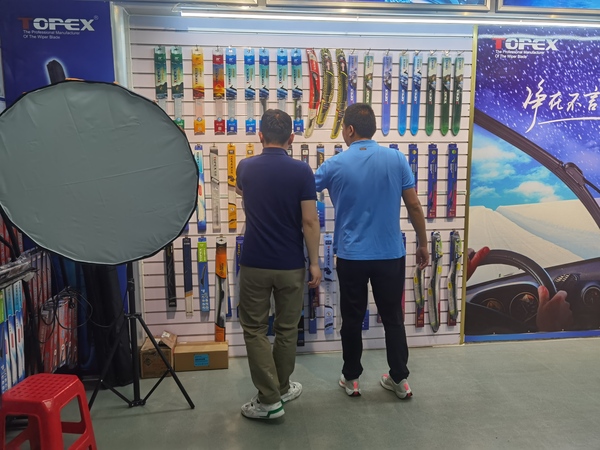
I am Jacky Huang, CEO of Xiamen TOPEX Auto Parts Co., Ltd. When a distributor asks me which wiper blade type is best, I rarely recommend only one. The correct answer depends on the vehicles, climate, customer expectations, and retail prices in that distributor’s market.
The goal is not to make every category equally large. It is to assign each product type a clear commercial role and stock it according to verified demand.
Why Stocking Too Much of One Wiper Blade Type Limits Sales
No single blade construction covers every customer and vehicle equally well. Conventional, beam, and hybrid blades use different structures, while OE fitment describes how a product matches a particular vehicle application and connector.
A distributor that depends too heavily on one category may lose sales at both ends of the market. An economy-only range may not satisfy customers looking for modern appearance or easier vehicle-specific installation. A premium-only range may exclude older vehicles and price-sensitive buyers.
Stocking too much of one blade type limits sales because the market contains different vehicle ages, windshield designs, connectors, budgets, and performance expectations. A balanced range gives customers an entry-level option, one or more upgrade choices, and accurate solutions for important OE applications.
Vehicle Age Influences Product Demand
Older vehicle populations often support demand for:
- Conventional framed blades
- Common U-hook connections
- Economy and standard price tiers
- Familiar installation methods
- Broad replacement availability
Newer vehicles may create stronger demand for:
- Beam or frameless blades
- Push-button, pinch-tab, side-pin, or top-lock connections
- OE-style appearance
- Vehicle-specific adapters
- Unequal driver- and passenger-side pairs
- More accurate model-year data
The vehicle population should therefore influence the depth of each category. A market dominated by older vehicles should not copy the assortment of a market dominated by newer passenger cars.
Customer Budgets Require Multiple Price Points
Customers do not all define value in the same way. One buyer may want the lowest acceptable replacement price, while another prefers modern design, quieter operation, or direct-fit installation.
A practical product architecture can include:
| Product tier | Possible blade type | Main customer need |
|---|---|---|
| Entry | Conventional framed blade | Affordable replacement |
| Standard | Conventional or basic beam blade | Balanced cost and performance |
| Upgrade | Beam or hybrid blade | Modern appearance and improved positioning |
| Premium | Advanced beam, hybrid, or OE-fit blade | Fitment confidence and higher-value features |
| Vehicle-specific | OE exact-fit blade | Direct application and easier installation |
The product differences should be meaningful. Several nearly identical blades with different packaging can confuse customers without creating real market coverage.
One Product Type Can Create Inventory Imbalance
If the distributor buys deeply into only one category, it may have excess stock in that range while frequently losing orders for other applications.
Inventory imbalance may lead to:
- Stockouts of requested connectors
- Excess quantities of common lengths
- Lower basket value
- Emergency purchases
- Slow-moving premium or economy products
- Lost vehicle-specific sales
- Customer dependence on competitors
- Reduced cash available for new applications
The product mix should be evaluated at SKU level rather than only by category value.
The Product-Mix Mistakes That Create Returns and Dead Stock
A mixed range can still fail if quantities are allocated mechanically. Conventional, beam, hybrid, and OE-fit products should not automatically receive equal inventory because they serve different vehicles and commercial roles.
The most common product-mix mistakes are allocating equal quantities to every category, selecting products only by length, treating OE fitment as a separate construction, accepting unverified coverage claims, and adding long-tail applications without evidence of demand.
Treating OE Fitment as a Construction Type
Conventional, beam, and hybrid describe the blade’s physical construction:
- A conventional blade normally uses an articulated frame and several pressure points.
- A beam blade uses a frameless or low-profile structure with shaped spring rails.
- A hybrid blade generally combines a supporting frame with an aerodynamic cover.
OE or exact fit primarily describes application-specific compatibility. An OE-fit blade may use a beam, hybrid, or framed construction.
The distributor should therefore record both characteristics.
| Classification | Example |
|---|---|
| Construction | Beam blade |
| Fitment approach | OE exact fit |
| Position | Driver side |
| Length | Vehicle-specific |
| Connector | Dedicated push-button adapter |
| Application | Defined make, model, and year |
This prevents catalogue confusion and improves purchasing analysis.
Selecting Products Only by Length
A 24-inch blade is not automatically compatible with every vehicle using that length. The arm type, adapter, blade position, installed angle, and windshield curvature also matter.
The SKU plan should consider:
- Vehicle make
- Model
- Model year
- Driver, passenger, or rear position
- Blade length
- Arm connection
- Adapter code
- Windshield curvature
- Product structure
- Installation instructions
A retailer can stock the correct length and still generate a return if the connector is wrong.
Chasing Maximum Theoretical Coverage
A multi-fit product may reduce SKU pressure, but its coverage should be verified on important local vehicles. A very high advertised percentage does not prove that every adapter locks securely or that the blade follows every windshield correctly.
Buyers should test:
- Adapter engagement
- Connector retention
- Blade angle
- Windshield contact
- End pressure
- Installation steps
- Driver- and passenger-side pairing
- Package instructions
Reliable coverage of high-demand applications is more valuable than broad theoretical coverage supported by incomplete data.
Giving Long-Tail Products Too Much Inventory
Uncommon OE applications can help a distributor provide better service, but they should not receive the same quantity as core products.
Long-tail items can be handled through:
- Light stock
- Centralized inventory
- Special orders
- Supplier replenishment
- Marketplace listings without deep local stock
- Periodic mixed-SKU shipments
This preserves application coverage while limiting dead stock.
How to Balance Conventional, Beam, Hybrid and OE-Fit Blades
The right balance begins with five factors: vehicle age, application structure, climate, customer price bands, and sales channels. The distributor should then compare these factors with historical sales and return data.
Conventional blades should cover important entry-level and older-vehicle demand, beam blades should support modern and upgrade applications, hybrid blades should provide mid-range or premium differentiation, and OE-fit products should focus on popular vehicles where direct installation justifies dedicated stock.
Conventional Blades: Protect the Entry-Level Segment
Conventional blades remain commercially relevant because they offer familiar construction, broad availability, and accessible pricing.
They are particularly useful for:
- Older vehicles
- Common U-hook applications
- Price-sensitive customers
- Independent repair shops
- Wholesale channels
- Markets where framed blades remain familiar
The TOPEX comparison of hybrid and conventional wiper blades provides additional information about their different structures and market roles.
Conventional blades should not be removed simply because beam products are growing. Doing so may eliminate an important entry price point.
Beam Blades: Serve Modern and Upgrade Demand
Beam blades use shaped spring rails rather than an exposed articulated frame. A correctly designed blade can distribute pressure continuously across curved glass and maintain a low-profile aerodynamic appearance.
The TOPEX flat wiper blade range gives distributors options for modern aftermarket programs and different connector requirements.
Beam-blade performance still depends on:
- Spring-rail curvature
- Rubber-edge quality
- Arm pressure
- Adapter alignment
- Windshield shape
- Blade length
- Manufacturing consistency
The word “beam” alone does not guarantee superior performance on every vehicle.
Hybrid Blades: Create a Middle or Premium Tier
Hybrid blades generally combine frame-supported pressure distribution with an aerodynamic cover. They can provide a visual and commercial bridge between conventional and fully frameless products.
The TOPEX hybrid wiper blade range can support buyers seeking an additional product tier.
Hybrid blades may appeal to:
- Customers upgrading from conventional blades
- Buyers who prefer a protected frame
- Retail programs requiring visual differentiation
- Applications designed for hybrid construction
- Markets needing a mid-range alternative
Buyers should check the cover, joints, frame alignment, rubber quality, and complete wiping result.
OE-Fit Blades: Focus on Proven Applications
OE-fit blades are useful when direct vehicle compatibility creates meaningful customer value. Their dedicated connectors can simplify installation and reduce the need to select from several loose adapters.
However, every vehicle-specific product adds inventory complexity. OE-fit blades should initially focus on:
- Popular local vehicles
- High-volume model years
- Applications with known replacement demand
- Vehicles using modern or unusual arm connections
- Products with accurate fitment data
- Applications where customers value direct installation
The distributor can expand OE coverage after the first range demonstrates stable sales.
Include Rear Blades in the Product Plan
Rear blades are easily overlooked, but SUVs, crossovers, hatchbacks, and estate cars create recurring demand. Rear connectors are often highly vehicle-specific.
A focused rear range can:
- Increase basket value
- Complete front-and-rear replacement
- Improve vehicle coverage
- Differentiate the distributor
- Support online application searches
Rear blades should be selected according to local vehicle registrations rather than treated as one universal category.
How TOPEX Helps Distributors Build a Market-Specific Wiper Range
At TOPEX, I begin product-mix planning by asking about the buyer’s country, vehicle population, sales channel, price levels, climate, and existing sales. These details help us recommend a focused range instead of applying one global assortment to every market.
TOPEX supports market-specific product planning through conventional, beam, hybrid, OE exact-fit, rear, and specialty blade options, together with connector information, vehicle applications, sample evaluation, private-label packaging, and mixed-SKU order planning.
Building the Initial Product Architecture
A distributor may begin with:
- One entry-level conventional range
- One standard or premium beam range
- One hybrid upgrade range where demand exists
- OE-fit products for high-volume applications
- Selected rear blades
- Seasonal products where climate requires them
The exact combination depends on local demand. Some markets may need deep conventional coverage, while others require stronger beam and OE-fit programs.
Fitment and SKU Support
Before finalizing the range, we can review:
- Important vehicle makes
- Model years
- Driver- and passenger-side lengths
- Rear applications
- Arm types
- Adapter requirements
- Product positions
- Packaging
- Quantities by SKU
- Replenishment plans
Representative samples should then be tested for connector security, windshield contact, wiping, noise, and installation simplicity.
Private-Label and Packaging Options
Depending on the project, private-label support may include:
- Logo application
- Product colors
- Printed boxes, cards, sleeves, or blister packs
- Size and adapter labels
- Barcodes
- Installation diagrams
- Carton markings
- Product images
- Online product information
Packaging should communicate the product tier and fitment clearly. It should help customers understand why a conventional, beam, hybrid, or OE-fit product occupies a particular price position.
Start with a Controlled Range and Optimize It with Sales Data
A new distributor cannot know the perfect product mix before launch. Vehicle data and competitor research provide a strong starting point, but actual sales and return results must refine the range.
The lowest-risk strategy is to launch core products in controlled quantities, track performance by SKU, increase products with strong sell-through and return-adjusted margin, correct fitment problems, and discontinue products that remain unproductive.
Build a Controlled Trial Range
The first order should record:
- Product code
- Construction type
- OE or multi-fit classification
- Length
- Adapter
- Vehicle applications
- Opening quantity
- Landed cost
- Selling price
- Target margin
- Reorder point
- Supplier lead time
Do not judge the order only by total category quantity. Review the commercial purpose and exposure of every SKU.
Track the Right Inventory Metrics
| Metric | What it reveals |
|---|---|
| Sell-through rate | How quickly each SKU sells |
| Inventory age | Products becoming slow-moving |
| Weeks of supply | Stock relative to expected demand |
| Stockout frequency | Core products requiring more inventory |
| Fitment-return rate | Application or adapter problems |
| Quality-return rate | Wiping or construction problems |
| Gross margin | Basic product profitability |
| Return-adjusted margin | Profit after returns and warranty costs |
| Reorder frequency | Actual replenishment demand |
| Attachment rate | Front, rear, or paired-blade sales opportunity |
Fitment returns and quality returns should be recorded separately. An incorrect application listing requires a different response from defective rubber or unstable wiping.
Adjust the Range by Evidence
After the trial period, assign each SKU an action:
- Expand: strong sales, healthy margin, and low returns
- Maintain: stable but moderate performance
- Correct: demand exists, but fitment or packaging needs improvement
- Reduce: inventory is deeper than actual demand
- Discontinue: sales and strategic value remain weak
- Seasonal hold: retain the product but change the stocking period
The second order should not repeat the first order automatically. It should reflect what the market has demonstrated.
Review the Mix Regularly
Vehicle populations and customer expectations change. New vehicles enter the aftermarket, while older applications may remain commercially important for many years.
A regular review can examine:
- Sales by construction
- Sales by connector
- Sales by vehicle age
- Price-tier performance
- Front and rear demand
- Seasonal changes
- Competitor activity
- Customer inquiries
- Supplier lead time
- Inventory value and age
This process keeps the range aligned with the actual market rather than the original purchasing assumptions.
Conclusion
A profitable wiper blade range should reflect the vehicles, budgets, climates, and buying habits of the distributor’s actual market. Conventional blades can support older vehicles and entry-level price points, while beam blades meet demand for modern appearance, aerodynamic stability, and curved-windshield contact.
Hybrid blades provide a useful middle or premium tier, and OE-fit products simplify installation for specific high-demand applications. OE fitment should not be confused with blade construction because an OE-fit product may use a beam, hybrid, or framed design.
These categories should not receive equal inventory automatically. Distributors should begin with local vehicle data, verify size and connector compatibility, launch controlled quantities, and use sell-through, return rates, margins, and replenishment frequency to adjust the mix over time.
Frequently Asked Questions About Wiper Blade Product Mixes
What is the difference between conventional, beam, and hybrid wiper blades?
Conventional blades use an articulated frame with multiple pressure points. Beam blades use shaped spring rails in a low-profile or frameless structure. Hybrid blades generally combine a supporting frame with an aerodynamic cover. Each structure serves different vehicle, price, and positioning requirements.
Are OE-fit wiper blades a separate blade structure?
No. OE fitment primarily describes vehicle-specific compatibility and connector design. An OE-fit blade may use a conventional, beam, or hybrid structure. Distributors should record construction and fitment method separately.
Which wiper blade types should distributors stock first?
Begin with products covering common local vehicles and price levels. This often includes conventional blades for entry demand, beam blades for modern applications, selected hybrid upgrades, OE-fit products for popular vehicles, and rear blades for common SUVs and hatchbacks.
How should local vehicle age influence the product mix?
Markets with older vehicles may require deeper conventional and U-hook coverage. Markets with newer vehicles may require more beam, hybrid, and OE-specific products with modern connectors. Vehicle age should be combined with actual sales and application data.
Can multi-fit beam blades reduce the number of required SKUs?
Yes, verified multi-fit platforms can cover several arm types with fewer base products. However, buyers must test adapter locking, installation angle, windshield contact, and vehicle applications before relying on broad coverage claims.
Which data should distributors use to adjust their wiper blade range?
Useful data includes sell-through, inventory age, stockouts, fitment returns, quality returns, gross margin, return-adjusted margin, reorder frequency, vehicle applications, seasonal demand, and customer inquiries. SKU-level results should guide expansion and discontinuation decisions.

--- END ---


