
LHD vs RHD Wiper Blades: A Fitment Guide for Importers
Nov 03, 2026
Left-hand drive and right-hand drive do not automatically represent two completely separate wiper blade categories. Many symmetrical conventional blades and reversible aftermarket products can work in both markets. However, drive orientation becomes important when the application uses different left and right lengths, a directional spoiler, an offset connector, an asymmetric blade or an OE-specific installation.
For importers, the safest approach is to confirm the complete vehicle application instead of purchasing by length or destination country alone. The same model name may use different wiper systems across production years, regional specifications and body versions.
I am Jacky Huang, CEO of Xiamen TOPEX Auto Parts Co., Ltd. From our experience supporting global wiper blade programmes, LHD and RHD compatibility should be treated as a fitment field that must be verified—not as an assumption based on a “universal” product description.
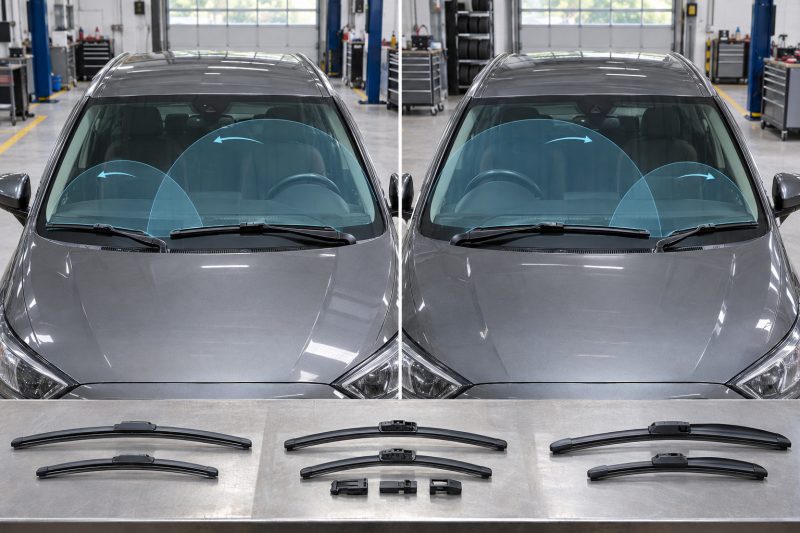
Why Importers Must Confirm Drive Orientation Before Ordering Wiper Blades
LHD means the driver normally sits on the left side of the vehicle, while RHD places the driver on the right. This difference affects the primary viewing area, but it does not tell buyers everything about the wiper system.
The vehicle manufacturer may also change:
- Wiper-arm pivot locations
- Driver- and passenger-side blade lengths
- Sweep direction
- Tandem or opposed arm layout
- Connector orientation
- Spoiler direction
- Parked blade position
- Windshield curvature
- Blade construction
- Left- and right-side product design
A blade that fits the connector may still perform poorly if its spoiler faces the wrong direction or its spring structure does not match the windshield. At higher road speeds, an incorrectly oriented spoiler may fail to use airflow as intended, increasing the possibility of unstable contact or blade lift.
Wipertech identifies spoiler position and wiper-arm configuration—such as tandem or opposed—as important differences when comparing LHD and RHD applications. Importers should therefore inspect the actual wiper system rather than assuming that changing the steering-wheel side only reverses the blade lengths.
| Check item | LHD market | RHD market | Action for the importer |
|---|---|---|---|
| Driver position | Driver normally sits on the vehicle’s left | Driver normally sits on the vehicle’s right | Do not translate “driver side” automatically as left |
| Primary viewing area | Emphasis usually falls in front of the left-side driver | Emphasis usually falls in front of the right-side driver | Verify the original sweep coverage |
| Blade length | Left and right combination varies by vehicle | Left and right combination varies by vehicle | Never infer lengths from drive orientation alone |
| Wiper-arm layout | May use tandem, opposed or another layout | May use tandem, opposed or another layout | Inspect the arm pivots and sweep direction |
| Spoiler orientation | May require a defined airflow direction | Direction may differ from the LHD version | Confirm whether the spoiler is reversible or specific |
| Connector | Depends on vehicle, year and arm design | Depends on vehicle, year and arm design | Verify connector family, dimensions and lock |
| Package position | May use LH/RH or driver/passenger labels | Position meaning changes with drive orientation | Use clear vehicle and physical-position information |
| Stocking method | Based on locally registered LHD applications | Based on locally registered RHD applications | Do not build the range from drive side alone |
Importers should be particularly careful when the same vehicle model is sold in both LHD and RHD countries. Although the vehicle may retain the same model name, the windshield, wiper arms, blade pair or spoiler design may not be identical.
Ordering the wrong version can create:
- Failed installations
- Reduced driver-side coverage
- Blade interference
- High-speed lift
- Noise or judder
- Fitment-related returns
- Incorrect online listings
- Slow-moving inventory
Drive orientation should therefore be recorded alongside make, model, year, body style and sales market in every fitment database.
The LHD and RHD Fitment Mistakes That Create Avoidable Returns
Most LHD and RHD errors do not begin with a visibly defective blade. They begin with incomplete product data or ambiguous position labels.
Purchasing by Length Alone
Two blades may share the same nominal length while using different connectors, spoiler directions, curvatures or mounting positions.
Length confirms only the wiping span. It does not confirm:
- Arm compatibility
- Adapter dimensions
- Blade angle
- Driver or passenger position
- Spoiler orientation
- Windshield conformity
- Sweep clearance
A 24-inch LHD blade and a 24-inch RHD blade may be interchangeable in one product design but position-specific in another.
Treating “Driver Side” as “Left Side”
This is one of the most avoidable catalogue and packaging errors.
For an LHD vehicle:
- The driver-side blade is normally on the vehicle’s left.
- The passenger-side blade is normally on the vehicle’s right.
For an RHD vehicle:
- The driver-side blade is normally on the vehicle’s right.
- The passenger-side blade is normally on the vehicle’s left.
Importers should store both the functional position and the physical position. A reliable record might identify a blade as:
Driver side / vehicle right / RHD application
This format reduces confusion when information is transferred between factories, distributors, marketplaces and packaging designers.
Assuming the Driver-Side Blade Is Always Longer
The driver-side blade is often longer because manufacturers want to maximize the cleared area in front of the driver. However, this is not a universal engineering rule.
Blade length depends on:
- Windshield dimensions
- Glass curvature
- Arm pivot locations
- Sweep overlap
- Parked position
- Cowl and A-pillar clearance
- Tandem or opposed movement
- Vehicle styling
Do not reverse an LHD size pair automatically when preparing an RHD application. Use market-specific vehicle data.
Interchanging Left and Right Blades
Even when both blades have the same connector, they may not be interchangeable. One side may use:
- A different length
- A directional spoiler
- A different curvature
- An offset mounting point
- A side-specific end profile
- A different adapter orientation
The blades should be treated as a pair of position-specific components until the supplier confirms that the design is symmetrical or reversible.
Ignoring Spoiler Direction
A directional spoiler is intended to interact with airflow in a particular installed orientation. Reversing the blade may place the spoiler on the wrong side of the structure.
Possible results include:
- Reduced aerodynamic pressure
- Blade lift at higher speeds
- Increased vibration
- Uneven windshield contact
- Noise
- Poor appearance
A symmetrical blade without a directional spoiler may be less sensitive to LHD/RHD orientation, but this must still be confirmed for the connector and application.
Believing “Multi-Fit” Means Every Vehicle
A multi-fit blade uses a common platform and a selection of adapters to cover several arm types. It does not guarantee compatibility with every LHD and RHD vehicle.
The buyer must still verify:
- Blade length
- Vehicle position
- Arm connector
- Connector dimensions
- Required adapter
- Windshield curvature
- Spoiler direction
- Sweep clearance
- Model year
- Market specification
The TOPEX guide to LHD and RHD wiper blade fitment provides additional background for importers managing both market types.
How to Verify LHD and RHD Wiper Fitment Step by Step
Fitment verification should begin with the destination market and end with an actual wet-windshield test.
Step 1: Define the Destination Markets
List every country where the products will be sold. Do not describe a programme simply as “European,” “Asian” or “global.”
For example, a distributor serving several countries may require:
- LHD European applications
- RHD United Kingdom and Irish applications
- RHD Japanese applications
- RHD Australian and New Zealand applications
- Mixed imported-vehicle applications in another market
Country-level planning provides a better foundation than continent-level assumptions.
Step 2: Identify the Complete Vehicle Application
Record:
- Vehicle make
- Model
- Model year
- Generation
- Body style
- Regional model code
- Production date where necessary
- LHD or RHD configuration
The same vehicle may change connectors or blade lengths during a model update. Body styles can also use different windshields or wiper layouts.
Step 3: Record Position Precisely
Avoid using “left,” “right” or “driver” without additional context.
A complete position record should state:
- Driver or passenger side
- Vehicle left or vehicle right
- LHD or RHD
- Front or rear position
This wording is especially important for multilingual packaging and electronic catalogues.
Step 4: Confirm the Blade Lengths
Measure or look up both front blades separately. Do not assume that reversing the steering position reverses the original LHD blade pair.
Where catalogue data conflicts, compare:
- Regional fitment databases
- OE references
- Original blade lengths
- VIN-specific parts information
- Physical vehicle measurements
Step 5: Identify the Arm Connector
Record the complete interface rather than a general family name.
Examples include:
- U-hook or J-hook
- Push button
- Pinch tab
- Side pin
- Side lock
- Top lock
- Bayonet
- Vehicle-specific OE connector
Push-button, hook and pin systems can have multiple dimensions. Visually similar connectors are not necessarily interchangeable.
Step 6: Inspect the Wiper Layout
Determine whether the arms use:
- Tandem movement
- Opposed movement
- A single-arm layout
- A special concealed or service position
Observe the parked position and the direction in which each blade moves. This information helps determine whether a spoiler or asymmetric structure is correctly oriented.
Step 7: Confirm Product Symmetry
Ask the supplier whether the product is:
- Symmetrical and usable on either side
- Reversible through installation orientation
- Adjustable through an adapter or spoiler component
- Position-specific
- LHD-specific
- RHD-specific
- OE exact-fit for a defined vehicle application
The answer should be supported by product drawings, installation instructions or verified fitment data.
Step 8: Test Representative Samples
Fit the blades to actual high-volume vehicles in the target market. Test on clean, wet glass and document:
- Adapter security
- Blade orientation
- Sweep clearance
- Driver-side coverage
- Windshield contact
- Tip lift
- Noise
- Judder
- Interference between blades
- Parked position
Where high-speed stability is an important product claim, use a suitable controlled test rather than relying only on a stationary workshop inspection.
LHD/RHD Pre-Order Checklist
| Check item | Question the buyer should confirm |
|---|---|
| Destination market | In which LHD or RHD countries will the product be sold? |
| Vehicle application | What are the make, model, year, body style and regional code? |
| Blade position | Is the product for the driver side, passenger side or a complete set? |
| Blade length | What length is required on each physical side? |
| Arm connector | Does the vehicle use U-hook, push button, side pin or another interface? |
| Wiper layout | Are the arms tandem, opposed or arranged differently? |
| Spoiler direction | Is the spoiler directional, reversible or side-specific? |
| Product symmetry | Is the blade symmetrical, reversible or drive-specific? |
| Fitment data | Does the supplier’s database cover the target-market version? |
| Sample test | Has the product been tested on representative local vehicles? |
| Packaging | Are vehicle, drive orientation and position stated clearly? |
| SKU control | Do LHD- and RHD-specific versions use separate product numbers? |
Universal, Reversible or Drive-Specific Blades: What Is the Difference?
Not every blade needs separate LHD and RHD versions. The correct classification depends on the product’s structure and application.
Symmetrical Universal Blades
A symmetrical blade has no strongly directional structure and may be installed on either physical side when the length and connector are correct.
This category may include some:
- Conventional framed blades
- Simple U-hook blades
- Symmetrical beam blades
- Refill-based products
Even a symmetrical blade still requires vehicle-specific verification. “Usable on both sides” does not mean “fits every vehicle.”
Reversible Blades
A reversible product can be configured for different installation directions. Depending on the design, this may involve:
- Rotating the blade
- Repositioning the adapter
- Selecting an alternative mounting direction
- Adjusting a reversible spoiler component
The instructions should explain the correct configuration. Installers should not improvise by reversing a directional product without supplier approval.
Multi-Fit Blades
Multi-fit products use several adapters to extend connector coverage. Their advantage is inventory consolidation, particularly for distributors serving a diverse vehicle population.
The TOPEX T-PRO-S multifunctional flat wiper blade is listed for left- and right-hand-drive applications and uses multiple adapters. This dual-orientation capability should be understood as a documented product feature, not a characteristic that can be assumed for every multi-fit blade.
Drive- or Position-Specific Blades
Separate LHD or RHD versions become more likely when the product uses:
- A directional spoiler
- An offset connector
- An asymmetric beam
- A side-specific curvature
- A dedicated OE connector
- A left/right integrated set
- An application-specific aerodynamic profile
These products should use clearly differentiated SKUs. Packaging should prevent warehouse staff and customers from confusing the versions.
| Product format | Potential LHD/RHD use | Main verification requirement |
|---|---|---|
| Symmetrical conventional blade | Often usable in either orientation | Length and connector |
| Symmetrical beam blade | May support both | Curvature, adapter and vehicle listing |
| Reversible blade | Can support both when configured correctly | Installation direction |
| Multi-fit blade | May cover both with verified adapters | Application and adapter matrix |
| Directional spoiler blade | May require a defined orientation | Spoiler direction and sweep layout |
| OE exact-fit blade | Often application-specific | Market, vehicle, year and physical side |
| Integrated left/right set | May be drive-specific | Complete pair and vehicle configuration |
Importers should ask the supplier for an explicit LHD/RHD statement for every product family. A general company claim is not enough to approve all models.
How to Build the Right LHD and RHD Assortment for Your Markets
A profitable assortment should reflect the registered vehicles in each sales territory. Importers should not divide purchasing quantities according to the global share of LHD and RHD countries.
Map the Local Vehicle Parc
For each market, identify:
- Leading vehicle makes
- Popular models
- Relevant model years
- Vehicle origin
- Local and grey-import versions
- Common arm connectors
- Front blade pairs
- Rear-wiper demand
- LHD/RHD specification
Grey imports deserve special attention. An imported Japanese RHD vehicle may require different fitment from a locally sold LHD version carrying a similar name.
Start with High-Volume Applications
Prioritize products for vehicles that generate the greatest local replacement demand. Test these applications first and keep deeper stock only after fitment is confirmed.
Lower-volume applications can be:
- Stocked conservatively
- Consolidated through verified multi-fit products
- Supplied by special order
- Added after search and enquiry data confirm demand
Separate Drive-Specific Inventory
When a product has different LHD and RHD versions, use separate:
- SKU numbers
- Barcodes
- Package labels
- Warehouse locations
- Fitment records
- Online listings
- Product photographs
Do not rely on a small handwritten L or R mark that can disappear during handling.
Use Clear Packaging Language
Packaging should include enough information to prevent position errors. Useful fields include:
- Product code
- Blade length
- Vehicle application
- Model-year range
- Front position
- Driver or passenger side
- Vehicle left or right
- LHD or RHD where relevant
- Adapter code
- Installation diagram
For products genuinely designed for both orientations, state this clearly without suggesting universal vehicle compatibility.
Monitor Fitment Returns
“Does not fit” should not remain one general return category. Record whether the root cause was:
- Incorrect vehicle listing
- Wrong drive orientation
- Driver/passenger confusion
- Wrong physical side
- Incorrect adapter
- Wrong connector dimensions
- Directional spoiler error
- Installation difficulty
- Missing component
- Product defect
This information should be used to correct the master database, packaging and sales-channel listings.
Review the Range Regularly
Vehicle applications change as new models enter the market and older vehicles decline. Review LHD and RHD coverage using:
- Unit sales
- Fitment return rate
- Stockout frequency
- Inventory age
- Customer enquiries
- Searches with no result
- Adapter complaints
- Repeat purchases
- Unique vehicle coverage
The objective is not to stock separate LHD and RHD versions unnecessarily. It is to identify exactly where one product can serve both markets and where application-specific inventory is justified.
Conclusion
Left-hand drive and right-hand drive fitment cannot be determined from blade length alone. Importers must confirm the destination market, vehicle model, model year, blade position, arm connector, wiper layout and spoiler orientation before placing a bulk order.
Some symmetrical or reversible aftermarket blades can serve both drive orientations, while directional spoilers, offset connectors and OE-specific designs may require separate LHD and RHD versions. Driver-side and passenger-side lengths also vary by vehicle and should not be predicted solely from steering-wheel position.
The safest approach is to use market-specific fitment data, test representative samples on actual vehicles and manage drive-specific products with clear SKUs and packaging.
Frequently Asked Questions
What is the difference between LHD and RHD wiper blades?
The difference may involve blade position, length combination, sweep layout, spoiler direction, connector orientation or application-specific construction. However, many symmetrical blades can serve both orientations when fitment is verified.
Can the same wiper blade fit both left-hand and right-hand drive cars?
Yes, some symmetrical, reversible and documented multi-fit products can work in both markets. The correct length, connector, adapter, position and vehicle application must still be confirmed.
Does the driver-side wiper always have to be longer?
No. It is often longer to increase coverage in front of the driver, but final lengths depend on windshield geometry, pivot locations, sweep pattern and vehicle design.
Why does wiper blade spoiler orientation matter?
A directional spoiler is designed to use airflow in a particular installed direction. Incorrect orientation may reduce aerodynamic pressure, contributing to unstable contact, vibration or lift at higher speeds.
How should importers verify LHD and RHD vehicle fitment?
Record the destination market, drive orientation, make, model, year, body style, physical blade side, functional position, length, connector and spoiler direction. Then test representative samples on actual vehicles.
Should distributors stock separate LHD and RHD wiper blade SKUs?
Separate SKUs are appropriate when the products differ in spoiler direction, connector offset, curvature, structure or OE application. Symmetrical products verified for both orientations may use one SKU with clear fitment data.

--- END ---


