
Wiper Blade Sample Testing Checklist Before a Bulk Order
Nov 02, 2026
A wiper blade sample may look correct, install easily and produce a clean first wipe. That is useful evidence, but it is not enough to approve a large wholesale or private-label order.
The buyer still needs to determine whether the blade matches the required specification, fits representative vehicles, maintains contact across different windshield curvatures and includes the correct adapters, labels and packaging. A short sample test also cannot prove long-term durability or consistency across thousands of mass-produced units.
I am Jacky Huang, CEO of Xiamen TOPEX Auto Parts Co., Ltd. When working with wholesale buyers, I recommend treating sample evaluation as a controlled and documented process. The purpose is not simply to decide whether a sample looks “good.” It is to create measurable requirements that the supplier must reproduce during bulk production.
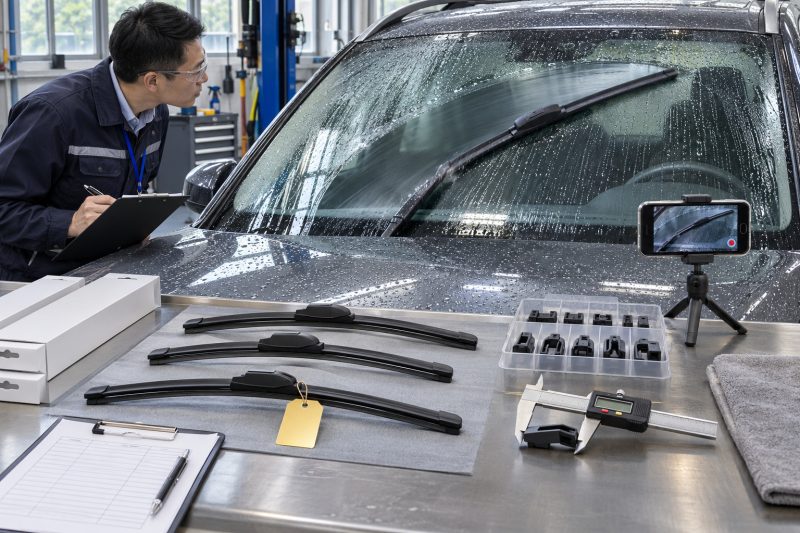
Why One Clean Wipe Is Not Enough to Approve a Wiper Blade
One successful wiping cycle confirms only that one sample worked on one vehicle under a particular set of conditions. It does not automatically confirm that the same blade will perform consistently across other sizes, adapters, windshields, climates or production batches.
An initial sample test can reasonably help buyers confirm:
- Whether the sample matches the requested model and size
- Whether the supplied adapter fits the specified wiper arm
- Whether the connector locks securely
- Whether the blade moves without interference
- Whether the rubber maintains contact during a wet test
- Whether visible streaking, smearing or missed areas appear
- Whether the sample creates noise or reversal judder
- Whether the package contains the correct product and accessories
However, the same short test cannot prove:
- Long-term wiping durability
- UV and ozone resistance
- High- or low-temperature performance
- Corrosion resistance
- Rubber aging over time
- Stability after prolonged outdoor storage
- Consistency among different production batches
- Performance across every advertised vehicle application
These limitations are important because suppliers may prepare initial samples more carefully than ordinary production units. Even when the sample is selected randomly, it still represents only a very small part of the proposed order.
| Approval question | Can an initial sample answer it? | Additional verification needed |
|---|---|---|
| Does the blade install on the stated arm? | Yes | Test the required adapters and applications |
| Does it wipe cleanly at first? | Yes | Record a controlled wet test |
| Is the connector secure? | Yes | Check retention and repeated installation |
| Does the package match the request? | Yes | Approve final artwork and packing structure |
| Will the rubber last through its claimed service period? | No | Durability and environmental testing |
| Will long and short sizes perform equally? | No | Test representative lengths |
| Will mass production match the sample? | No | Production samples and batch inspection |
| Will every batch use the same materials? | No | Specifications, traceability and change control |
A clean first wipe should therefore be considered an initial qualification result—not final proof of supplier capability.
Buyers should also distinguish product approval from supplier approval. A good sample does not demonstrate that the factory can maintain material control, meet the delivery schedule, print the packaging correctly or respond professionally to quality problems.
The Sample-Testing Mistakes That Lead to Returns and Fitment Claims
Poor sample testing creates false confidence. The product passes a convenient demonstration, but problems appear after the distributor receives the bulk shipment or lists the blades across multiple sales channels.
Testing Only One Convenient Size
A short beam blade can perform well even when its spring-rail design is unsuitable for longer lengths. As blade length increases, pressure distribution, end contact and aerodynamic stability become more difficult to control.
A representative sample plan should include short, medium and long sizes. The TOPEX wiper blade supplier audit checklist explains why longer flat blades may reveal pressure-distribution problems that remain hidden on shorter products.
Testing Only a U-Hook Application
U-hook connectors are common and usually familiar to installers, but they cannot represent push-button, pinch-tab, side-lock, bayonet or other arm systems.
Non-U-hook adapters should be tested for:
- Correct orientation
- Installation effort
- Locking security
- Movement after installation
- Blade angle
- Clearance around the arm
- Ease of removal
- Instruction accuracy
A blade that accepts an arm physically may still sit too high, tilt incorrectly or move during operation.
Failing to Record the Test Vehicle
A comment such as “the 24-inch blade streaks” is incomplete. The supplier needs the exact application and test conditions to reproduce the issue.
Record at least:
- Vehicle make and model
- Model year
- Body style or generation
- Sales region
- Left- or right-hand-drive configuration
- Driver, passenger or rear position
- Wiper-arm connector
- Adapter used
- Blade size and product code
- Windshield condition
- Ambient temperature
- Washer fluid or test water used
Without this information, a supplier cannot determine whether the problem involves the sample, application data, installation or vehicle condition.
Testing on Contaminated Glass
Oil film, road grime, wax, tree sap, insects and water-repellent coatings can make a good blade smear or chatter. Scratches and chips can also interfere with the wiping edge.
The windshield should be inspected and cleaned before testing. If the glass has a coating, document it rather than quietly comparing the result with an uncoated windshield.
Testing should be performed on wet glass. Operating a new blade repeatedly on a dry or gritty surface can damage the wiping edge and produce misleading results.
Approving Installation Without Checking Retention
The blade should not be approved merely because it can be pushed onto the arm. The adapter must lock securely and hold the blade at the intended angle.
Check whether:
- The correct adapter was selected.
- The blade can be installed without excessive force.
- The locking feature fully engages.
- The blade resists a gentle pull.
- The adapter remains stable during operation.
- The blade can be removed using the stated method.
Ignoring Noise, Judder and Tip Lift
A sample may clear most water while still producing objectionable noise, jumping at reversal or losing contact near one end.
These defects may become customer complaints even if a still photograph makes the windshield appear clear. A complete test should therefore include video with sound.
Reviewing the Blade but Not the Package
For private-label projects, the customer receives a complete retail product rather than an unpackaged blade. Packaging errors can create just as many claims as wiping defects.
Verify:
- Product model
- Size marking
- Adapter list
- Vehicle or connector information
- Barcode
- Installation instructions
- Logo and artwork
- Included accessories
- Package strength
- Blade protection
- Shipping-carton markings
How to Test Wiper Blade Fitment and Wiping Performance Step by Step
Testing should follow a repeatable sequence so that different samples and suppliers can be compared under similar conditions.
Sample Testing Record
| Check item | What the buyer should inspect | Recommended evidence |
|---|---|---|
| Sample identity | Model, length, rubber type, adapter combination and batch information | Label and complete package photographs |
| Appearance | Surface finish, rubber edge, spring rails, frame, end caps and adapter assembly | Close-up product photographs |
| Dimensions | Actual length, rubber dimensions and critical connector measurements | Caliper measurement photographs |
| Fitment | Correct interface, secure installation and interference with the arm | Connector and installed-blade photographs |
| Windshield condition | Cleanliness, aging, scratches, oil film or water-repellent coating | Photograph before testing |
| Wipe quality | Fine lines, water film, missed areas, haze or fixed bands | Before-and-after photographs from a fixed angle |
| Contact pressure | Full-length contact, tip lift or jumping during operation | Full wiping-cycle video |
| Noise and judder | Noise during upward, downward or reversal movement | Test video with sound |
| Adapter security | Lock engagement, reasonable removal and unwanted movement | Connector-operation video |
| Packaging | Model, size, adapters, instructions, barcode and protection | Complete packaging photographs |
| Repeatability | Whether the same issue appears on another sample or vehicle | Separate sample-test records |
| Approval status | Pass, modify and retest, or fail | Signed approval form |
Step 1: Identify Every Sample
Assign a unique sample number and record its:
- Supplier
- Model number
- Nominal length
- Product structure
- Rubber specification
- Adapter set
- Package version
- Date received
- Batch or lot information
Do not test several unmarked versions together. If one performs better, the buyer must be able to identify exactly which specification produced the result.
Step 2: Inspect Materials and Assembly
Before installation, inspect the sample under good lighting.
Look for:
- Cuts, waves or contamination along the wiping edge
- Uneven rubber coating
- Loose end caps
- Distorted spring rails
- Scratches or inconsistent surface treatment
- Flash or poor moulding around plastic components
- Loose rivets or frame joints
- Adapter movement
- Incorrectly assembled spoilers
- Differences between samples of the same model
Compare the product with the quotation, drawing and specification rather than relying only on catalogue photographs.
Step 3: Measure Critical Dimensions
Confirm the actual blade length and the dimensions that affect installation. Depending on the design, this may include:
- Connector width
- Push-button opening
- Pin diameter
- Hook channel
- Adapter height
- Rubber profile
- Spring-rail position
- End-cap clearance
Measurements should be photographed with the tool display visible. Record the permitted tolerance before approving production.
Step 4: Inspect and Prepare the Windshield
Clean the glass and document any scratches, chips, pitting or coatings. Confirm that the wiper arm is not visibly bent or damaged.
The washer system should provide sufficient fluid across the test area. A blocked nozzle may cause dry friction and make an acceptable blade appear defective.
Step 5: Confirm Fitment
Use the application record to verify the blade position, size, arm type and required adapter.
After installation:
- Confirm the adapter is fully locked.
- Apply a gentle retention pull.
- Check for looseness.
- Observe the blade’s working angle.
- Confirm clearance from trim and the other blade.
- Verify that the product remains inside the glass boundary.
Photograph the connector before and after installation.
Step 6: Complete a Controlled Wet Test
Wet the windshield evenly or use the vehicle’s washer system. Observe several complete cycles at normal and higher wiper speeds where safe and appropriate.
The blade should:
- Clear the intended area
- Maintain contact throughout the sweep
- Reverse direction smoothly
- Avoid repeated streaks or smearing
- Remain stable at both ends
- Produce no abnormal scraping or chatter
- Return to its parked position correctly
View the result from the driver’s normal seating position as well as from outside the vehicle.
Step 7: Classify the Defect Pattern
Avoid vague descriptions such as “does not wipe well.” Record the visible pattern and its location.
| Observed defect | Possible cause |
|---|---|
| Fine fixed line | Debris, a nick or damaged rubber edge |
| Cloudy moving film | Glass contamination or residue |
| Consistent missed band | Incorrect curvature or uneven pressure |
| Tip lift | Poor end pressure or unsuitable spring-rail design |
| Reversal judder | Rubber friction, installation angle or arm alignment |
| Adapter movement | Incomplete lock or connector mismatch |
| One-sided missed area | Blade curvature, arm pressure or windshield geometry |
| Intermittent noise | Contamination, loose assembly or directional instability |
Use fixed-angle photographs for wiping patterns and video for noise, jumping, tip lift and adapter movement.
Step 8: Repeat the Test
Where possible, test a second sample of the same specification. If a defect appears only once, inspect that unit carefully. If the same problem repeats, the issue is more likely to involve the design, material or application.
For critical applications, repeat the test on another vehicle using the same fitment.
How to Build a Representative Sample Set for Your Market
One convenient blade cannot represent an order containing multiple sizes, adapters and structures. The sample set should reflect both the technical range and the applications that generate the most business.
A representative set may include:
- Short, medium and long blade lengths
- High-volume local vehicle applications
- U-hook and non-U-hook connectors
- Driver-side and passenger-side blades
- Flat and more strongly curved windshields
- Conventional, beam and hybrid products included in the order
- Rear wiper blades where relevant
- Private-label packaging and complete adapter sets
Select Samples by Risk, Not Convenience
High-risk products deserve more attention. These normally include:
| Higher-risk sample | Reason for inclusion |
|---|---|
| Long beam blade | Reveals pressure-distribution and tip-contact problems |
| Strongly curved windshield application | Tests conformity across the complete blade |
| Non-U-hook connector | Tests adapter selection and locking security |
| Popular vehicle application | Has greater commercial exposure if fitment is wrong |
| Driver-side blade | Operates across the primary viewing area |
| Rear blade | Often uses a compact vehicle-specific connection |
| Hybrid blade | Requires correct frame, cover and adapter assembly |
| Private-label package | Confirms the complete product customers will receive |
If the proposed order includes both flat wiper blades and hybrid wiper blades, buyers should test both structures rather than approving one as a substitute for the other.
Include Local Vehicle Applications
The sample plan should be based on the target country’s vehicle population. Test the models that are likely to generate the highest sales or the greatest return exposure.
Application selection can use:
- Vehicle-registration data
- Distributor sales history
- Workshop enquiries
- Marketplace searches
- Fleet customer records
- Previous fitment returns
- Competitor coverage gaps
A technically impressive sample has limited value if it does not represent the vehicles the distributor will serve.
Separate Product Samples from Packaging Samples
A supplier may first send standard-packaged products for technical testing. Before mass production, the buyer should also approve samples using the final private-label packaging.
That package should contain the exact blade, adapter set, instructions and labels planned for the order. A correct product placed in the wrong box can still generate widespread returns.
How to Turn an Approved Sample into a Bulk-Production Standard
Sample approval becomes useful only when it is transferred into written production controls.
Establish a Golden Sample
The final approved unit should become the Golden Sample. Both buyer and supplier should identify, date and sign the retained reference.
Where practical, both parties should keep sealed samples. The Golden Sample should represent the final combination of:
- Blade structure
- Length
- Rubber specification
- Wiping-edge finish
- Spring rail or frame
- Coating
- Adapter
- End caps
- Logo
- Product colour
- Package
- Barcode
- Instructions
- Accessories
The sample should not replace the written specification. It should support it.
Create Measurable Acceptance Criteria
Terms such as “good quality” or “same as sample” are difficult to enforce without measurable requirements.
The quality agreement can define:
- Product dimensions and tolerances
- Approved materials
- Rubber hardness or agreed compound specification
- Connector dimensions
- Adapter retention requirements
- Appearance limits
- Wiping-performance criteria
- Noise and judder limits
- Packaging contents
- Artwork version
- Barcode verification
- Inspection sample size
- Acceptance Quality Limit where applicable
- Procedure for nonconforming goods
Any material, tooling, component supplier or process change should require notification and written approval.
Review Pre-Production and Production Samples
Before full production, confirm that the factory can reproduce the approved configuration using normal materials, tooling and processes.
Production samples should be selected from actual manufacturing rather than prepared separately by the sales or engineering team.
Compare them with the Golden Sample for:
- Identity
- Dimensions
- Assembly
- Connector operation
- Wiping performance
- Appearance
- Packaging
- Labels and barcodes
Use a Controlled Trial Order
A trial order tests capabilities that a sample cannot reveal, including:
- Bulk consistency
- Packaging accuracy
- Batch traceability
- Production lead time
- Carton protection
- Documentation
- Communication
- Corrective-action response
Do not expand immediately from a few approved samples to the complete annual programme when the supplier has not yet demonstrated repeatable production.
Conduct Pre-Shipment Inspection
Before shipment, randomly selected units should be compared with the approved specification and Golden Sample.
The inspection can cover:
- Quantity and product identity
- Workmanship and appearance
- Dimensions
- Connector and adapter operation
- Sample wet-wiping performance
- Package contents
- Artwork and barcode accuracy
- Carton markings
- Shipping-carton condition
- Batch and traceability information
Inspection does not guarantee that every unit is perfect, but it provides evidence that the shipment meets the agreed sampling standard before release.
Conclusion
Approving a wiper blade sample should involve more than confirming that it fits one vehicle and produces one clean wipe. Buyers should test representative lengths, adapters and product structures under recorded conditions while checking fitment security, windshield contact, streaking, missed areas, noise, judder and packaging accuracy.
The vehicle, glass condition, installation method and test environment should also be documented so the supplier can reproduce and investigate the result. Once approved, the final sample should become a Golden Sample supported by written specifications and agreed inspection criteria.
A controlled trial order and pre-shipment inspection are still necessary because an initial sample cannot prove long-term durability or batch consistency. The goal is to convert one satisfactory sample into a repeatable production standard.
Frequently Asked Questions
What should buyers check when testing a wiper blade sample?
Check product identity, dimensions, materials, assembly, connector security, installation, windshield contact, wiping clarity, noise, judder, packaging and included adapters. Record the vehicle, glass condition and test environment.
Is one wiper blade sample enough to approve a supplier?
No. One sample cannot represent different lengths, connectors, blade structures or production batches. A representative sample set and controlled trial order provide more reliable evidence.
How should buyers test wiper blades for streaking and noise?
Clean and wet the windshield, install the blade correctly and observe several complete cycles. Use fixed-angle photographs to record streaks and missed areas, and video with sound to document noise, jumping and reversal judder.
Which blade sizes and adapters should be included in a sample set?
Include short, medium and long sizes, high-volume local applications, U-hook and non-U-hook connectors, driver and passenger positions, and every product structure included in the intended order.
Can a short road test prove wiper blade durability?
No. It can reveal initial fitment, noise, contact and wiping behaviour, but durability requires accumulated-cycle and environmental testing using multiple units.
How can buyers ensure bulk wiper blades match the approved sample?
Retain a signed Golden Sample, freeze the written specification, approve production samples, require change control and inspect randomly selected units before shipment.

--- END ---


